
Narrow electric convectors for limited wall space
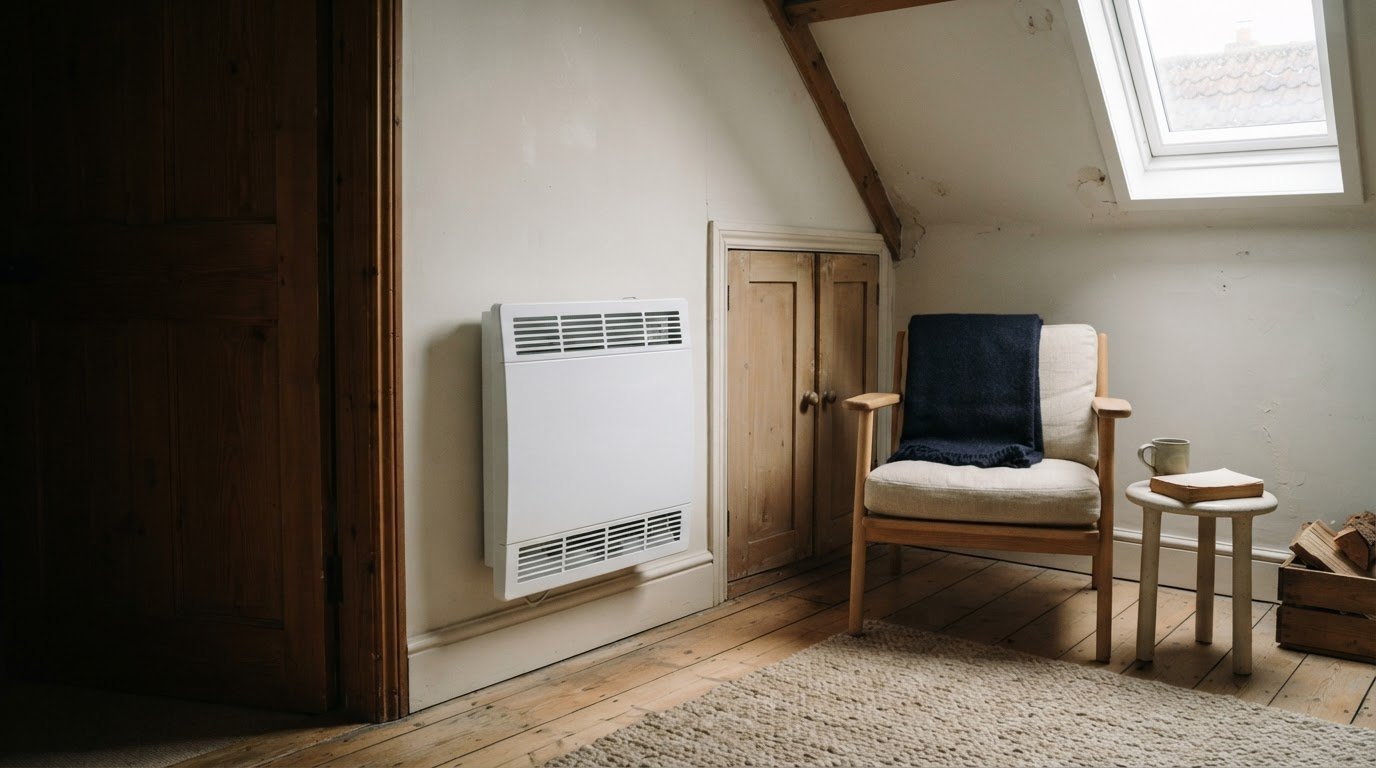
Heating a room doesn't have to start with central heating. A narrow electric convector for narrow walls heats the air in the room and runs on electricity, without a boiler or pipes. The warm air rises, after which cooler air is drawn in and heated again.
If you have limited free wall space, not only the output but also the fit and use of the space matter. A convector can serve as primary heating in a smaller room or as supplementary heating, for example in an attic or outbuilding. This allows you to add heat directly without running pipes to that space.
In this article, you will learn how an electric convector works and what to consider when wall space is limited. You will also discover how insulation and room size influence the required heating capacity. This will help you better determine whether a narrow wall-mounted model suits your situation and what to expect from heating without a central connection.
Key points
- With a thermostat, you maintain the desired temperature; smart models can also be controlled via Wi-Fi and an app.
- The placement affects how heat spreads through the room. Discover why a spot near a window or exterior wall is often suitable.
- Match the required heating capacity to the surface area and the insulation of the room.
- If wall space is limited, compare the dimensions and front type so that the convector fits your room and interior.
What is an electric convector?
An electric convector heats the air using electricity. Cold air is drawn in at the bottom, passed along the heating element, and sent warm into the room. Because warm air rises, cooler air reaches the element again. This creates continuous air circulation. The technical efficiency of electric heating is nearly 100 percent: virtually all the electricity used is converted into heat.
A built-in thermostat measures the temperature and switches on the heating element when necessary. For example, set the desired room temperature; the convector then regulates when to heat itself. This is useful in a home office that you use mainly during the day. The thermostat does not prevent heat loss, but it does help maintain the set temperature.
With a schedule, you add planning to the temperature control. For example, you can set the heating to turn on before a specific time of use and turn off again later. This way, the appliance does not have to operate continuously at the same setting. The functions vary by model. Therefore, when making your choice, pay attention to the controls and the functions you really need.
With smart convectors, Wi-Fi and an app complement the controls. You can adjust settings via the app, in addition to the controls on the unit. This is convenient when you want to change the heating schedule without walking to the wall convector. The thermostat regulates the temperature; Wi-Fi is a way to control settings. So, these are different functions.
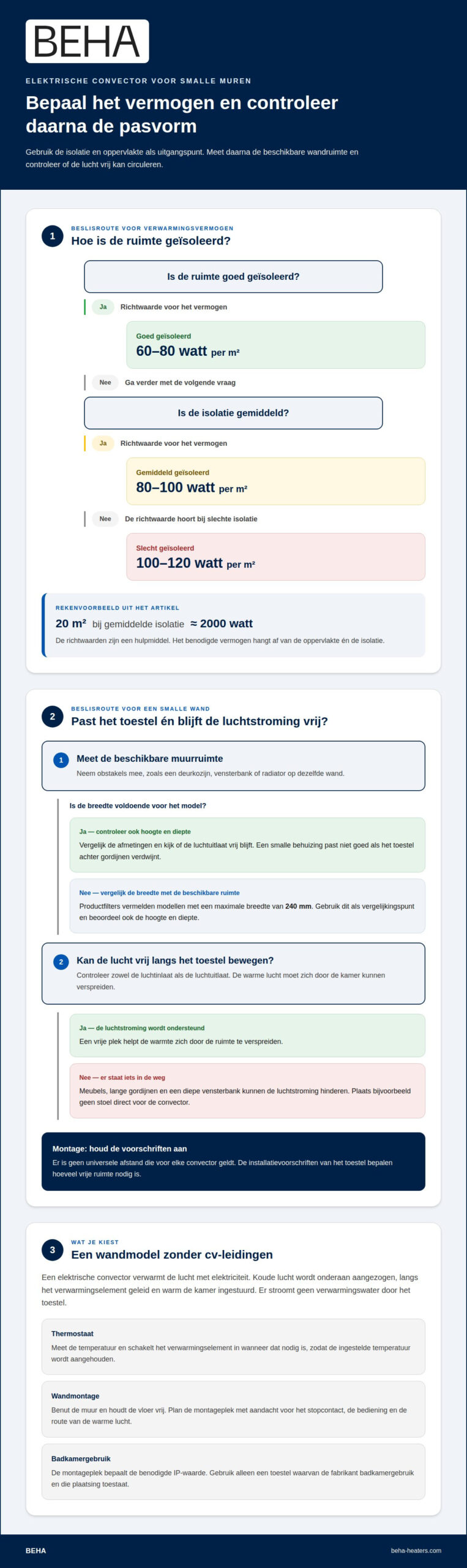
For a narrow wall, placement matters in addition to the controls: the unit must fit properly and not block air circulation. Furthermore, for use in the bathroom, the mounting location determines the required IP rating. There is no universal rating for every location. Only use a unit there whose manufacturer permits bathroom use and placement.
Also pay attention to the product marking. According to the NVWA, electrical equipment covered by the Electrical Equipment Decree must have a CE marking. Therefore, assess not only the temperature control but also the product information of the electric convector.
Even distribution of heat
An electric convector heats air, which then circulates through the room. For even heat distribution, the air must be able to move freely past the unit. Curtains, furniture, or a deep windowsill can obstruct this flow. Therefore, leave space around the convector and position it so that the warm air can spread well throughout the room.
The required power depends on the surface area and insulation. As a guideline, 60 to 80 watts per square meter applies to well-insulated rooms. With average insulation, this is 80 to 100 watts, and with poor insulation, 100 to 120 watts per square meter. For an average insulated room of 20 m², the calculation comes out to approximately 2000 watts.
View power guidelines as a guideline, not as a measure of heat distribution. An appropriate capacity helps achieve the desired temperature; placement partly determines how the heat spreads. For example, a convector behind a sofa can restrict airflow, whereas an open space supports circulation.
An electric convector generates heat using an electric element. Therefore, no heating water flows through the unit. This distinction is important for energy efficiency and heat pumps: lower water temperatures and connection to a heat pump are characteristic of water-based convector heating, not of an electric version.
A convector with a heat exchanger heats air using hot water flowing through finned tubes. The warm air rises, and cooler air is drawn in from below. In this way, heat is distributed via natural air circulation. This system requires less water and does not need to reach such high temperatures. Due to the lower water temperatures, it is compatible with sustainable heat sources such as heat pumps.
An electric convector uses no water for heating; electricity consumption depends on the required power and the heat demand. If you would like to explore heating options, view the options for electric heating.
Wall convectors for rooms with limited wall space
A wall convector utilizes the wall and keeps the floor free for furniture. In limited space, pay attention to the width, the mounting location, and free airflow.
Space-saving design for narrow walls
First, measure the available wall space, including obstacles such as a door frame or windowsill. Product filters list electric convectors with a maximum width of 240 mm. Use that measurement as a point of comparison, but also assess the height and depth. A narrow housing will only fit well if the air outlet remains unobstructed and the unit does not disappear behind curtains.
Convectors for small spaces
In a small room, the ratio between the appliance and the heating demand matters. A compact model can serve as primary heating in a smaller space or as supplementary heating alongside another system. Consider a home office where you primarily need localized heat. Choose the power output based on the room and insulation, not just on the available wall space.
Space-saving wall mounting
A wall-mounted model takes up no floor space and keeps the area underneath the unit usable. This is practical next to a desk, in a narrow hallway, or near a doorway. Determine the mounting position before placing furniture. Take into account the power outlet, controls, and the path of the warm air. A radiator on the same wall can further limit the available space.
Free space around the convector
There is no universal spacing for every convector; the unit's installation instructions determine how much clearance is required. Keep the air intake and outlet free of furniture, decorations, and long curtains. For example, do not place a chair directly in front of the convector. This limits blockages in the airflow and prevents textiles from hanging against the unit. Also consider walls and window sills when choosing the mounting location.
Convector radiators take up less space than traditional radiators and fit into narrow spaces with limited wall space. They are also suitable for small areas in the home.
Electric convectors without connection to central heating
In a room without a central heating connection, the choice starts with the usage pattern. A home office occupied during the day requires something different than a guest room that you use occasionally. First, determine when the room needs heat and how long you stay there. This way, you can better assess whether electric heating fits your daily routine.
Next, consider the location and characteristics of the room. An extension with exterior walls can retain heat differently than a room situated between heated spaces. Drafts along windows or doors also affect comfort. Therefore, take the structural situation into account in your assessment, rather than just looking at the floor area.
Also consider whether you need a constant heat source or primarily want to heat at specific times. In a hobby room that you use irregularly, for example, the duration of use may be more important than in a room where you spend extended periods daily. The best choice aligns with the function of the room, the heat requirement, and the desired method of use.
For electrical materials covered by the Electrical Equipment Decree under the Commodities Act, a CE marking is required, according to the NVWA. Follow the manufacturer's instructions for electrical connection and installation. This ensures compliance with the requirements for the specific device, without relying on a universal connection method.
Make your choice based on the room itself: how often do you use it, how well does it retain heat, and where is the space available? List these points in advance to determine more accurately which heating suits the situation.
If you want to explore the possibilities for your space, take a look at the electric heating options.
Electric convectors are suitable as supplementary heating and for spaces without a connection to central heating, such as attics or outbuildings. They also fit into spaces where a central heating system cannot be installed; piping or complex infrastructure is not required. Depending on the space, electric convectors can serve as primary heating in smaller rooms or as supplementary heating. In this way, they offer various possibilities for spaces without a connection to central heating.
BEHA
BEHA offers electric convectors for spaces with limited wall space and rooms without a connection to central heating. You can choose from smart convectors with a steel, glass, or paintable front, in addition to Classic convectors.
Start with your situation: how much wall space is available, how do you use the room, and which control system suits that? The smart convectors can be controlled via Wi-Fi and an app. A steel or glass front gives the unit a distinctive look; with a paintable front, you can match the appearance to the color of your interior. Classic convectors are an alternative if you are looking for a traditional design.
With these characteristics, you can determine more precisely which type suits the room and your heating needs. Contact BEHA to discuss your question about an electric convector.
Choose a solution that fits your space
Also look ahead: does the use of the room change throughout the day or season? Note when you need heat and which control method suits that. This way, limited wall space becomes a concrete starting point for your choice.
A narrow electric convector for narrow walls must fit both the layout and your daily routine. Therefore, also consider what you want to preserve in the room, such as unobstructed walking space or room for furniture.
With these starting points, you can determine more specifically which electric heating suits your situation. Discuss your requirements and contact BEHA to take the next step.
Frequently Asked Questions
Which narrow electric convectors are suitable for a narrow wall?
A suitable model fits within the free wall width with its entire housing. Therefore, measure not only the flat section of the wall, but also the space up to frames, switches, and window sills. Take into account protruding skirting boards or pipes that might obstruct the bottom edge. This prevents a device from fitting on paper but not working properly in the chosen location.
What are the dimensions of compact electric convectors?
Compact models do not have a fixed standard size; dimensions vary by version. Before comparing, note the available width, height, and depth of the mounting location. For example, make a simple sketch showing the position of door frames and window sills. Compare these measurements with the product specifications and the required mounting space. This way, you assess whether the convector fits physically, not just whether the capacity seems suitable.
Which narrow convectors have a thermostat, timer, or Wi-Fi control?
Smart models offer features such as Wi-Fi and app control, schedules, and room-by-room temperature settings. Vacation and frost protection modes can also be useful when you are not using a room temporarily. Some smart models work with Apple Home, Google Home, and Amazon Alexa. Compare the desired controls with the features of the specific model before making a choice.
How do you mount a narrow electric convector to the wall?
Plan the mounting location before drilling holes. Draw the outline of the appliance on the wall and check that doors, furniture, and window coverings leave the spot clear. Also, check the location of the power outlet so that the cable can reach the chosen position without having to run awkwardly across a walkway. For the final installation, follow the instructions included with the specific appliance.