
Odorless electric heater for primary or supplementary heating
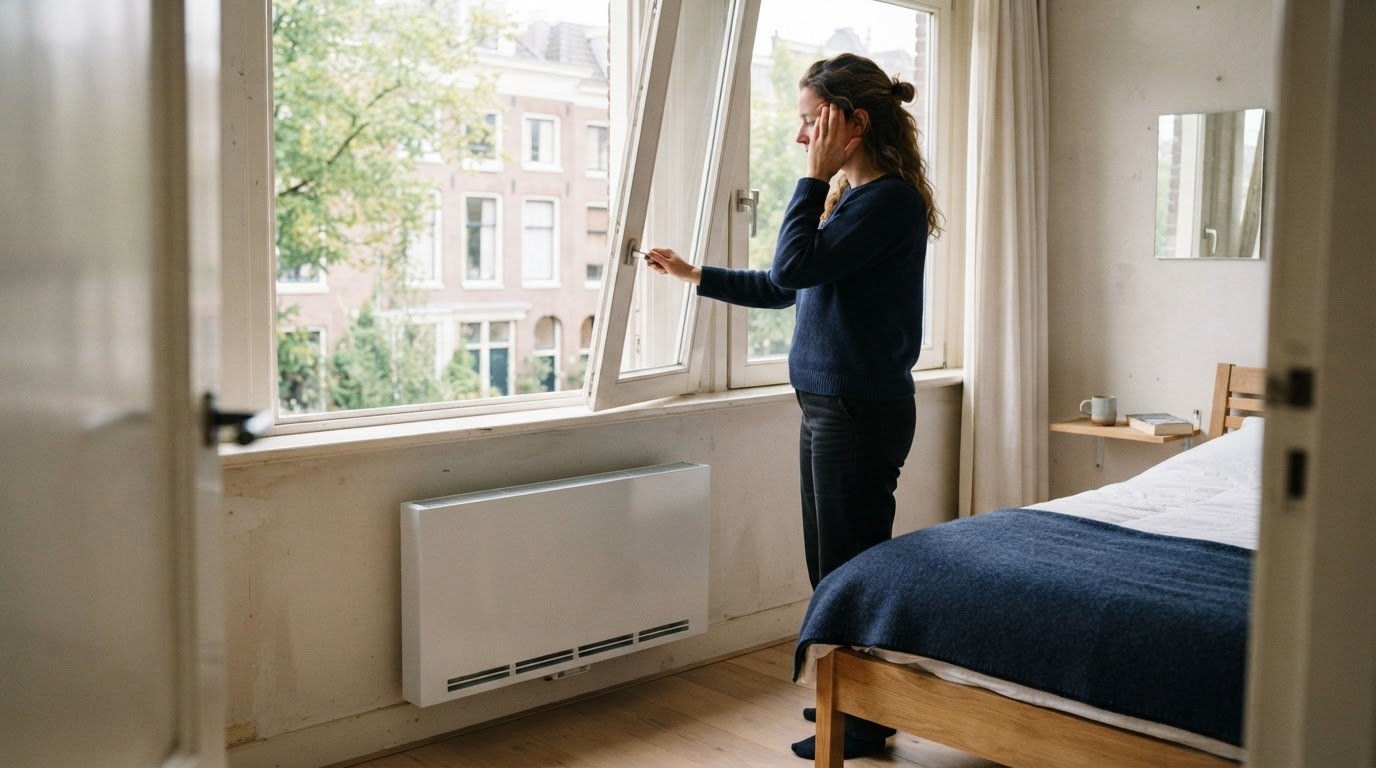
An odorless electric heater for headaches can be appealing if you want to avoid heating odors. Which heater is suitable also depends on the room and its use. An electric convector heats without burning fuel and can provide primary or supplementary heating in a small room.
Naturally, you want to know if such a heater provides sufficient heat and what that means for your electricity consumption. Consumption depends on the power output and how long the heater is switched on. Read how convection heaters work, when they are suitable for your room, and what to look out for when using them as primary or supplementary heating.
Key points
- A convection heater heats the room and makes little noise. Discover which features suit your needs.
- The power output and burning time determine the power consumption; a 2000-watt heater consumes 2 kWh per hour at full power.
- Match the output to the size and use of the room to determine whether the heater can serve as primary or supplementary heating.
- Headaches do not necessarily have to be caused by the heater itself. Also pay attention to the conditions in the room and when symptoms occur.
Electric convection heaters and their features
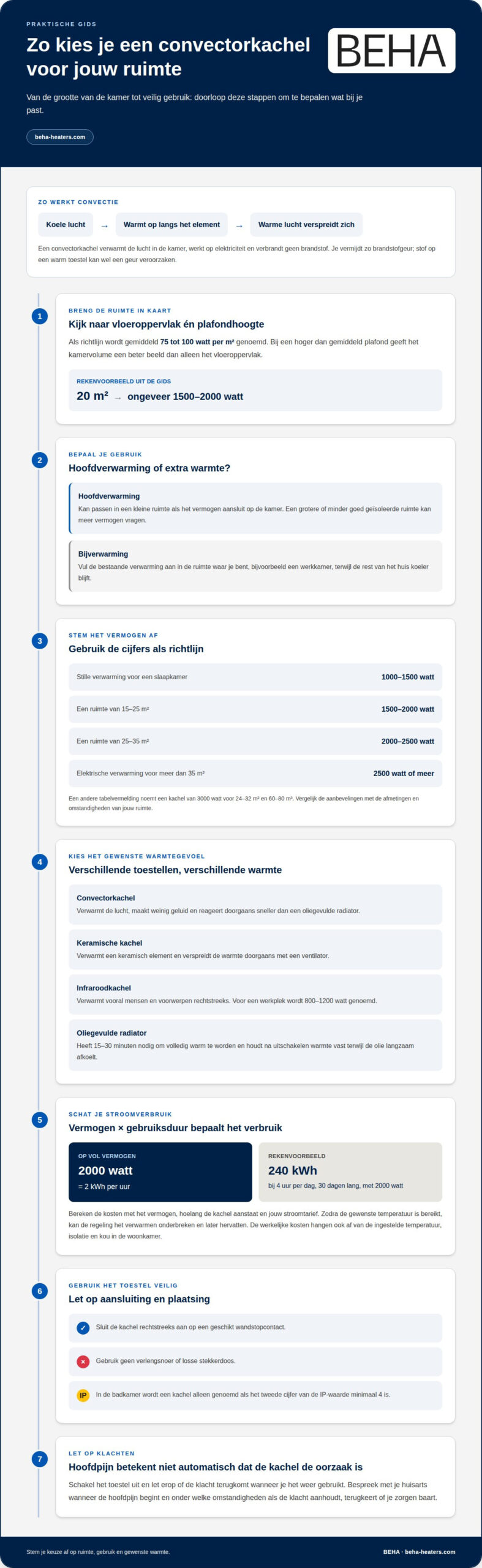
A convection heater heats the air in the room. Cool air flows past the heating element, heats up, and rises, causing the warm air to spread throughout the space. The heater operates on electricity via a power outlet and does not burn fuel. This way, you heat without the smell of fuel, although dust on a warm appliance can cause an odor.
The main differences lie in the way the heat is generated and distributed. A convection heater heats the air. A ceramic heater heats a ceramic element and typically distributes the heat with a fan. Infrared primarily heats people and objects directly, rather than first heating the air in the entire room.
A convection heater produces little noise and can therefore be suitable for a bedroom. For such a room, a quiet model of 1000 to 1500 watts is recommended. Additionally, match the power output to the room: as a guideline, an average of 75 to 100 watts per m² applies. With a ceiling higher than average, the room volume is more important than just the floor area.
As supplementary heating, a convection heater can supplement the central heating system when you primarily use a single room. A 2000-watt model, for example, can provide extra heat in a living room, but the required capacity also depends on insulation and room size. For electric heating of rooms larger than 35 m², 2500 watts or more is recommended. Thus, the room size, not just the number on the unit, helps determine what fits.
An oil-filled radiator works differently: it takes 15 to 30 minutes to heat up fully. After being switched off, the oil retains heat while it cools down slowly. A convection heater generally responds more quickly to being switched on, but does not emit heat for as long in the same way after being switched off. That difference can be a factor if you only want to provide short-term supplementary heating.
The best electric choice therefore depends on your goal: silent convection for even room heating, infrared for direct heat in a specific spot, or an oil-filled radiator that retains heat after being switched off. Before making your choice, compare the time of use, the room, and the desired level of warmth.
Electricity consumption and operating costs
Consumption depends on the power output and the operating time. A 2000-watt convection heater consumes 2 kWh per hour at full power. A standard electric heating element converts approximately 1 kWh of electricity into 1 kWh of heat. Therefore, the desired comfort does not automatically require continuous full power.
Calculate the operating costs based on three factors: the power output, how long the heater is on, and your electricity tariff. This is a calculation example, not a fixed price for every Dutch connection.
A longer usage period makes the difference visible. Heating for four hours a day at 2000 watts for 30 days amounts to 240 kWh. This way, you can translate a daily usage pattern into a monthly amount.
A heater does not need to operate at full power continuously. As soon as the desired temperature is reached, the control system can interrupt heating and resume it later. The actual costs therefore also depend on the set temperature, the insulation, and how cold the living room is.
The type of heating also determines where the heat ends up. A ceramic heater heats via a ceramic element; a convection heater heats the air in the room. Infrared heats people and objects directly. For a workspace, an infrared heater of 800 to 1200 watts is recommended, while 2000 watts or more is often required for a living room. The appropriate choice depends on the area you want to heat.
If you want to control power consumption, match the output to the room and heat only when necessary. See how smart convectors fit in with targeted heating and setting the desired temperature.
Infrared heaters heat people and objects directly, requiring less power.
Electric heaters as primary or supplementary heating
An electric heater can serve as the primary heating source in a small, well-fitting room. As a guideline, an average of 75 to 100 watts per m² is cited. For a 20 m² room, the recommended capacity is approximately 1,500 to 2,000 watts. In a larger or less well-insulated room, more power may be required.
As supplementary heating, you use a device alongside the existing heating, for example to heat a home office while the rest of the house remains cooler. This way, you primarily heat the room you are in. A convection heater heats the air; a ceramic heater or fan heater distributes heat differently. Depending on the type, an electric radiator can retain heat longer.
Which solution fits depends on the space and your usage. A 1000-watt heater can heat a small room; for a room of 15 to 25 m², 1500 to 2000 watts is recommended. Also consider the ceiling height: with a higher ceiling, the room volume provides a better indication than just the floor area. The power output partly determines the consumption when the appliance is switched on.
For indoor electric heaters, a practical safety rule is to connect the device directly to a suitable wall socket. Do not use an extension cord or a separate power strip. In a bathroom, a heater is only listed if the second digit of the IP rating is at least 4. Suitable placement and proper use are important, especially in damp areas.
Headaches coinciding with the use of heating are not automatically caused by the heater. Switch off the appliance and observe whether the symptoms return when you use it again. Contact your GP if the headache persists, recurs, or concerns you. Discuss when the symptoms start and under what circumstances.
When choosing an appliance, it is wise to match the recommended capacity to the space you want to heat. For a room of 25-35 m², 2000 – 2500 watts is recommended.
The table also lists a 3000-watt electric heater as suitable for a surface area of 24-32 m² and a volume of 60-80 m³. Compare the stated power ratings with the dimensions of the room to determine which recommendation fits best.
Which causes of headaches can be related to an electric heater?
Headaches while heating do not automatically mean that the electric heater is the cause. Pay attention to the connection: does the complaint start every time you switch on the appliance, or does it also occur without heating? An electric appliance does not burn fuel and therefore emits no combustion gases during normal use.
The conditions in the room can change once the heater is on. A strongly heated room can feel stuffy, whereas a fan heater circulates air and makes noise. A dusty smell during heating can also be bothersome. Such signals do not, in themselves, prove what is causing the headache.
If symptoms recur, keep a brief record of what happens. Note, for example, when you turn on the heater, how the room feels, and when the headache starts. Turn off the appliance and leave the room for a moment. If the symptoms subside, that is useful information, but not proof that the heater is the cause.
Next, check a few practical points:
- Lower the set temperature if the room becomes unpleasantly warm.
- Ventilate the room and see if the air feels more pleasant afterwards.
- Keep the air vents clear and remove dust according to the instructions for use.
- Pay attention to noise or smell; compare, for example, a convection heater with a fan heater.
An odorless electric heater for headaches does not prevent every possible trigger. If symptoms return, occur even without heating, or make you worried, discuss them with your GP. Tell them when they occur and what changes you have tried. This will give the GP a clearer picture than just the presence of a heater.
Do you want to choose heating that suits the space and usage? View electric heating options and compare which type of heat suits your situation.
BEHA
BEHA sells electric convectors for various rooms and heating needs. The range includes smart convectors with a steel, glass, or paintable front, and Classic convectors. The smart models can be controlled via Wi-Fi and an app, allowing you to tailor the heating to your usage.
Factors such as the size of the room, whether it will be used as primary or supplementary heating, and the desired controls play a role in your choice. Compare the features of the convectors, but do not assume that a heater will prevent headaches. Odors or complaints can have multiple causes; an electric convector is primarily a heating solution.
Would you like to discuss which type of convector suits your space and heating needs? Contact BEHA.
Choose heating that suits your space
An odorless electric heater for headaches is not a solution for every headache complaint. Therefore, view the choice primarily as a way to tailor heating to your space and daily use. Consider what you find pleasant: a gently heated room, controls that fit your routine, or a front that matches your interior.
BEHA offers smart convectors with a steel, glass, or paintable front, in addition to Classic convectors. Compare the finishes and choose based on your situation and how you heat the room. If symptoms recur, discuss them with your GP. A heating device does not determine a medical cause.
Would you like to discuss your electric heating requirements and discover which convector suits them best? Contact BEHA. This way, you can look specifically for a solution for your space.