
Paintable radiator: the complete guide to a seamless interior in 2026
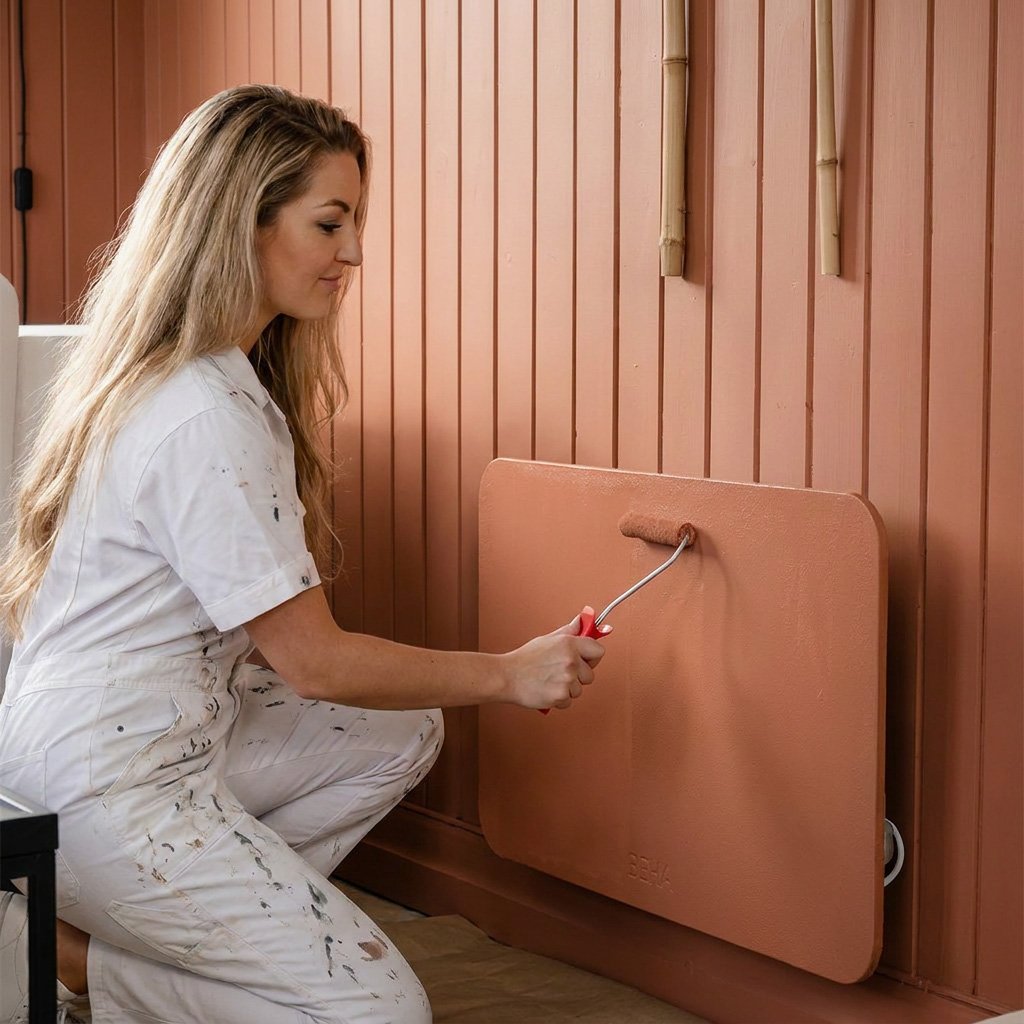
A paintable radiator allows heating and interior to merge in the same color language. However, not every radiator is suitable for wall paint. A specially designed paintable front, painting an existing central heating radiator, and a radiator cover each require a different approach. In this complete guide, you will discover which solution fits best, how to paint safely, and how to achieve a durable, sleek result.
Key points
- BEHA RAW is an electric convector with a special paintable front, not a traditional water-based radiator.
- Always follow the painting instructions for the exact model; never paint grilles, sensors, controls, or connections.
- An existing central heating radiator usually requires degreasing, sanding, a suitable primer, and radiator paint.
- A conversion quickly changes the appearance, but can affect airflow, thermostat measurement, and heat output.
- First choose the required power and technical suitability, then the color and finish.
What is a paintable radiator?
A paintable radiator has a surface intended by the manufacturer to be finished in a color of your choice. At BEHA , this concerns the RAW series: an electric convector with a lightly textured, paintable front. You can match the front to the wall color or choose an accent color.
The term “radiator” is widely used in practice. Technically, an electric convector works primarily with natural air circulation: cooler air flows in at the bottom, is heated, and rises again at the top. A classic central heating radiator contains hot water and emits heat via a combination of radiation and convection.
Why can't you paint every radiator the same?
A standard radiator may have a hard factory lacquer, rust spots, grease, or old paint layers. Wall paint does not automatically adhere durably to these. Temperature fluctuations also place demands on primer and paint. A specially paintable front has been designed as a finishing system, but even in this case, the manufacturer's current instructions remain the guiding principle.
Paintable is different from “any paint is suitable”
The term does not mean that every type of paint, layer thickness, or working method is safe. Check the product manual and warranty conditions. Use only paint and preparation approved by BEHA . If in doubt, ask BEHA Benelux or your paint specialist for advice, stating the exact RAW model.
Advantages of an electric convector with a paintable front
A paintable radiator primarily offers design freedom without a separate casing around the unit. The heater can visually disappear against the wall, while air vents and controls remain accessible.
- Tone-on-tone: the same color as the wall creates a calm, architectural result.
- Accent color: let the front match doors, skirting boards, window profiles, or furniture.
- Customizable again: with a new interior color, the approved front can be refinished.
- Slim wall solution: no bulky radiator enclosure is required.
- Room-by-room control: an electric convector has its own thermostat and can be programmed per room.
Does painting affect the heat?
A thin coat of paint applied correctly according to the manufacturer should not hinder the intended use. Thick, numerous, or unsuitable layers can affect the finish and heat transfer. Even more importantly: paint must never block the air intake, outlet, sensor, or controls.
Wi-Fi and controls
The RAW models combine the paintable front with Wi-Fi and control via the BEHAapp. This allows you to manage temperatures and schedules. Wi-Fi does not make the heating element more efficient, but it can limit waste if it results in heating for a shorter time or at a lower temperature.
Interior freedom without hiding the technology
A painted front remains accessible for cleaning, inspection, and operation. This is a practical difference compared to a fixed casing. The convector remains visible as a form, but the color contrast disappears. This provides more visual calm, especially on long accent walls and in minimalist interiors.
Paint, replace, or install a radiator cover?
The best choice depends on the condition of your existing heating, the required capacity, budget, and desired result.
| Solution | Advantage | Disadvantage | Suitable when |
|---|---|---|---|
| BEHA RAW paintable front | Designed for color integration and smart electrical control | New device and correct sizing needed | You are looking for electric zone heating and freedom of color |
| Painting an existing central heating radiator | Low material costs and preservation of installation | More preparation, difficult corners and longer drying time | The radiator is in good technical condition and you can paint it carefully |
| Radiator cover | Quickly change the look without painting the radiator | Extra volume and potentially less free airflow | The conversion demonstrably fits the radiator and the room |
| New colored designer radiator | Sustainable factory finish and many shapes | Replacement and installation costs | You want to retain a water-based system and specific design |
When is a radiator cover less suitable?
A closed or poorly designed surround can restrict convection air and increase the local temperature around the thermostat. As a result, the room may heat up more slowly or the control may stop too early. Always check that the surround has sufficient free inlet and outlet and is suitable for the type of radiator.
When does painting the existing radiator make sense?
If a central heating radiator is technically sound, correctly sized, and rust-free, repainting can be a cost-effective refresh. Take into account disassembly or tricky painting work behind and between panels. A specialized radiator paint and suitable metal primer are generally safer than ordinary wall paint.
When should you choose a new paintable radiator?
Choose a new paintable electric model if you want to control each room individually, do not want to add central heating pipes, or want to heat an existing space specifically. For long-term main heating of an entire home, also compare a heat pump or water-based system.
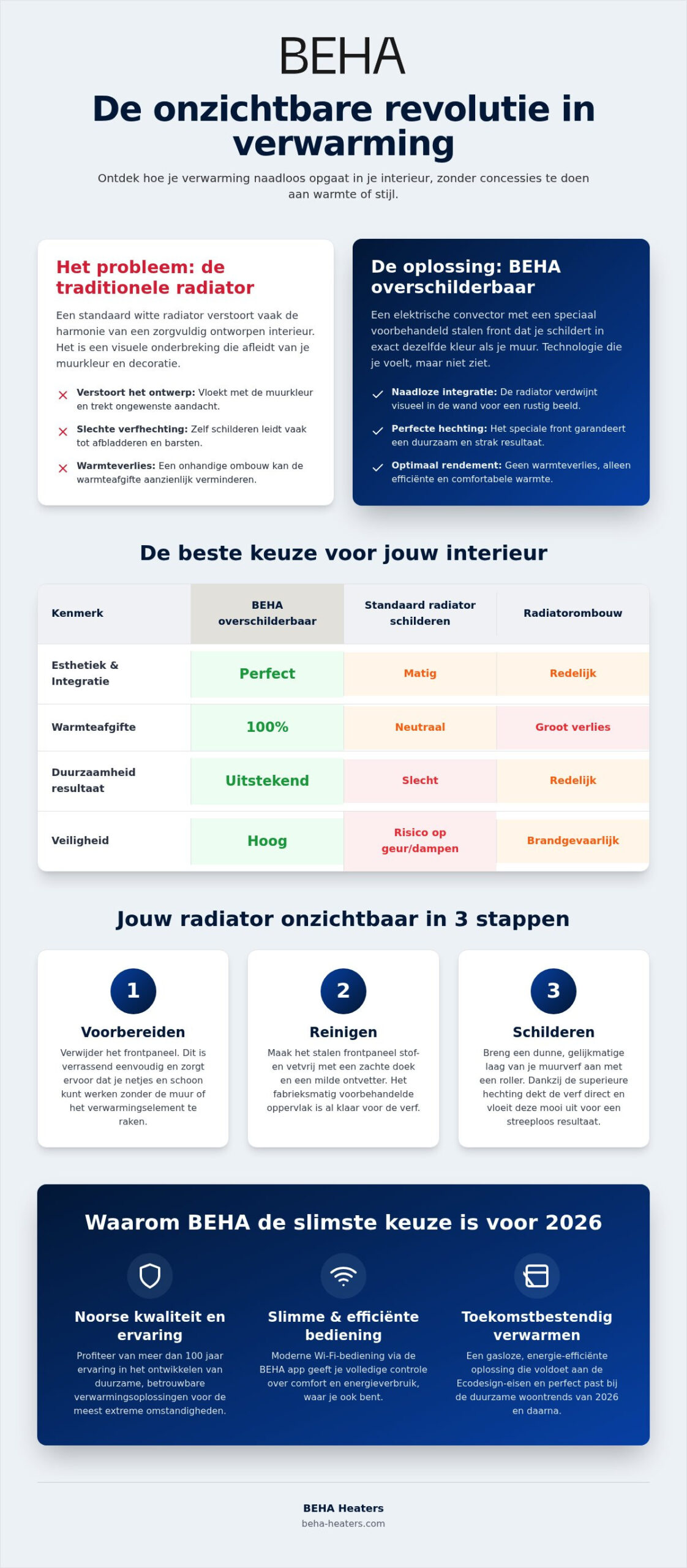
Step-by-step plan: painting a BEHA RAW paintable radiator
This step-by-step plan is a practical preparation. The manual and painting instructions for your exact model always take precedence.
- Check the model and instructions. Confirm that the front is paintable and which paint and preparation BEHA permits.
- Switch off the appliance completely. If prescribed, unplug the device and allow the front to cool down completely.
- Protect the surroundings. Cover the floor and walls and protect all parts that must not be painted.
- Clean the approved front. Remove dust and grease using the method in the manual and let the surface dry.
- Test color and paint. Check a small sample and compare the color in daylight and artificial light.
- Apply thin, even layers. Avoid drips and a paint build-up that is too thick.
- Keep technology clear. Never paint grilles, openings, sensor, controls, cable, connections, or warnings.
- Respect the drying and curing time. Do not switch the device back on until the permitted paint has fully cured.
- Check before use. Ensure that nothing obstructs the airflow and that the device remains correctly mounted.
Paint on the wall or remove the front?
Do not remove a front panel or part unless the official manual explicitly permits and describes this. Self-disassembly may affect electrical safety, assembly, or warranty. If you paint the appliance to the wall, carefully shield the wall, floor, and all technical components.
Which paint do you use?
Use only a type of paint permitted in the current BEHAinstructions. The same color code does not automatically mean the same paint chemistry or gloss level. Keep the product name, batch number, and a small amount of paint for later touch-ups.
How many layers are sensible?
Multiple thick coats are no guarantee of quality. Work as thinly as necessary for even coverage and respect the drying time between coats. Stop when the coverage is good; unnecessary layer buildup makes future touch-ups more difficult.
Painting an existing central heating radiator
A traditional water-based radiator requires a different working method than BEHA RAW. First, check for leaks, heavy rust, and loose paint. Technical defects must be repaired before you begin the finishing.
- Turn off the heating and let the radiator cool down completely.
- Protect floor, wall, faucet, and pipes.
- Clean and degrease the entire surface to be painted.
- Remove loose paint and rust; lightly sand the existing layer.
- Apply a suitable metal- or rust-inhibiting primer where necessary.
- Use radiator paint that is suitable for temperature fluctuations.
- Allow each layer and the final layer to fully cure before heating.
Sentimo also recommends a cold, cleaned, and sanded surface for traditional radiators, with primer and heat-resistant paint. That process is more labor-intensive than a front developed specifically for color finishing.
Common painting mistakes
- Painting while the radiator is still warm.
- Work over grease, dust, rust, or loose paint.
- Using unsuitable wall paint on a standard metal radiator.
- Applying layers that are too thick or skipping drying time.
- Paint over ventilation grilles, thermostat, tap, or labels.
- Reheating the appliance too soon.
Color advice for a paintable radiator
The same color as the wall
A tone-on-tone finish provides the most visual tranquility. If permitted, use paint from the same batch and gloss level as the wall. However, due to the different surface texture and lighting, the color may still appear slightly different. Therefore, test a sample first.
A deliberate color accent
Align the radiator with doors, skirting boards, window profiles, or custom-made furniture. In a calm interior, a single repeated accent color works better than many separate shades. For official color references, you can consult the RAL color chart , but always evaluate a physical sample in your own lighting.
Matte, satin, or glossy?
Matte is generally the least noticeable against a matte wall, but can be more prone to stains. Satin is often easier to clean and provides more reflection. The BEHA approved paint type remains the deciding factor; do not choose based solely on aesthetics.
Popular interior combinations
| Living style | Color strategy | Effect |
|---|---|---|
| Scandinavian | Off-white, light grey or wall colour | Quiet and light |
| Japandi | Greige, sand or warm earth tone | Soft and natural |
| Industrial | Anthracite, black or color of window frames | Powerful and graphic |
| Hotel chic | Deep wall color or subtle contrast | Luxurious and layered |
| Eclectic | Repeat an accent from art or textiles | Personal and coherent |
BEHA RAW: paintable radiator with Wi-Fi
The BEHA RAW series combines a paintable front with electronic control and Wi-Fi. According to the current BEHAproduct page, there are three versions:
| Model | Assets | Dimensions, approx |
|---|---|---|
| RAW HR 8 Wifi | 800 W | 44.8 × 70.6 × 9 cm |
| RAW HR 10 Wifi | 1,000 W | 44.8 × 83 × 9 cm |
| RAW HR 12 Wifi | 1,250 W | 44.8 × 95.4 × 9 cm |
View the current specifications and available models on the official page for BEHA RAW paintable heating. Always check the power, dimensions, IP rating, mounting location, and manual of the exact model before purchasing.
What capacity do you need?
A first indication is approximately 25 to 50 watts per cubic meter. The low value is only suitable for a well-insulated room. Ceiling height, glazing, exterior walls, ventilation, and the desired temperature influence the heat demand. Have a heat loss calculation performed for primary heating.
Not automatically suitable for the bathroom
A paintable front does not mean that the appliance can be used in every damp room. The RAW HR 12 product information, for example, states IP20. Always check the IP rating and permitted bathroom zone of your exact appliance and, in case of doubt, consult a certified electrician.
100 years BEHAexperience
BEHA has been developing electric heating solutions since 1917. For buyers in Belgium and the Netherlands, accurate local product specifications, warranty, service, and manuals are particularly relevant. Therefore, compare the current model on BEHA Heaters and not just general claims about the series.
More inspiration on paintable heating
For additional interior ideas, also read our existing page about style and comfort with a paintable radiator.
Conclusion: paintable straight from the drawing board
A paintable radiator is the most predictable choice when you consciously want to integrate the heating into the wall color. BEHA RAW has been developed as an electrical system for this purpose. If you wish to paint an existing central heating radiator, use the correct metal preparation and radiator paint. A casing can provide quick visual results, but must not obstruct the airflow and control.
First, choose the correct wattage and a safe mounting location. Then, follow the official painting instructions and test the color in your own light. This ensures the result remains beautiful not only on the day of painting but also practical for daily use.
Frequently asked questions about the paintable radiator
Can I paint every radiator with wall paint?
No. A standard central heating radiator usually requires a suitable primer and radiator paint. Use wall paint only if the manufacturer of the specific paintable front explicitly permits this.
Do I need to sand BEHA RAW first?
Follow the current instructions for the exact RAW model. Do not sand a factory- behafront on your own initiative, as this may affect the substrate or the warranty.
Am I losing heat through the paint layer?
A thin, correctly applied, and approved coat of paint should not hinder the intended use. Thick or numerous layers and painted-over air vents can, however, negatively affect heat dissipation.
How do I prevent peeling paint?
Work on a cold, clean, and grease-free surface, use suitable paint, respect the drying time, and apply thin coats. For a standard radiator, sanding and primer are often necessary.
Can I repaint a paintable radiator?
This is possible provided the manufacturer permits it and the existing layer is still suitable as a substrate. Avoid an unnecessarily thick paint build-up and ask for product advice if in doubt.
Which color makes the radiator stand out the least?
The same color and a similar gloss level as the back wall usually produce the calmest result. A physical color sample prevents surprises caused by lighting and surface texture.
Is a radiator cover energy-efficient?
That depends on the design and free airflow. An enclosure that is too sealed can interfere with convection and thermostat measurement. Choose only a demonstrably suitable enclosure with sufficient openings.
Can BEHA RAW be used in the bathroom?
Not automatically. Check the IP rating and permissible electrical zone of the exact model. RAW HR 12 is listed as IP20 on the product page.
Does BEHA RAW work without Wi-Fi?
Check the model manual for local operation. Wi-Fi is intended for additional app functions; according to product specifications, the heating must remain safely operable even during a temporary internet outage.
How do I clean a painted front?
Switch off the appliance, let it cool down, and use a soft cloth according to the instructions of the paint and appliance manufacturer. Avoid abrasives and harsh cleaners.
Is a paintable model cheaper than a conversion?
Compare purchase, installation, painting materials, lifespan, and expected energy consumption. For an existing, good central heating radiator, painting can be cheaper; for new electric zone heating, RAW offers an integrated solution.