
Safe electric heating for the bathroom: what to look out for in 2026

What good is a behawarm shower if you constantly wonder whether the heater can really handle the dense water vapor in the room? The search for safe electric bathroom heating is more important than ever in 2026, now that we are switching en masse to gas-free solutions due to the ban on new fossil fuel boilers. You want that familiar warmth without the fear of short circuits or unclear technical specifications that raise more questions than they answer.
We understand that current regulations can be frustrating due to the maze of IP ratings and complex installation zones. In this article, you will discover how to heat your bathroom safely, smartly, and comfortably with the right electrical solutions that meet the strictest safety standards. We dive into the world of NEN 1010 zones, explain why an IP24-certified convector is the Norwegian standard of quality, and show how modern Wi-Fi features help you save energy. This way, you enjoy a warm room every morning with the peace of mind you expect from BEHA .
Key Points
- Learn why IP24 certification is the gold standard for safe electric bathroom heating and how it protects you against moisture.
- Discover how to divide the bathroom into safety zones according to NEN 1010 standards to determine the ideal location for your heater.
- Understand the difference between fast convection heat and direct infrared radiation so that you make the most efficient choice for your space.
- See how smart Wi-Fi control not only increases your comfort but also helps manage your energy costs in a gas-free home.
- Discover the benefits of Norwegian engineering and why BEHA 's years of experience are essential for reliable bathroom heating.
What makes an electric heater safe for the bathroom?
In the bathroom, safety is not a luxury, but an absolute necessity. Water and electricity are a dangerous combination if the technology is not specifically designed for this environment. A safe electric bathroom heater must therefore meet stricter requirements than a heater placed in the bedroom or living room. This concerns not only the exterior, but above all the internal protection against moisture and heat. Norwegian manufacturers such as BEHA established these standards as the norm decades ago, simply because the extreme conditions in the North leave no room for compromise.
Understanding IP ratings and protection classes
The most important indicator of safety is the IP rating. This international code indicates the extent to which a device is protected against the ingress of solids and liquids. The first digit after 'IP' indicates protection against dust and contact, while the second digit is crucial for the bathroom: water resistance.
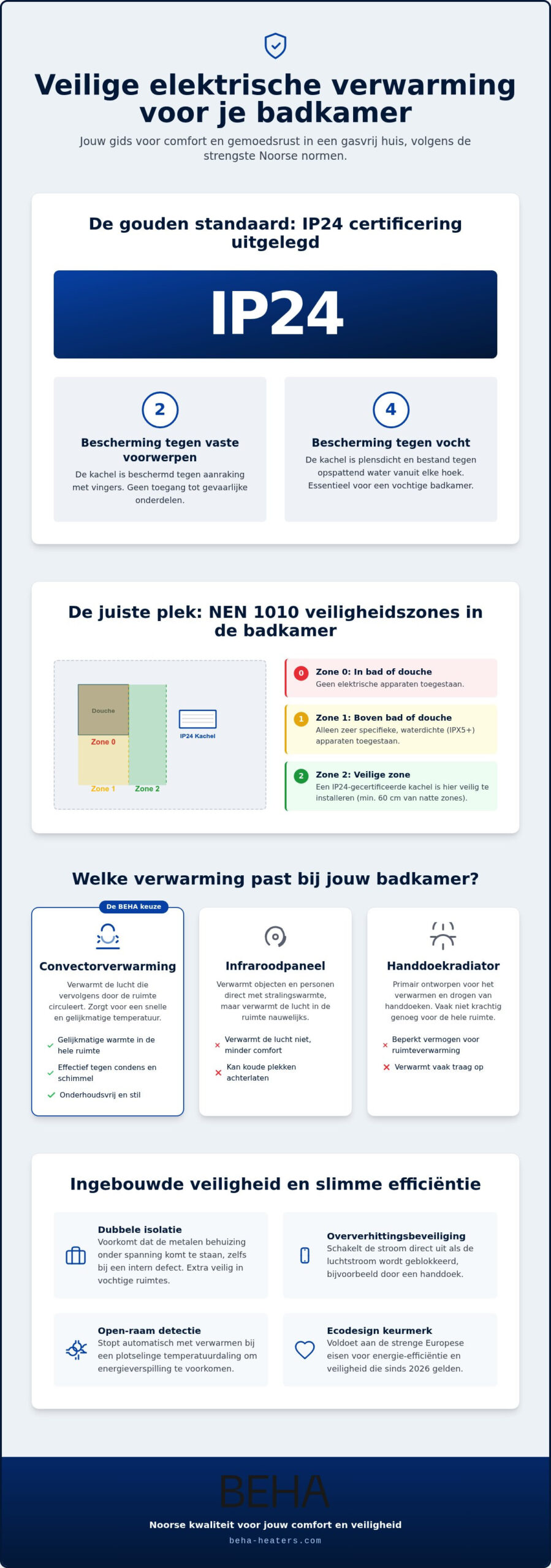
For a bathroom convector, IP24 is the minimum standard. This means that the heater is protected against contact with fingers and, more importantly, is resistant to splashing water from any angle. There is a fundamental difference between splash-proof and completely waterproof. An IP24 heater can easily withstand the condensation and occasional splashes released during showering, but is not intended to be placed directly under the shower stream. Many cheap alternatives claim safety but lack the robust sealing of the electronics required to function for years in a humid environment without corrosion or dangerous malfunctions.
Safety standards and the ecodesign label
Since the tightening of regulations in 2026, electric heaters must meet strict ecodesign requirements. These standards look not only at how safe a device is, but also at how energy-efficiently it uses. Nowadays, a certified heater features smart functions such as open-window detection. As soon as the temperature suddenly drops, for example because you open the window to ventilate, the heater switches itself off. This prevents unnecessary waste and overheating of the system.
In addition, double insulation is an indispensable feature for a safe electric bathroom heater. This ensures that no voltage can build up on the metal casing in the event of an internal defect. Together with automatic overheat protection, which immediately interrupts the power if the airflow is blocked by, for example, a wet towel, this forms the core of a reliable installation. A standard heater for the living room lacks these specific safety features, making the risk of a short circuit extremely high. Therefore, never rely on a CE marking alone; always specifically check the IP certification for damp areas.
The different types of electric heaters for your bathroom
When looking for safe electric bathroom heating, you will quickly discover that there are various technologies on the market. The most well-known options are convection heaters, infrared panels, and towel radiators. Although infrared panels are often praised for their direct radiant heat on the skin, they hardly heat the air in the room. In a bathroom, this can lead to cold corners where moisture easily condenses on the walls. Towel radiators are practical for drying textiles, but often lack the power to quickly bring an entire room to a comfortable temperature. BEHA therefore consciously chooses advanced convection technology. This method draws in cold air from the bottom, heats it via a safe element, and distributes the warm air evenly through the top. This ensures a constant temperature throughout the entire room, from floor to ceiling.
Why convector heating is ideal against mold
Convector heating does more than just raise the temperature; it is an effective weapon against moisture problems. The constant air circulation sets the humid air in motion after showering. This is a crucial advantage over systems with stagnant heat. The active airflow helps to minimize condensation on cold surfaces such as mirrors, grout, and exterior walls. Dry walls mean a reduced risk of mold growth, which benefits the lifespan of your bathroom and your own health. Furthermore, BEHA 's modern convectors are completely maintenance-free. Because there are no moving fans inside the housing, there is no dust accumulation or wear caused by humid air, guaranteeing long-term reliability.
Calculating the required power
To comfortably enjoy your bathroom, the heater's capacity must be precisely matched to the size of the room. In the Netherlands, we use a standard of 100 watts per square meter for bathrooms to raise the temperature quickly and effectively. Therefore, an 8 m² bathroom requires a heater of at least 800W. However, there are factors that can influence this figure. A room with a high ceiling, a large exterior wall, or extensive glass surface requires extra capacity to compensate for heat loss. It is advisable to install slightly too much capacity rather than too little; a powerful heater reaches the desired temperature faster and therefore needs to run at full power for a shorter time. When installing heavier models, ensure that the circuit in your fuse box has sufficient capacity, especially if other appliances are connected to the same circuit. Curious which solution best suits your home? Then take a look at our smart convectors for an overview of the available sizes and wattages.
Smart features for more safety and comfort
Modern technology makes safe electric bathroom heating not only more comfortable but also significantly more reliable. By 2026, Wi-Fi integration will no longer be a luxury; it will be an essential tool for both energy management and preventative safety. Imagine you are at work and suddenly doubt whether you turned off the heater after that hurried morning shower. With a smart connection, you can check this immediately on your smartphone and intervene remotely. This not only prevents unnecessary electricity costs but also provides peace of mind that your home remains safe while you are away.
The beha app: control over heat and safety
The accompanying app acts as your personal guide for optimal heat management. You can easily set detailed weekly schedules that seamlessly align with your daily rhythm. As a result, the bathroom is only at a comfortable temperature when you are actually there, such as during the morning rush or the evening bath ritual. Outside of these time slots, the heater automatically switches to a lower setting.
An often underestimated but crucial function is temperature monitoring to prevent freezing. The app proactively warns you if the room temperature drops below a critical threshold. This is particularly valuable in winter to avoid damage to water pipes. For those who want to know everything about the technical possibilities, we have compiled an electric convector with Wi-Fi: the complete guide to smart and economical heating in 2026, in which we delve deeper into these innovations.
Smart thermostats and energy saving
Precision is the keyword for the latest generation of thermostats. While traditional systems often exhibit large temperature fluctuations, BEHA sensors measure the ambient temperature accurate to the degree. This constant monitoring prevents energy-guzzling peaks in power consumption because the heater never has to work harder than strictly necessary. In a home without a gas connection, this efficiency is indispensable for spreading the load on the electricity grid and keeping your monthly costs low.
In addition to digital security, physical safety in the home has been considered. Even in the bathroom, a child lock on the heater is a valuable addition. It blocks manual operation on the device itself, preventing curious children from accidentally changing settings. In this way, BEHA combines digital innovation with tangible safety that holds up in every situation.
Installation and placement: where can you safely hang the heater?
Determining the right location for your heater in the bathroom is not a matter of taste, but of strict safety regulations. The NEN 1010 standard divides the bathroom into different zones based on the proximity of water sources. Zone 0 is the bath or shower itself, while Zone 1 covers the space directly above it. For safe electric bathroom heating, Zone 2 is the most important place to keep in mind. This is the strip up to 60 centimeters around your bath or shower. An IP24-certified convector is specifically designed to be mounted in this zone, as it can withstand the inevitable splashing water without affecting the internal electronics.
In addition to the zoning, the physical space around the heater is crucial for a healthy airflow. For optimal operation, a convector must hang at least 10 centimeters above the floor. This gives the heater sufficient room to draw in cold air. Keep at least 20 centimeters of distance from walls, towels, or ceilings on the sides and top. If you place the heater too close to a corner or behind a door, the heat cannot escape. This unnecessarily activates the overheating protection and shortens the lifespan of your device. Although many heaters come with a plug, a fixed connection via a splash-proof junction box is preferred in a humid environment. This not only looks sleeker but also eliminates the risk of moisture in a loose socket.
Step-by-step plan for safe wall mounting
Mounting on a tiled wall requires precision. Always use a sharp tile drill bit and drill without the hammer function first to prevent cracking. It is essential to mount the wall bracket exactly level. A tilted heater disrupts the natural rise of warm air, which negatively affects the efficiency of convection. Before drilling, always check with a pipe locator to ensure there are no water pipes or electrical cables running behind the tiles. Do you have no experience drilling into ceramic or connecting electricity? Then do not hesitate to call in a professional for the final installation.
Electrics in the bathroom: the technical side
Every electrical installation in the bathroom must be protected by a residual current device (RCD) with a maximum rating of 30 mA. This is your most important safety net in the event of any faults. Always use heat-resistant cords suitable for damp environments for the wiring. A wall convector with a built-in electronic thermostat is the safest choice in this regard, as it responds accurately to temperature changes and poses a lower risk of sparking than mechanical variants. Do you want to get started immediately with a reliable solution? Check out our IP24 bathroom convectors for models that meet all modern installation standards.
Choose the Norwegian quality of BEHA for your bathroom
Norway is known worldwide for its unforgiving winters and cutting-edge technology. When you choose a safe electric bathroom heater from BEHA, you bring more than 100 years of Norwegian experience into your home. While many manufacturers have only recently switched to electric solutions, for BEHA this has been the core of their existence for decades. The bathroom series was developed with the idea that a heater should not only be reliable in humid conditions but also be an enrichment to your interior. It is the synergy between robust materials and a minimalist design that distinguishes this brand from cheap mass-produced items.
Design that suits your interior
A bathroom is often a place where you pay close attention to the finishing touches, from the tiles to the taps. It is therefore a shame if a standard white heater disrupts the harmony. BEHA therefore offers innovative solutions that go beyond the standard. For instance, you can choose a paintable radiator, allowing the heating to literally blend in with the color of your walls. For those seeking a more modern look, there are models with a glass front. These instantly give your bathroom a luxurious, hotel-worthy appearance without compromising on the powerful convection heat we discussed earlier. Thanks to compact wall mounting, these heaters take up hardly any valuable space, which is ideal for both small shower rooms and spacious bathrooms.
Long-term maintenance and warranty
At BEHA sustainability means that a product functions trouble-free for decades. Because the convectors contain no moving parts such as fans, there is no mechanical wear. The high-quality housing is behaagainst corrosion, which is essential in the aggressive, humid environment of a bathroom. Should the power unexpectedly fail, you do not need to worry about the settings. The automatic restart function ensures that the heater immediately returns to the set program as soon as power is restored.
With the assurance of an established manufacturer and direct support within the Benelux, you are choosing not just a heater, but a long-term solution. You are investing in safe electric bathroom heating designed to perform when you need it most. Whether you are making your current home gas-free or designing a new bathroom, the Norwegian reliability of BEHA forms the reliable foundation for your daily comfort.
Ready for a warm and carefree bathroom
Heating your bathroom without a gas connection will have become the new standard by 2026. By choosing safe electric bathroom heating with the correct IP24 certification, you immediately combine comfort with the necessary peace of mind. We have observed that proper placement in zone 2 and the use of smart Wi-Fi features are essential to guarantee both safety and a low energy bill. Norwegian quality is not an unnecessary luxury here; it is the foundation for a system that lasts for years without any worries.
BEHA has been built on Norwegian reliability since 1917. Today, that rich history translates into robust, splash-proof convectors that you can easily manage via the BEHA app. Whether you choose a sleek glass front or a paintable model that blends seamlessly into your walls, you are choosing technology that can withstand the most humid conditions.
View our safe bathroom heating and choose your model to prepare your bathroom for a gas-free future today. Enjoy the perfect temperature every morning in an environment that is truly safe for you and your family.
Frequently Asked Questions
Can any electric heater be installed in the bathroom?
No, certainly not every heater is suitable for use in damp areas. A safe electric bathroom heater must have at least an IP24 certification to be splash-proof. Ordinary heaters for the living room lack the necessary protection against condensation and direct moisture, which can lead to short circuits. Therefore, always check the specifications of the unit. BEHA bathroom convectors are specifically designed to function safely for years in these challenging conditions without the risk of dangerous malfunctions.
What is the safest place for a heater in a small bathroom?
The safest location is in zone 2, at a minimum distance of 60 centimeters from the shower or bath. In a small bathroom, fixed wall mounting is the best choice to avoid tripping hazards and contact with water on the floor. Ensure the convector is mounted in a location where air can circulate freely for optimal efficiency. Furthermore, by securely mounting the heater to the wall, the unit remains out of reach of direct splashing water.
How much electricity does an electric bathroom heater consume on average?
Consumption depends entirely on the power output and your daily routine. For an average bathroom, we calculate with 100 watts per square meter. A 1000-watt heater running at full power for one hour a day consumes 1 kWh of electricity. Thanks to BEHA 's smart Wi-Fi features, you can significantly reduce consumption. The heater then only heats the room when you are using it, effectively preventing unnecessary costs and energy waste in a modern home.
Is an infrared panel safer than a convector heater?
In terms of safety, both systems are equivalent, provided they have the correct IP rating for damp rooms. The difference lies in the heating method. A convector heater is often the better choice for the bathroom because it circulates the air. This helps reduce condensation on the walls and prevents mold formation in the grout. Infrared panels only emit direct radiant heat, causing the air itself to remain colder and moisture to condense more easily on cold surfaces in the room.
Can I install my BEHA heater in the bathroom myself?
Physical wall mounting is easy to do yourself using the included wall bracket and screws. However, strict regulations apply to electrical connections in the bathroom. Although our heaters come with a plug, a fixed connection to a splash-proof junction box is often the safest option. Do you have little experience with electricity in damp areas? Then we recommend hiring a certified installer to fully comply with the applicable national safety standards for electrical installations.
What should I do if my bathroom heater gets wet?
BEHA bathroom heaters are IP24 certified, which means they are perfectly resistant to normal water splashes. So you don't need to worry if a few drops land on the housing while showering. However, should the heater become soaking wet or completely submerged due to an accident, immediately switch off the power at the fuse box. Allow the unit to dry completely and always consult an expert before switching the heater back on to prevent internal damage or a short circuit.
Are subsidies available for electric heating in 2026?
In 2026, a national budget will be available for the transition to gas-free living in the Netherlands. Although the focus is often on heat pumps, there are sometimes local schemes for making the bathroom fully electric. The government has reserved 150 million euros annually for sustainability until 2030. It is advisable to check the current conditions of the RVO. Subsidies for individual heaters are often part of a larger insulation package or renovation project to make your entire home more energy-efficient.
How does frost protection work on a smart bathroom heater?
Frost protection is an automatic function that constantly monitors the temperature in the bathroom via the app. As soon as the sensor detects that the temperature is approaching freezing point, the heater switches on briefly. This prevents water pipes in the walls from freezing and bursting during a cold winter period. You can set this threshold yourself in the app, ensuring your bathroom remains protected against frost damage at all times, even when you are away from home for an extended period on vacation.