
Safe wall convector for pets: how to assess the heat
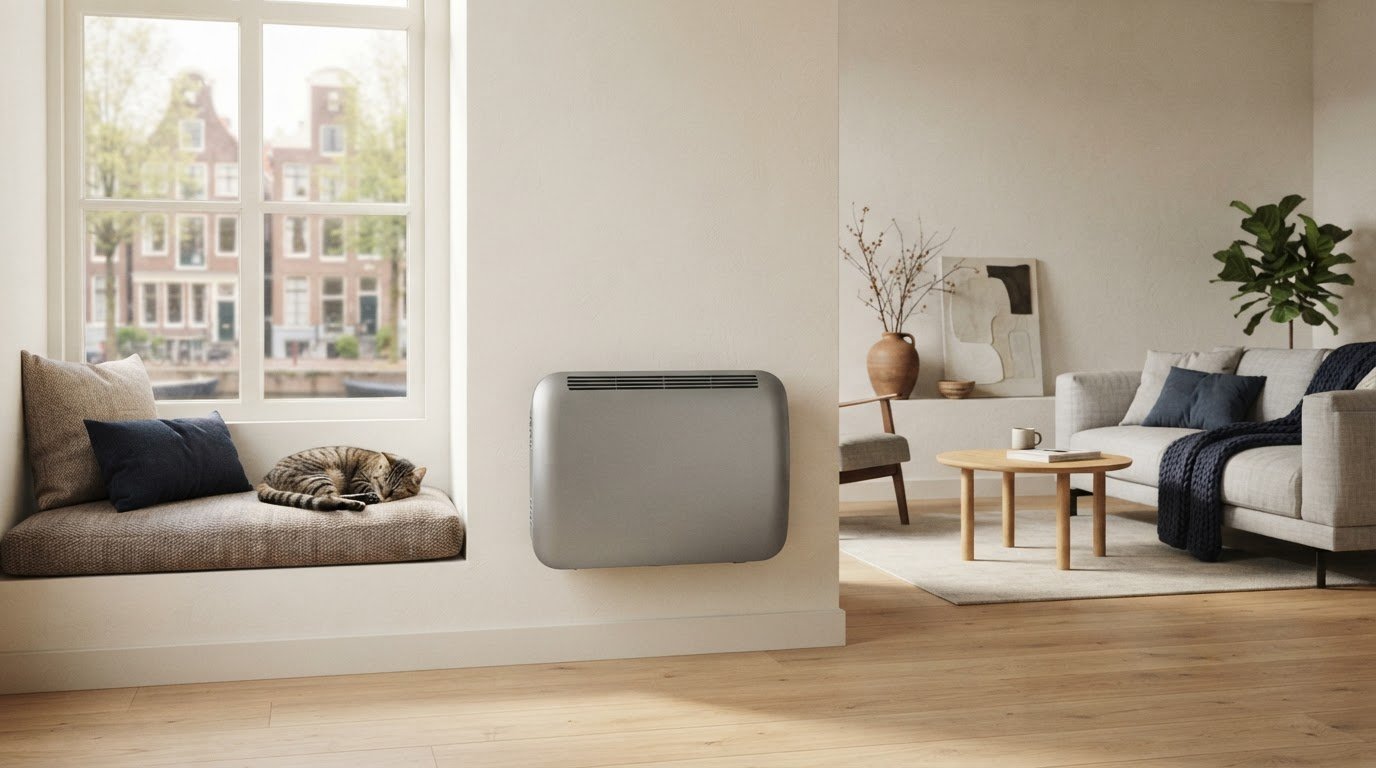
A wall heater mounted out of reach is not automatically safe for your pet. A safe wall convector for households with pets is also assessed based on the touch temperature and the distance to the place where your animal rests. Preferably keep at least 1.5 meters clear on the direct side of the heater.
It is understandable that you primarily want to know how hot the enclosure gets: animals tolerate heat less well than humans, and a heater can be attractive as a resting place. With infrared panels, the touch temperature varies by model. Panels for a nursery are often limited to 60 to 70 degrees Celsius, while ceramic front plates can reach temperatures of up to 120 degrees Celsius.
In this article, you will read how surface temperature, mounting height, material selection, and heating type relate to safety. This will help you determine which placement suits your home and pet, when a convector is a logical choice, and what to look out for regarding cords, edges, and access to a cooler spot.
Key points
- When assembling, consider not only the height, but also the designated resting place, walking routes, and accessibility for your pet.
- Pay attention to a smooth finish and avoid sharp edges or protruding parts in the room where your pet stays.
- An electric infrared heater mounted on the wall or ceiling can be a more suitable choice than a freestanding gas heater or fire pit.
- Ensure your pet can always move to a cooler spot and keep cords out of reach and out of the walking path.
Sensor placement and mounting height
A wall convector does not stand freely on the floor, but its location partly determines heat distribution and safety. Take into account your pet's walking routes and resting places, as well as the prescribed clearance around the unit.
Mounting height and pets
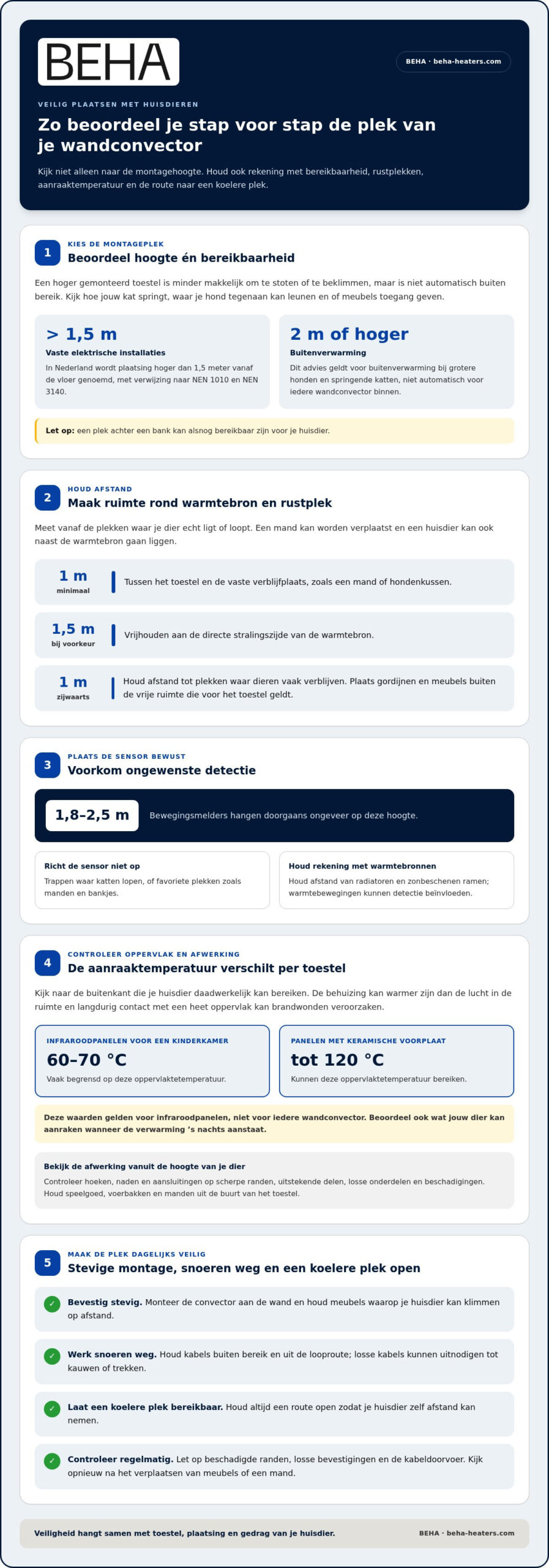
Mounting height is the distance between the floor and the underside of the convector. Animals are less likely to knock over or climb a wall-mounted unit that hangs higher. For fixed electrical installations in the Netherlands, placement higher than 1.5 meters from the floor is defined, with reference to NEN 1010 and NEN 3140. Consider how your cat jumps and what your dog can lean against. A spot behind a sofa, for example, might still be accessible.
For larger dogs and jumping cats, an installation height of 2 meters or higher applies to outdoor heating. This advice applies to outdoor heating, not automatically to every indoor wall convector. Indoors, choose a position that suits the unit and your pet's movements.
Distance to curtains and pet baskets
The clearance prevents heat from falling directly onto a resting place or flammable material. Keep at least 1 meter between a heater and your pet's permanent resting place, such as a basket or dog cushion. Additionally, keep the radiant side clear: preferably at least 1.5 meters applies to this. Place curtains and furniture outside the clearance space applicable to the appliance.
Do not measure only directly in front of the heat source. A pet may also lie next to the device or move a basket. Therefore, maintain a distance of at least 1 meter to the side from areas where animals frequently stay. This ensures the heat source remains out of the immediate vicinity of the resting place.
The sensor requires specific placement. Motion detectors are typically mounted at a height of approximately 1.8 to 2.5 meters. Do not point them at stairs where cats walk, or at favorite spots such as baskets and benches. Also, keep them away from radiators and sunlit windows; heat movements can affect detection. Furniture and walking routes also influence what the sensor detects.
Minimize the risk of tipping over by mounting the convector securely to the wall and keeping furniture your pet can climb on at a distance. Tuck away cords so they do not run across the floor where animals play. Loose cables can invite chewing or pulling. Always leave a path to a cooler spot open so your pet can move away on its own.
Safe materials and sharp edges
The housing and finish also play a role in choosing a convector for a home with pets. Pay attention to the material, protruding parts, and areas where dogs or cats walk.
Material selection for safe use
When choosing materials, consider the housing and finish that your pet can reach during daily use. View the device from your animal's perspective: a dog can sniff along the bottom edge with its nose, and a cat can touch openings with a paw. Also, check that the finish remains intact during normal cleaning.
Check the surroundings: could toys, food bowls, or baskets slide against the convector? A loose object could hit the unit or induce your pet to scratch it. Keep the walking path clear and do not place anything on or against the housing.
Prevent sharp edges
Sharp edges and protruding parts can cause an animal to bump into something or scratch itself. Check the exterior, especially the corners, seams, and joints. Re-examine these areas after cleaning or moving furniture. A protruding corner is especially important to watch out for if your dog enthusiastically runs along the wall.
Also pay attention to loose parts and damage. A bent edge or a loose cover can turn a smooth surface into a hazard. Do not secure damaged parts with tape in a place where animals can reach them. Clear the area and do not place a basket directly against a sharp edge.
The purchase price depends on the type of convector, the model, and the controls. You calculate the power consumption by multiplying the output in kilowatts by the number of operating hours. The electricity tariff then determines the costs. This allows you to compare different usage scenarios without looking solely at the purchase price.
Regularly check a mounted convector for damaged edges, loose fixings, and the cable entry. After moving a cabinet or dog bed, check that nothing is rubbing against the unit. Keep cleaning products and loose cables out of reach. This is how you assess how the unit and the setup function together for your pets.
Touch temperature and risk of burns
The touch temperature is the heat of the surface that an animal can reach. The risk depends on the type of heater, the placement, and how long the animal is in contact with the device.
Surface temperature
The touch temperature varies by device and surface. Infrared panels for a child's room are often limited to 60 to 70 degrees Celsius. Panels with a ceramic front plate can reach temperatures of up to 120 degrees Celsius. These are values for infrared panels, not for every wall convector.
Therefore, do not look solely at the set room temperature. The outside of a device can be warmer than the air in the room. Cats can jump onto furniture and reach higher areas. Assess which surfaces your pet can actually touch, even when the heating is on at night.
Risk of burns to pets
Prolonged contact with a hot surface can cause burns. Cats may lie against a heating device and dogs may rub their flanks against it. Small animals sometimes stay closer to the floor and find it more difficult to avoid a heat source. Keep in mind that pets tolerate heat less well than humans.
Therefore, the type of heater and accessibility must be assessed together. Touch protection is no substitute for distance and supervision. Always move cats, dogs, and small pets to a cooler spot when the heater is on. Preferably keep the direct side of the heater clear by at least 1.5 meters. This prevents an animal from lying in the heat radiation for an extended period.
Also pay attention to your animal's behavior. Restlessness, shivering, shaking, or reduced activity can indicate that it is cold, but heat also requires attention. Does your pet change resting spots or does it stay lying right next to the heater? Then check the temperature and whether there is a clear route to a cooler spot. A basket directly next to the heat source limits that choice.
If a device is switched on at night, prolonged exposure is an especially important factor to consider. Before going to sleep, check that your pets cannot reach the heat source and can leave their enclosure. A safe setup combines appropriate heating, a controllable surface temperature, and a cooler resting place.
Safe types of heaters for pets
The type of heating device determines how heat reaches the room and which risks you need to consider. An electric infrared heater mounted on the wall or ceiling is described as a safer choice for pets than a freestanding gas heater or fire pit. Fixed mounting makes the device less likely to be knocked over, but does not eliminate the risk of heat or contact.
Do not choose a safe wall-mounted convector for households with pets based solely on its position on the wall. Also check which safety features the manufacturer lists for the unit. Overheat protection can switch off the unit if it becomes too hot; a child lock helps prevent settings from changing accidentally. Such features do not replace safe placement or supervision.
Infrared panels use long-wave IR-C radiation and, according to available information, do not emit harmful UV rays. The influence of infrared heating on the spread of dust, pollen, and dust mites depends on the conditions in the room. This can be a factor if an animal is sensitive to airborne particles. It says nothing in itself about the temperature of the surface.
When choosing a safe wall-mounted convector for households with pets, the layout remains a determining factor. A dog could bump into a freestanding unit, and a cat could jump onto furniture and get closer to a wall-mounted unit. Therefore, ensure that your pet can always access a cooler spot. Switch off the heater when pets are left unattended.
The practical choice is an electric device whose placement, operation, and safety features suit your animals' behavior. Compare fixed wall or ceiling heating with portable heat sources in the room where the animal stays. Additionally, watch out for overheating: rapid breathing, lethargy, or feeling hot requires immediate attention. In case of severe overheating, call the veterinarian and begin cooling, without using ice-cold water.
BEHA: Smart convectors steel front
BEHA offers smart convectors with steel fronts for those seeking a fixed electric heating solution. Control via Wi-Fi and the BEHA Smart App can help tailor the heating to your daily routine. There are also smart convectors with glass or paintable fronts and Classic convectors.
Match the design to the room and the place where your pet stays. A suitable front panel can make the convector blend in with your interior, but safe installation and sufficient distance remain important. The characteristics of the chosen unit and the interior design together determine how you use the heat responsibly.
Would you like to choose a convector that suits your home and heating needs? Contact BEHA to discuss the possibilities.
Choose a solution that suits your household
A safe wall convector for households with pets starts with a choice that suits both the space and your animal's behavior. Think ahead: is a young cat gaining access to a new room, is the layout changing, or is your dog's favorite resting spot shifting? Reassess the setup if such changes affect the accessibility of the heater.
BEHA offers smart convectors with steel, glass, and paintable fronts. This allows you to match the design to your interior without losing sight of the location and intended use. The convector is only one part of the choice; the layout and daily habits also determine how it fits into your home.
Would you like to discuss the possibilities for your situation? Ask BEHA for advice and explore which design suits your living space. This way, you take a well-considered next step towards a comfortable home for you and your pet.
Frequently Asked Questions
How safe is the touch temperature?
That depends on the type of heating and the surface temperature of the device. The room temperature does not indicate how hot the housing feels. Therefore, assess which parts your pet can reach, for example, when a cat jumps onto a windowsill. The duration of contact also matters: lying against a hot surface for an extended period poses a greater risk than moving past it briefly.
Which wall convectors are safe for households with dogs or cats?
A permanently mounted electric device can be a suitable choice because it does not stand freely on the floor. However, this does not automatically prevent a dog from bumping into it or a cat from reaching the device. Consider the situation in your room: can your pet touch the housing and can it move to a cooler spot? Compare those conditions to a freestanding heat source.
What surface temperature can a wall convector reach and when does a risk of burns arise?
The temperature varies by device; values of 60 to 70 degrees Celsius have been cited for infrared panels, and ceramic front plates can reach up to 120 degrees Celsius. These figures do not automatically apply to wall convectors. The risk of burns increases with direct, prolonged contact with a hot surface. Therefore, pay attention to the material, the accessible part, and the ability of your pet to move away.
How do you safely mount a wall convector to the wall and at what height?
Mount the convector securely according to the unit's installation instructions, taking into account the wall and the electrical connection. For fixed electrical installations in the Netherlands, placement higher than 1.5 meters from the floor is specified, with reference to NEN 1010 and NEN 3140. Also, take into account furniture that cats might jump on and ensure that cables are not accessible.
What are the prices and power consumption of safe wall convectors in the Netherlands?
The purchase price depends on the type of convector, the model, and the controls. Calculate the power consumption by multiplying the power in kilowatts by the number of operating hours. The electricity tariff determines the costs.