
Silent electric wall convector: The complete guide to noiseless heating in 2026
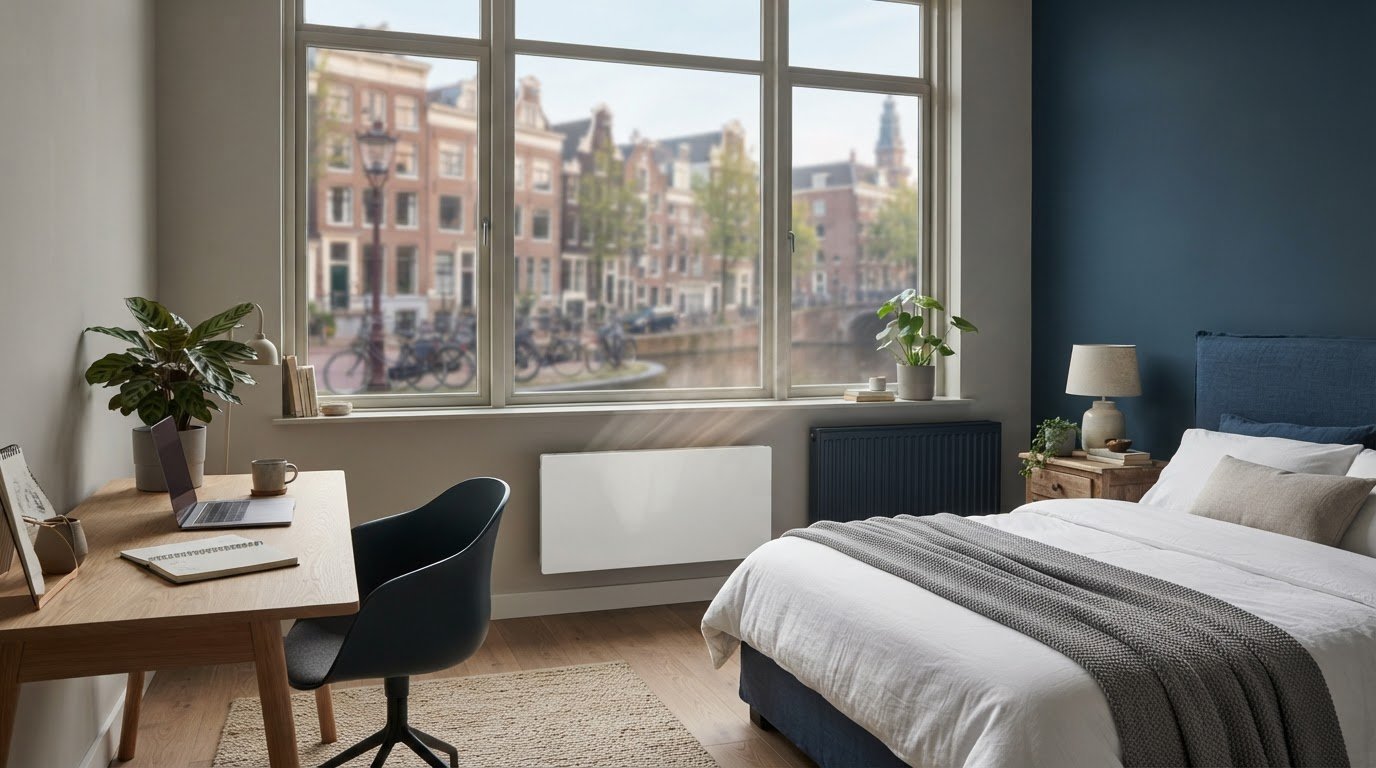
What if your heating could be as quiet as a switched-off light? Many people accept the monotonous hum of a built-in fan or the irritating ticking of a mechanical thermostat as an unavoidable evil while sleeping or working from home. You surely recognize it: an awkward freestanding heater that takes up precious floor space and switches on noisily every time. A modern, silent electric wall convector shows that it can be done differently. By making smart use of natural convection, this type of wall heating brings behawarmth into the home without producing a single decibel of sound.
True peace is only achieved when advanced electronic thermostats make mechanical clicking noises obsolete once and for all. In this comprehensive guide, you will discover exactly how a silent wall convector works, which technical details make the difference, and how to choose maximum energy efficiency and comfort. We walk you through all the key considerations step by step, so you can find the perfect silent heating solution for your interior with peace of mind.
Key Points
- Discover how natural convection without moving fans creates a behaflow of heat in absolute silence.
- Learn why a silent electric wall convector with an electronic thermostat puts an end to annoying mechanical clicking noises.
- Gain insight into crucial construction details, such as floating elements and sturdy wall brackets, that prevent thermal creaking and resonance.
- Discover why silent wall mounting offers the ideal solution for an undisturbed night's sleep in the bedroom and optimal focus at your home office.
- See how Norwegian craftsmanship, smart Wi-Fi control, and energy-saving sensors come together in a sleek, contemporary wall design.
What makes an electric wall convector really quiet?
Many comparison websites claim that fan heaters with a 'sleep mode' are suitable for quiet rooms, or that only infrared panels can heat silently. Neither assumption is correct. A high-quality convector without a blowing mechanism behaa noise level of exactly 0 dB. True silence, however, is no fluke. It requires well-thought-out physical operation and careful material selection.
An effective , silent electric wall convector owes its acoustic comfort to two core principles: the absence of mechanical drive and the elimination of internal friction. Whereas cheap heaters emit continuous noise due to fluctuating temperatures, high-quality Norwegian engineering ensures balanced heat distribution without disturbing background noise.
The principle of natural air circulation
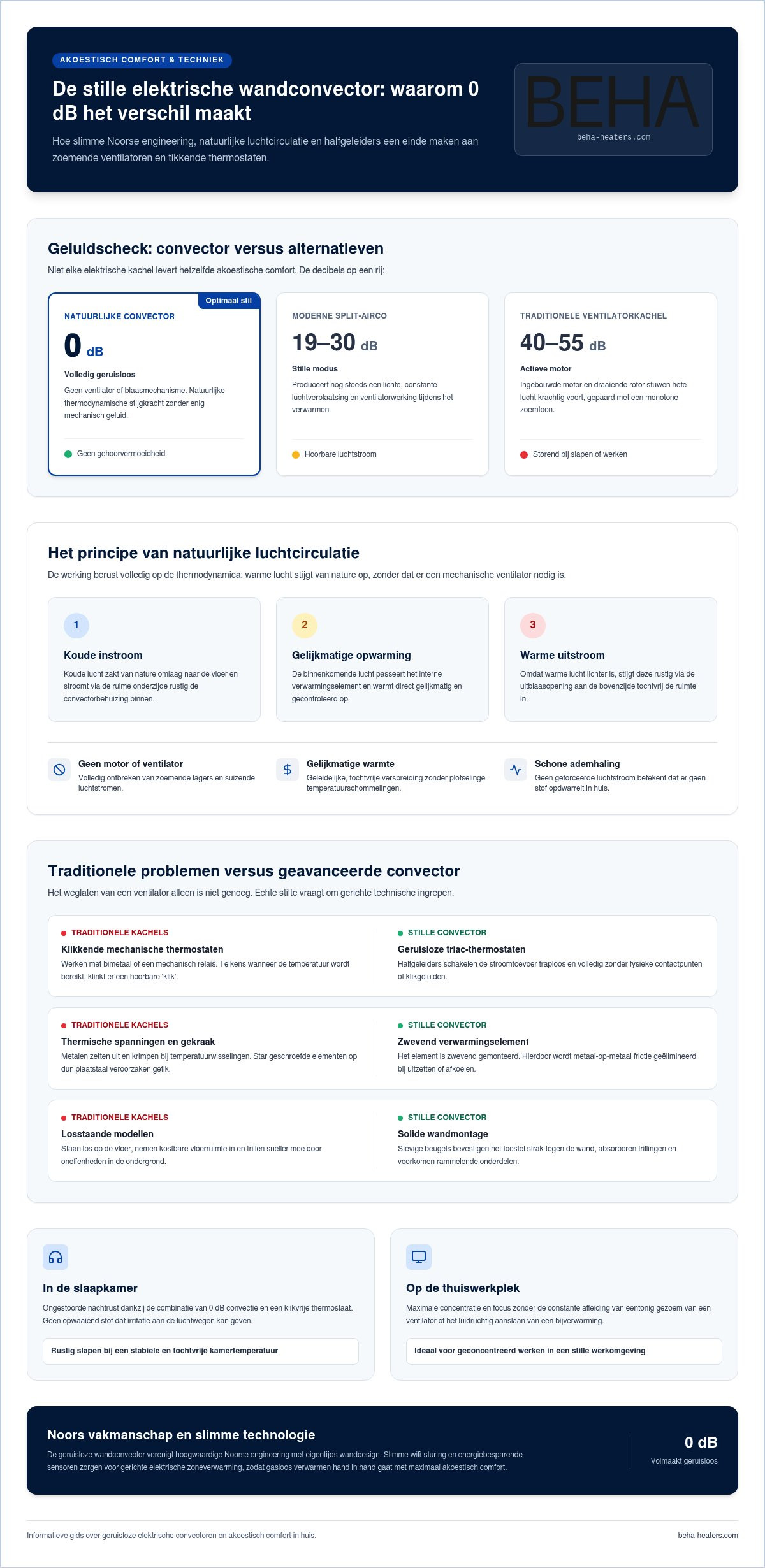
The operation is based entirely on the thermodynamics of natural convection. Cold air naturally sinks to the floor, flows into the convector housing at the bottom, and passes through an internal heating element. Because warm air is lighter than cold air, it rises gently into the room through the outlet at the top.
- No motor or fan: Because there is no mechanical rotor present, humming bearings and whistling airflows are completely absent.
- Even heat: The air moves gradually and draft-free through the room, without sudden temperature fluctuations.
- Clean breathing: Because there is no forced airflow, no dust is stirred up. This prevents irritation of the airways.
Why traditional stoves often make noise
Unfortunately, omitting a fan does not guarantee that every heating panel is whisper-quiet. Budget models and outdated systems frequently suffer from two persistent acoustic problems:
- Clicking mechanical thermostats: Old-fashioned heaters work with a bimetal or mechanical relay. Every time the set temperature is reached, you hear a distinct 'click'. In a quiet bedroom, this can significantly disrupt your night's sleep.
- Thermal stresses: Metals expand when heated and contract when cooled. When a heating element is screwed rigidly onto thin sheet steel, this friction causes an annoying ticking or creaking sound.
An advanced silent electric wall convector solves this by using noiseless triac thermostats. These semiconductors switch the power supply steplessly and without physical contact points. Additionally, a floating heating element prevents metal-on-metal friction. The result is a constant heat output where you forget the device is even on.
Convection versus other electric heaters: the noise check
Not every electric heater provides the same acoustic comfort. Those looking for supplementary heating often encounter a wide spectrum of devices, from small fan heaters to infrared panels. However, the differences in noise production are significant. While a traditional fan heater produces between 40 and 55 dB due to the built-in motor, a natural convector operates at a level of 0 dB. Even a modern split air conditioner often still produces 19 to 30 dB of constant air displacement in silent mode.
The mounting method plays a decisive role in this. Freestanding models vibrate more readily in response to unevenness in the floor. A solidly mounted , silent electric wall convector, on the other hand, is attached tightly to the wall with sturdy brackets. As a result, vibrations are absorbed and rattling housing parts become a thing of the past. According to independent insights from Milieu Centraal regarding electric heating, targeted electric zone heating is a sensible step towards achieving gas-free comfort, provided you choose the right system for each room.
Convector versus fan heater
Fan heaters are appreciated for their ability to quickly heat a small area. The mechanical fan propels hot air forward forcefully, but this is accompanied by a continuous hum and swirling air currents. For a workspace or bedroom, this can quickly lead to hearing strain. A wall convector, on the other hand, heats by natural buoyancy. You enjoy the same rapid heat build-up, but in complete silence. Discover more about advanced control options in our guide to the electric convector with Wi-Fi.
Convector versus infrared heating
Infrared panels, like convectors, are completely silent (0 dB), but their operation differs fundamentally. Radiant heat only warms bodies and objects directly within the panel's line of sight. As soon as you step out of the radiation range, the ambient air still feels cold. A convector, on the other hand, heats the entire air mass in the room evenly. This makes it the most comfortable choice for rooms where you spend hours at a time.
Would you like to experience the tranquility in your home yourself? View the range of BEHA heating solutions and discover how a well-designed Norwegian wall mount ensures a pleasant and quiet indoor climate.
What should you look out for when buying a quiet wall convector?
Many buying guides take a superficial look at wattage and purchase price. If silence is your priority, this approach falls short. A device may be labeled noiseless on paper, but still produce disturbing sounds in practice. Therefore, when purchasing a reliable, silent electric wall convector, to three determining factors: the switching technology, the structural finish, and a well-thought-out power calculation.
In addition, compliance with the European ECODESIGN directive (Lot 20) is essential. This standard mandates a seasonal energy efficiency of at least 38% for fixed local heaters above 250W. This means that modern appliances must be equipped with smart energy-saving features, such as automatic open window detection and a programmable weekly cycle via an app or digital module.
The type of thermostat and switching
Traditional bimetallic strips bend during temperature changes and produce a sharp click every time. Therefore, specifically choose an electronic triac thermostat. This semiconductor circuit regulates the power without moving contacts, ensuring that switching on and off is 100% inaudible. An accurate sensor measures deviations of up to 0.2 °C. As a result, the device does not cycle constantly and power consumption remains stable.
Design and finish of the housing
High-quality materials prevent acoustic irritation. Look for heating panels where the extruded aluminum element rests on friction-free mounting points, so that expansion does not produce friction noise. Appearance also matters in your living space. Are you looking for a timeless, robust look? Then consider an electric heater with a steel front . If you want the radiator to blend seamlessly with your wall color, a paintable radiator offers the ideal solution.
Capacity and space calculation
A correctly sized capacity ensures a behaand quiet indoor climate. An undersized heater must constantly burn at full power, causing unnecessary thermal stress. An appropriate capacity quickly reaches the desired temperature and then switches back silently to a low maintenance cycle
- Well-insulated new construction: Count on approximately 60 to 70 watts per square meter.
- Average insulation (double glazing, moderate cavity wall insulation): Use approximately 80 to 90 watts per square meter.
- Older homes with single glazing: Assume 100 watts or more per square meter.
With the right capacity and a properly mounted , silent electric wall convector, you create a sustainable installation that you never hear, but whose comfortable operation you feel immediately.
The best places in the house for a quiet wall convector
While many overviews randomly list spaces ranging from garages to campsites, a well-thought-out heating plan requires a focused look at acoustically sensitive living zones. In a busy living room, a soft hum is barely noticeable. In an enclosed space where peace and quiet are the highest priority, every decibel counts. As a result, a quiet electric wall convector comes into its own in places where you relax, sleep, or work with concentration.
Moreover, fixed wall mounting ensures functional stability on the floor. Freestanding heaters often obstruct walkways and pose a potential risk if they end up too close to curtains or furniture. By choosing a fixed wall installation, you always maintain a safe distance from flammable materials, while allowing natural airflow to run unimpeded.
Bedrooms and children's rooms: an undisturbed night's rest
A bedroom places the highest demands on noiselessness. While fan motors produce a continuous, monotonous hum, a silent convector maintains the room temperature completely quietly. In addition, light pollution plays a role. Brightly illuminated LED screens on heaters can disrupt melatonin production. High-quality models therefore project the set temperature discreetly onto the floor for only ten seconds during operation, after which the room remains pitch black again. Thanks to a low surface temperature below 225°C, no dust is burned, keeping the air clean and preventing respiratory irritations.
Home offices and home offices: maximum concentration
Background noise during video meetings or intensive thinking leads to fatigue without you noticing. A noisy heater that keeps switching on disrupts your concentration. In an office, a convector offers a quick response as soon as your workday begins. Because the Dutch net metering scheme runs until the end of 2026, you can use solar power generated during the day directly to heat your workspace specifically without heating the entire home. You can set up a comfortable work schedule in advance via smartphone control, so your desk is already pleasantly warm before your first online meeting starts.
In the living room, too, a sleek wall convector proves its worth as stylish supplementary heating alongside a heat pump on chilly winter evenings. Do you want to permanently provide your bedroom or home office with reliable heat without any noise? Choose your silent BEHA convector and immediately experience the comfort of top Norwegian technology on your wall.
Why choose a Norwegian BEHA wall-mounted convector?
True reliability in heating technology does not happen overnight. While many suppliers rely on rapid assembly or complex service contracts, BEHA has been building on over a hundred years of Norwegian expertise since 1917. In Scandinavia, where harsh winters are the norm, effective and trouble-free heating is a basic necessity. This rich history is immediately reflected in the well-thought-out construction of every stove: robust, safe, and uncompromisingly quiet.
A silent Norwegian electric wall convector from BEHA combines this proven reliability with contemporary design. You have the freedom to choose from various styles that seamlessly match your interior style. Think of a timeless steel front, a minimalist glass front, or a paintable front that you finish in exactly the same shade as your wall. This way, the heater visually disappears into the room, while the thermal comfort is tangibly present.
Norwegian craftsmanship and thoughtful design
The secret to the long lifespan lies in the choice of materials and the construction. The convectors are manufactured from high-quality components that effortlessly withstand extreme temperature fluctuations without wear. Wall mounting is quick and easy thanks to the included, dimensionally stable wall frame. Once mounted, the unit hangs stably and vibration-free. Moreover, the convectors are maintenance-free: because there are no moving mechanical parts, you do not need to clean filters or lubricate bearings.
Smart technology and energy saving
In addition to acoustic tranquility, energy efficiency is central. All models fully comply with the strict European ECODESIGN standards. The integrated electronics continuously monitor the room temperature and prevent energy waste thanks to features such as open window detection. With the built-in Wi-Fi module, you can easily manage your heating schedule via the user-friendly app on your smartphone:
- Precise weekly programs: Set the desired temperature for individual rooms by day and by hour.
- Local autonomy: Even in the event of a temporary internet outage, the thermostat continues to strictly follow the set schedule.
- Energy-efficient heating: Heat only the rooms where you actually live or work.
Choose peace, sustainability, and Scandinavian comfort for your home. Are you ready for silent warmth? range BEHA and discover which silent electric wall convector best suits your home.
Enjoy behawarmth in absolute silence
Silent heating doesn't have to be a compromise between comfort and energy consumption. By choosing natural airflow without a fan, you permanently eliminate annoying buzzing from your bedroom or office. Furthermore, a whisper-quiet electronic thermostat prevents the familiar mechanical clicking sounds. This ensures your living space remains not only pleasantly warm but also completely soothing.
With over 100 years of Norwegian experience, BEHA solid Scandinavian engineering with a contemporary aesthetic. Because all models fully comply with the strict European ECODESIGN standards, you are assured of well-thought-out energy savings, such as intelligent open window detection and precise weekly scheduling. A high-quality, quiet electric wall convector thus represents a responsible, sustainable investment in your daily living comfort.
Ready to say goodbye to disturbing noise and enjoy pure acoustic peace? Discover the silent electric wall convectors from BEHA and choose the stylish wall solution that perfectly matches your interior.
Frequently asked questions about silent electric wall convectors
Does an electric wall convector really make absolutely no sound?
Yes, a high-quality convector with natural convection and an electronic thermostat produces 0 dB of sound. Because there is no fan, motor, or pump present, air and mechanical noises are completely absent. Switching on and off also occurs via silent semiconductors, so you do not hear any clicking sounds. Only cheap models with mechanical thermostats or creaking sheet metal sometimes make noise.
Why does an electric heater sometimes tick while warming up?
The ticking of a heater is usually caused by thermal expansion of the heating element and the metal housing. When cold metals heat up rapidly, they expand and parts rub against each other. In high-quality designs, the heating element is suspended on friction-free supports. This allows the material to expand and contract silently, effectively preventing annoying ticking and creaking noises.
Is a quiet wall convector suitable for use in the bedroom?
Yes, a silent electric wall convector is actually the ideal choice for bedrooms and children's rooms. Thanks to its completely noiseless operation and the absence of brightly lit displays, a good night's sleep remains undisturbed. The convector heats the air evenly without drafts or swirling dust, ensuring a healthy sleeping environment. Furthermore, the precise thermostat switches steplessly to keep the target temperature constant.
How much power do I need for a silent wall-mounted convector?
As a general guideline, count on 70 to 100 watts per square meter, depending on the insulation value of your home. In a well-insulated new-build room, 60 to 70 watts per square meter is often sufficient, while a drafty attic space requires 100 watts. An appropriately calculated capacity prevents overloading and ensures that the device heats up quickly and then modulates smoothly at low power.
Can I mount a quiet electric convector to the wall myself?
Yes, you can easily mount a convector to the wall yourself using the included wall bracket. BEHA supplies a rigid mounting frame that you attach to the wall level with a few screws. Then, you securely click the panel into place and plug the power cord into the socket. This means you do not need a specialist installer to get the unit up and running quickly.
What is the difference between a mechanical and an electronic thermostat in terms of noise?
A mechanical thermostat works with a physical bimetal that springs open or closes with an audible metallic click as soon as the temperature changes. An electronic thermostat, on the other hand, uses a silent triac semiconductor. This switches the power supply 100% silently and measures temperature fluctuations with an accuracy of up to 0.2 °C. In a quiet room, this makes a world of difference for your acoustic peace.
Is an electric convector without a fan more energy-efficient?
Yes, a fanless convector utilizes natural thermodynamics and consumes no extra power for a running motor. Combined with smart weekly programming and automatic open window detection, a modern , quiet electric wall convector meets the strictest ECODESIGN standards. Because the convector releases heat directly into the passing room air, no energy is lost, and you heat specifically only when necessary.