
Smart thermostat for your heater: how to choose in 2026
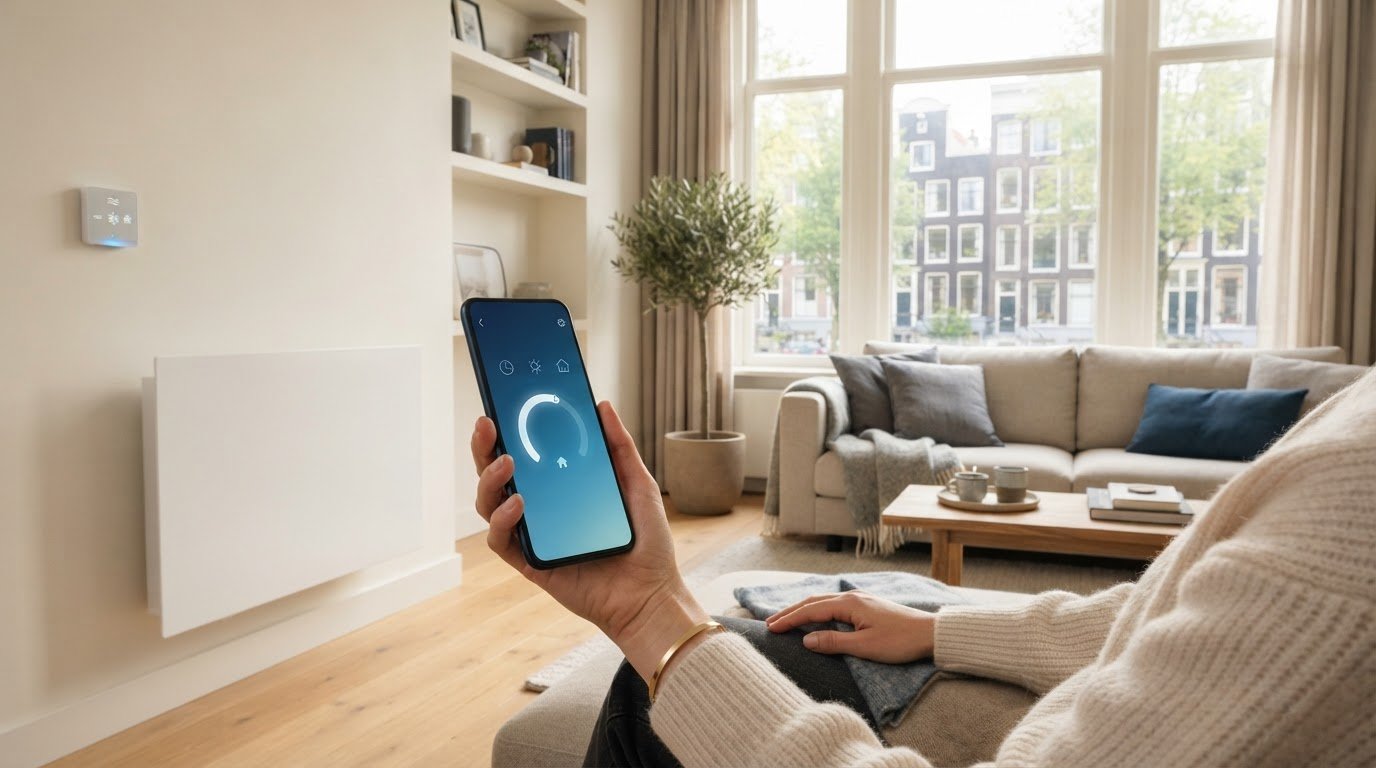
An app doesn't make your heater a thermostat. Those searching for 'smart thermostat heater' usually want to know whether an existing electric heater can automatically maintain the desired temperature or can only be controlled remotely. That difference determines which solution suits your heating and daily use.
A thermostat regulates the temperature, a timer switches the heating on or off at set times, and app control gives you control via your phone. These functions can work together, but only if the control system is compatible with the heater. Therefore, a separate smart thermostat does not automatically work with every electric heater. Some convectors have built-in Wi-Fi and app control, allowing you to adjust settings digitally.
Do you want comfort without running a heater unnecessarily? Then start with the type of heater and the associated controls. Below, you can read how thermostat control and smart controls work together, what the differences are between convectors, fan heaters, and other electric heaters, and what to look for when making your choice. This allows you to compare effectively and choose controls that suit your needs.
Key Points
- First, determine which type of electric heater you have and which controls it supports.
- A standalone smart thermostat only works if the control system and the heater can work together.
- Compare separate controls with a smart convector to determine which solution suits your home and habits.
- Take your desired temperature and daily usage into account, so that comfort and conscious heating come together.
- Consider the role that Wi-Fi and app control play, and choose a front finish for a convector that matches your interior.
What is a smart thermostat for an electric heater?
A thermostat regulates the heating based on a set temperature. Depending on the product, the control system determines when the electric heater emits heat to approximate the chosen room temperature. The thermostat connects the heater to a temperature target and controls the heating based on the set value.
'Smart' usually refers to digital controls or connected functions, but the capabilities vary by product. The temperature control can be located in the heater itself or work in conjunction with a separate controller. A timer serves a different purpose: it primarily follows a pre-set schedule. A timer can switch the heater on at a specific time, but does not automatically regulate the temperature like a thermostat does.
What exactly does a thermostat regulate?
With a temperature setting, you indicate how warm you want a room to be. The control system uses this setting to operate the heating. How quickly and in what way the temperature changes depends, among other things, on the control technology and the characteristics of the heater. For example, you can set a lower temperature when you are away during the day and choose a more comfortable level later.
The set value is the target, not a promise that every spot in the room will immediately become exactly the same temperature. The heater and the conditions in the room also play a role. Therefore, use the setting as a guideline and give the heating system time to respond.
What makes the controls smart?
's smart convectors BEHA feature Wi-Fi and app control, allowing you to operate the heating via a connected device. The available functions vary by product. Therefore, the term 'smart' in itself does not tell you exactly what a product can do. What is a smart thermostat? provides a broader explanation of connected controls.
An app handles the operation, while the thermostat function regulates the temperature. These two can be combined in a single product, but they do not mean the same thing: an app can make settings accessible without automatically controlling every function. Smart control also does not guarantee lower energy consumption. That depends partly on the chosen temperature, the duration of use, and how you set the heater. Therefore, do not look solely at remote control, but also at the temperature regulation the product offers.
How does a smart thermostat work with your heater?
The collaboration begins with a temperature target. You set how warm you want the room to be, after which the thermostat controls the heater according to the built-in controls. When the room reaches that target, the control system can adjust the heat demand. This creates a cycle of setting, heating, and fine-tuning. The precise operation depends on the technology inside the heater and the way the thermostat interacts with it.
A thermostat controls the heat demand based on a temperature setting, but does not independently determine how quickly a room heats up or how warm every spot feels. The characteristics of the heating appliance and the room play a role. Drafts and heat loss can affect comfort. Your usage pattern also matters: a setting that feels comfortable when you are sitting still is not the same for everyone or at every moment.
Temperature setting and heat demand
Suppose you use a room infrequently during the day. A lower temperature setting can then limit the heat demand. When you use the room again, you set the desired level again. This is no guarantee of specific savings or heating time. It shows how the set temperature guides the control system, whereas comfort depends on both the heater and the room.
Electric heating is not a uniform product category. A convector, fan heater, and oil-filled radiator can differ in heat output and control. It also varies by model whether the thermostat is located inside the heater, operates via a separate control unit, or is part of a connected control system. Therefore, a smart thermostat is not a universal combination: the controller must match the specific heater and its support.
App control and Wi-Fi in practice
With a smart convector with Wi-Fi and app control, you use the app to adjust settings. This does not automatically mean that the product learns your routine, detects your presence, or performs other functions. These capabilities depend on the specific product. Therefore, distinguish between the thermostat function, which regulates the temperature, and the digital control, with which you adjust settings.
Read more about the combination of electric heating and connected control in the guide on the electric convector with Wi-Fi. ENERGY STAR also provides general information about smart thermostats and their relationship to energy efficiency. This is US information, not proof that a specific feature or rating applies to a product in the Netherlands.
Do you want to combine digital control with electric heating? Then see how smart convectors from BEHA with Wi-Fi and app control fit in. Next, compare that integrated control with the capabilities of a separate thermostat.
Standalone thermostat or smart convector: which suits your situation?
The choice depends mainly on what you already have and how you want to control the heating. A separate thermostat can be an option if you want to keep an existing heater, but it only works if the controls and the unit can work together. A smart convector combines heating and individual control options in a single product. Therefore, compare not only the controls, but also which component regulates the temperature.
| Solution | Operation | Compatibility question | Fits |
|---|---|---|---|
| Separate thermostat | Via the separate controller; functions depend on the selected device. | Can the thermostat control the existing heater, and are the control and connection compatible? | A situation where you want to retain the current heating system and which is suitable for external control. |
| Smart convector | The convector combines heating with its own controls; smart versions may offer Wi-Fi and app control. | What control options does this convector have, and do they meet your needs? | A room where you want to choose heating and digital controls as a single product. |
First check which component controls the temperature, and then choose between a separate thermostat and a smart convector. This way, you avoid selecting controls that do not align with how your heater is controlled.
When is a separate thermostat worth considering?
A separate thermostat can be interesting if you wish to retain existing electric heating and modify its controls. Suitability depends on the type of heater, the existing connection, and how the unit is controlled. Do not assume that a thermostat designed for one type of heater will work with another. Modifications to electrical connections require appropriate professional knowledge. Do not perform them yourself if you do not possess this knowledge.
Before making your choice, determine where the temperature measurement takes place and which component regulates the heat demand. This allows you to distinguish between a thermostat that only displays a setting and a control system that can actually operate the heater. The product information for both the heater and the thermostat is the guiding factor in this regard.
When is a smart convector a better fit?
A smart convector with Wi-Fi combines heating and digital control capabilities in a single product. This is ideal if you want to choose a heating product with integrated controls, rather than adding a separate controller. Consider the space you want to heat, how often you adjust settings, and whether app control fits into your daily routine. The exact features vary by product.
BEHA offers smart convectors with a steel, glass, or paintable front. These are choices in appearance, not differences in thermostat function. If you would like to view a version with a steel front, read more about the electric heater with a steel front.
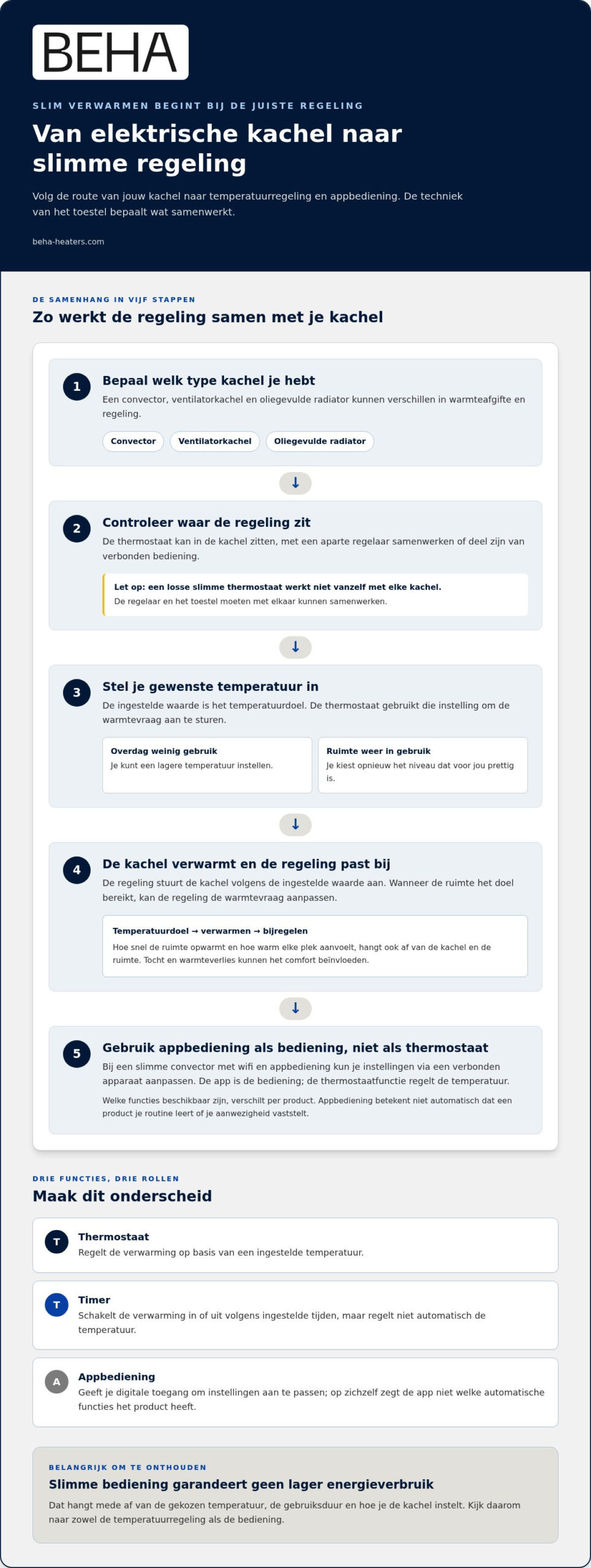
Here's how to choose a smart thermostat for your heater step by step
Making the right choice doesn't start with the app, but with the heater and the accompanying controls. First, assess your current situation. This prevents you from comparing features your heating system cannot use. Follow these five steps:
- Determine which type of heater you have. Note whether it is an electric convector, a fan heater, or another type. Also write down how you currently set the temperature: on the unit, with a separate control, or in another way. This will help you determine which product information is relevant.
- Check which controls are supported. Consult the information and instructions included with your stove to see how the temperature control works and whether external thermostat control or connected control is described. Do not assume general compatibility: this depends on the product and the connection.
- Determine what you want to achieve with the system. Do you primarily want to set the temperature, use the heating at fixed times, or adjust settings via an app? A schedule and remote control are different needs. By distinguishing these in advance, you avoid choosing features that add little value to your routine.
- Take the room and your daily routine into account. Consider which room you heat and when you need comfort there. A room you only use in the evening may require different control options than a room you spend time in regularly. The correct temperature setting depends on your preference and the use of the room.
- Compare the controls and ease of use. Decide whether you prefer adjusting settings on the device or via an app. Also check which component controls the temperature. Connected control makes settings more accessible, but does not automatically mean there are extra automatic functions or that energy consumption decreases.
First check your heater and usage situation
Start with three practical questions: what type of heating is installed, how do you set the temperature, and when do you use the room? Next, differentiate between a need for scheduling and remote control. If you primarily want heating at specific times, a time schedule is the core of your request. If you want to adjust settings via a connected device, look at the controls the product supports.
Compare operation without relying on individual functions
Compare solutions based on temperature control, ease of use, and compatibility, not just the number of functions in an app. The product information and instructions tell you which controls suit your heater. For additional background, you can view the guide on electric convectors with Wi-Fi.
Are you looking for an integrated solution with Wi-Fi and app control? Then take a look at 's smart convectors BEHA and compare the models with your space and daily use in mind. The different fronts are a choice of appearance. Evaluate the operation and temperature control based on the product information.
Smart heating with a smart convector from BEHA
A smart convector combines electric heating and digital control in one product. BEHA 's smart convectors feature Wi-Fi and app control, allowing you to tailor the controls to how you use the heating daily. You can find out which controls and temperature regulation a specific model has in the product information. So, don't just look at the word 'smart', but also at the product's features.
Operation and product selection at BEHA
Wi-Fi and app control offer a digital way to operate the smart convector. This in itself says nothing about additional automation or integration with systems from other brands. When making your choice, keep control and temperature regulation separate: check which functions are included with the model and how to set the desired temperature.
Appearance matters too. BEHA offers smart convectors with a steel front, a glass front, and a paintable front. This allows you to match the look to your interior. The front determines the appearance, not the thermostat functionality. Consider the location of the convector and how visible the front will be there. Then choose the version that suits both your interior and your desired controls.
Compare models on two separate points: the digital controls you are looking for and the front panel you find aesthetically pleasing in the room. This prevents you from confusing a difference in appearance with a difference in temperature control. You can then use the product information specifically to determine which convector suits your needs.
Experience and conscious electric heating
BEHA is a Norwegian family business that has been manufacturing electric heating products since 1917. BEHA 's electric heating products meet ECODESIGN requirements. This is relevant product information, but not a promise regarding your consumption or energy bill.
Conscious heating also starts with your own choices: which room you heat, when you use it, and what temperature you find comfortable. Digital controls can make adjusting settings accessible, but they do not guarantee lower energy costs or specific energy savings. In addition to the model, also review the product specifications and operating information. This allows you to evaluate the convector based on features that are important for your situation.
Would you like to compare the models and control options? Discover smart electric heating from BEHA and see which convector suits your space and preferences.
Choose heating that suits your daily rhythm
Make your choice based on how you actually use a room. Pay attention for a few days to when you need heat, what temperature feels comfortable, and whether you prefer adjusting settings on the device or digitally. This will clarify which controls add convenience and which features are less important.
Use those preferences as a guideline when considering a smart thermostat for your heater. Don't focus solely on extra features, but primarily on a solution that logically aligns with your heater, the room, and your habits. A clear understanding of what you want to control makes comparison easier.
Would you like to see which electric heating solution suits your needs? Discover smart electric heating from BEHA and compare the options. Choose a convector whose controls match your living and heating style.
Frequently asked questions about smart thermostats for heaters
Is a smart thermostat the same as a timer?
No. A timer follows a set schedule, whereas a thermostat responds to a temperature setting. Suppose you come home at a fixed time every workday: a timer can switch the heating on according to a schedule, but does not automatically indicate whether the room has reached the desired temperature. Digital control can offer extra convenience. Check per product which temperature measurement and control it supports.
Can a smart thermostat control multiple heaters simultaneously?
That varies by system and heater. Therefore, do not assume that a single controller can manage multiple appliances. Consider a living room and a study that are used at different times. If you want to set separate temperatures for these rooms, the chosen solution must support this method of control. Check the product information to see how many appliances can work together and whether they are controlled jointly or per room.
Does a smart thermostat also work without Wi-Fi?
That depends on the product. Some heaters have controls on the unit itself, while functions via an app can use Wi-Fi. If the network goes down, control via the app may be temporarily unavailable. Local controls vary by model. Therefore, consider which controls are essential for you and consult the user instructions to see what you can control without a connection.
Does a smart thermostat automatically save energy?
No, smart control does not guarantee lower consumption. The result depends, among other things, on how long you heat, which temperature you choose, and how you use the room. You can better assess the effect for your situation by tracking settings and energy consumption over comparable periods. Do not change multiple habits at the same time, as it is then harder to see which adjustment makes a difference.
Does a separate smart thermostat fit on any electric heater?
No. The connection and built-in controls determine whether a separate thermostat can work with your heater. Note the type and details of the heater and compare them with the specifications of the controller. The same app or Wi-Fi connection does not automatically mean that the two devices are compatible. Base your choice on the combination described in the product information.
What is the difference between a thermostat and a smart plug?
A thermostat regulates the heating based on a temperature target; a smart plug switches the power supply to a connected device. Therefore, a plug is not automatically a suitable temperature control for an electric heater. Check the heater's product instructions and only use a solution intended for it. Being able to switch it on and off remotely does not mean that the temperature is regulated appropriately.
Can I add a smart thermostat to my electric heater later?
Sometimes, but only if both products are suitable for that combination. Check the instructions for the heater and the thermostat before connecting or adjusting anything. Pay attention to the connection as well as how the existing control system works. If the product information does not support the combination, a shared app or wireless connection is not, in itself, a reason to assume that the products will work together. Do not modify electrical connections without appropriate professional knowledge.