
Supplementary heating in the living room: how to choose the right solution

More warmth in the living room does not automatically mean you have to heat the entire house. With the right supplementary living room heating, you direct the heat to where you need it, for example near the seating area. Which solution works best depends on the zone you want to heat, how quickly you want to feel the warmth, and how long the unit is switched on.
Are you undecided between a convector, fan heater, or infrared? Or are you wondering how much impact electric supplementary heating has on your energy consumption? That depends mainly on the power output and the duration of use. The insulation of your home, the location of the unit, and the size of the heated zone also play a role.
In this article, you will read how the different techniques work and how to choose what suits your living room and daily routine. You will discover what to look for regarding power and placement, and how targeted heating can help heat only the room you are using. Furthermore, BEHA smart convectors can be controlled via Wi-Fi and an app, allowing you to tailor your heating times to your day.
Key Points
- Choose supplementary heating for the area where you need extra comfort, so you do not unnecessarily heat the entire home.
- Compare convectors, fan heaters, and infrared based on their heat output and the location you want to heat.
- When making your choice, consider not only the floor area, but also the cold zone, hours of use, and installation options.
- Tailor the power and controls to your living room and daily routine.
- Compare smart convectors with steel, glass, or paintable fronts and choose a model that suits your space.
When is supplementary heating in the living room a smart choice?
The thermostat is set to a comfortable temperature, but it remains chilly on the sofa by the window. Sound familiar? Sometimes one part of the living room feels colder than the rest, for example because you sit there for a long time or because that spot is against an exterior wall. In such a situation, supplementary living room heating provide extra comfort in the area where you lack it, without having to immediately raise the temperature in the entire home.
Supplemental heating is additional heat alongside the heating you are already using. You use it where and when needed, for example in a seating area that you mainly use in the evenings. This is different from electric heating as the primary heating source. That choice requires a broader assessment, taking into account factors such as insulation, the rooms you wish to heat, and the duration of use.
Which living room requires extra heat?
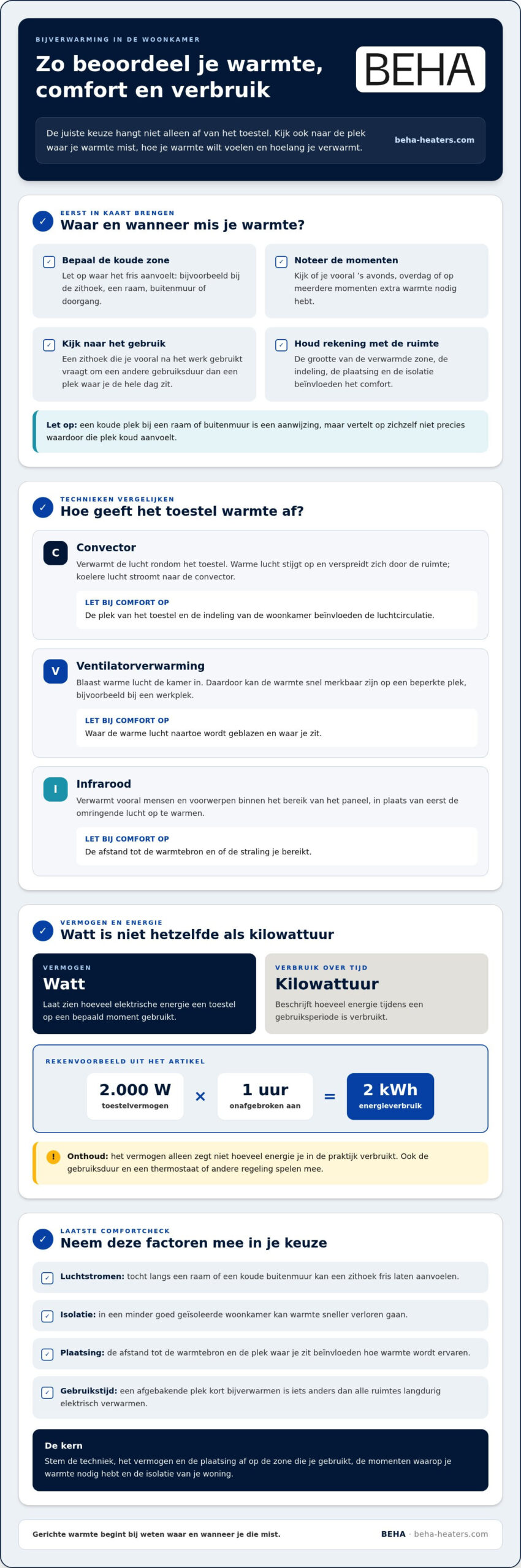
First, look at the pattern, not just the temperature on the thermostat. Does the seating area feel particularly cold as soon as you sit down in the evening, or does part of the room lag behind the rest during the day as well? Note where and when you notice the cold. This way, you will discover whether you want to heat a specific zone or need extra warmth at different times.
The use of the living room also matters. If you are rarely home during the day and use the space mainly after work, it may be pleasant to have extra warmth only during those hours. Additionally, check whether the cold spot is located close to a window, exterior wall, or passageway. Such characteristics are useful clues for your choice and placement, but they do not, in themselves, reveal exactly why the spot feels cold.
Supplementary heating or primary heating: what is the difference?
Supplementary heating supports the heating you are already using. This does not automatically mean you have to replace your current system. Heating part of the living room for a limited part of the day is different from heating all rooms electrically for extended periods. With the latter choice, the total heat demand and the insulation of the home play a greater role. The duration of use and the desired temperature also influence how much heat you need.
Targeted supplementary heating is particularly useful when you want extra comfort at fixed times in a defined area, while the existing heating continues to support the rest of the home.
The way heat spreads through a room also explains why the placement of a device matters. A convector heats air, which then moves. That process is called convection. Additionally, how comfortable it feels depends on the zone you want to heat and how long you do so.
In a less well-insulated living room, heat can be lost more quickly. As a result, the same setting may feel different than in a well-insulated room. Therefore, first identify where and when you lack heat. Use that information to make a more targeted assessment of the heating technology, capacity, and placement.
How does electric supplementary heating work and what determines the comfort?
Electric heating can emit heat in various ways. A convector heats the air surrounding the unit. The warm air rises and spreads throughout the room, while cooler air flows towards the convector. This creates air circulation, also convection . The location of the unit and the layout of the living room influence how that heat spreads.
Fan heating uses a fan to blow warm air into the room. As a result, heat can be felt quickly in a limited area, such as at a workspace. Infrared works differently: it primarily heats people and objects within the panel's range, rather than first warming the surrounding air. Which technology feels comfortable therefore also depends on where you are sitting and how you wish to experience the heat.
Why doesn't the same temperature always feel equally comfortable?
A thermostat measures or regulates the temperature at a specific spot, but does not automatically make every corner equally warm. Drafts along a window, a cold exterior wall, or a cool floor surface can make a seating area feel chilly. The distance to the heat source also matters: you feel infrared heat primarily where the radiation reaches you, whereas a convector heats the air in the room.
Therefore, there is no universal setting that provides the same comfort for every living room. Pay attention to where you sit, whether you feel drafts, and how long you use the room. Moreover, supplementary heating for a short period in a defined zone is different from electric heating as the primary heating source. When making the latter choice, you must consider the heat demand of the home as a whole, including the insulation and the rooms you wish to heat.
What do watts and kilowatt-hours tell us about a heater?
Watt indicates the power of a device: how much electrical energy it uses at a given moment. A kilowatt-hour describes the amount of energy consumed over time. Consumption is therefore related to both the power and the time the device heats. A 2,000-watt device that is switched on continuously for one hour uses 2 kilowatt-hours.
Watts indicate how powerfully a device is heating at that moment; kilowatt-hours tell you how much energy it has consumed during use. This distinction helps you read specifications carefully, but power alone does not tell you how much energy you actually use in practice. A thermostat or other control system can affect how long a device emits heat. Therefore, when comparing, do not look only at the wattage, but also at your usage time and the size of the zone you want to make comfortable.
If you have a fixed routine, adjustable controls can help align heating times with it. Smart convectors from BEHA can be controlled via Wi-Fi and an app. Take these controls into account when making your choice, along with the desired heating zone and the way heat is distributed in your living room.
Convector, fan heater, or infrared: which supplementary heating fits?
The right technology depends on what you want to heat. Do you want the air in a larger part of the living room to warm up, or are you primarily looking for warmth at a single seating area? A convector, fan heater, and infrared provide heat in different ways. No single option is the best choice for every living room.
| Heating type | Operation | Fits | Point of attention |
|---|---|---|---|
| Convector | Heats the air, which spreads through the room. | A zone or room where you want to make the air warmer. | Heat spreads through the air; the layout and placement play a role. |
| Fan heater | Blows heated air into the room. | A confined space where you want to feel warmth quickly. | The airflow and the range determine where the heat is noticeable. |
| Infra-red | Emits radiant heat to people and objects within range. | A fixed spot where you want to direct heat directly onto your body or objects. | Outside the range of the radiation, the heat feels different. |
Use the table as an initial selection. Next, consider whether you usually sit in one fixed spot or want the heat to spread throughout a larger part of the room. Also take into account the duration of use and the position of furniture. A device that suits a fixed seating area well is not necessarily equally suitable if you need heat in different places.
When is a convector suitable for your living room?
A convector can be a logical option if you want to heat the air in the room and allow the heat to spread from there. This is suitable, for example, for a living room where you want to make not only a single chair but also the immediate surroundings more comfortable. Its operation differs from infrared, which primarily emits heat to people and objects within its range.
Control is relevant if you use your living room at varying times. With smart convectors from BEHA , you can control the heating via Wi-Fi and an app, and tailor the heating times to your routine. Read more about electric convectors with Wi-Fi if you want to know how this control fits in with targeted heating.
When is fast or targeted heat more important?
Fan heating is worth considering when you want to feel warm air quickly in a defined area, for example during a brief moment of use. BEHA offers fan heating. Take the airflow into account and direct the device towards the zone where you want to experience warmth. The heat is not automatically equally noticeable everywhere in the living room.
Infrared may be suitable if you primarily want to warm yourself or objects in a fixed location. The radiation does not heat the air in the room in the same way as a convector. Those wishing to explore other applications of targeted infrared technology for the body can find inspiration at lampanapodczerwien.pl. Therefore, think carefully in advance about where you sit and whether that spot is within the range of the heat source. When choosing supplementary heating for the living room, the desired heated zone, your usage times, and your preference for air or radiant heat are the guiding factors.
This is how you plan supplementary heating in the living room step by step
A good choice doesn't start with the wattage on the packaging, but with your usage. First, determine where you lack heat, when that happens, and where a device can be placed or mounted. This prevents you from choosing a solution that heats the wrong zone or is difficult to fit into your daily routine.
Which location and usage moments do you need to map out?
Note which sitting or workspace feels cool and when you notice it. If you use the living room mainly in the evenings, write down how long you usually sit there. Observing for a few days can help you see the difference between a consistently cold spot and a room that cools down as a whole at certain times.
Next, consider where a device can be placed or hung. Take into account furniture, walkways, and the free space the product requires. Always follow the installation and operating instructions. Also check if a power outlet is accessible and if the controls do not disappear behind a cabinet or curtain. A suitable location makes it easier to use the heater practically.
How do you align assets and the scheme?
The required power does not depend solely on the floor area. Ceiling height, insulation, drafts, and the size of the zone you want to heat also play a role. An appliance for a small seating area serves a different purpose than heating that needs to bring the entire living room up to temperature. Therefore, consider your heating goal and the room as a whole, rather than just following a rule of thumb based on square meters.
Thermostat or app control helps you align your heating times with your routine. If you use the room at fixed times, adjustable controls can make it easier to have heat available at those moments. Smart convectors from BEHA can be controlled via Wi-Fi and an app. The control system does not change the heat demand, but it does help you manage usage times more consciously.
Checklist: Before making your choice, map out the cold zone, usage hours, insulation, ceiling height, drafts, installation space, accessibility of the power outlet, and operation.
Next, make a brief comparison: do you primarily want to heat the air in the living room, or are you looking for heat for a limited space? Take your findings into account when evaluating the power and operation. For broader guidance on choosing electric heating for different rooms, you can also consider the usage and the size of the room for which the device is intended.
Do you want to tailor your choice of living room supplementary heating to usage and operation? 's smart convectors BEHA based on the available versions with steel, glass, or paintable fronts.
Choosing a BEHAconvector for comfortable supplementary heating
If a convector suits your desire to heat the air in the living room, look beyond just the output. Also consider the desired controls and how the unit fits into your interior. BEHA 's smart convectors are available with a steel, glass, or paintable front. This allows you to tailor the design to both your heating needs and the look you are seeking.
For supplementary heating in the living room, the combination of space, controls, and daily use is particularly important. A device can provide extra heat, while the controls help to tailor that heat to your specific needs. Make your choice based on how you use the room and the zone you want to make more comfortable.
Which design complements your living room?
A steel front and a glass front each give the convector a different look. Which version suits you depends on your preference and how the unit blends in with the rest of your interior. If you want the heater to visually match the room, a paintable front might be an interesting option. In doing so, follow the product instructions for the front.
Are you looking for a heater that blends seamlessly into your interior? Then also read the guide on paintable radiators. Include your interior design preferences as a selection criterion, alongside the location where you want extra heat and how you want to operate the unit.
What does smart control add to daily use?
This can be handy when you are in the living room at fixed times, for example after coming home or later in the evening. You can use the controls to tailor heating settings and times to your routine, instead of regulating the heating independently of your daily use.
Ask yourself a few practical questions when making your choice: do you use the room according to a fixed pattern, do you want to be able to control the heating via an app, and which model suits your interior? This way, you match the features of the convector to your specific situation. App control helps regulate the heating but does not change how much heat your living room needs.
Do you want to compare the models and other heating options? Then take a look at 's electric heating solutions BEHA and compare the convectors based on operation and design.
Create warmth to match your living room
A pleasant choice starts with your daily use. Consider which spot you want to make more comfortable, how often you use it, and whether you want to feel warmth in the air or in a specific seating area. This way, supplementary living room heating becomes not a separate purchase, but a solution that fits your space and routine.
When considering your options, also take into account the desired operation and appearance. BEHA 's electric heating products meet ECODESIGN requirements. Weigh these features against heat requirements and design.
View 's electric heating solutions BEHA and compare the options for your living room. Choose the solution that suits the location, your desired controls, and the look of your interior.
Frequently asked questions about supplementary heating in the living room
Is supplementary heating in the living room suitable as primary heating?
That is possible, but it is a different choice than temporarily adding extra heat. If you want to use electric heating as your primary heating source, you must assess the heat demand of the home as a whole. Consider how many rooms you want to heat, how long the heating is on daily, and how well the home retains heat. For just a cold sitting area, supplementary living room heating is a more limited application. Let your choice depend on total usage, not just on a single appliance.
Can I leave an electric convector on all night?
That depends on the device and the manufacturer's instructions. Consult the manual for operating time, operation, and required clearance. Do not place a convector close to bedding, curtains, or other items that may obstruct air circulation. Use the thermostat or timer, if available, so that the heating does not run longer than necessary. Switch off the device if the manual advises against nighttime use.
Does an electric convector make the air in the living room drier?
An electric convector does not remove moisture from the air like a dehumidifier does. However, heated air can have a lower relative humidity, making the room feel drier, even if the amount of moisture has not changed. If you notice dry air, also check ventilation and other possible causes in the house. A hygrometer can help monitor humidity instead of relying solely on your feeling.
Can I combine supplementary heating with central heating?
Yes, electric supplementary heating can be used alongside central heating to provide extra warmth locally, for example when you spend most of the evening in one part of the living room. Set the systems so that they do not unnecessarily interfere with each other. If the central thermostat keeps the entire home at temperature, the extra heating may be less necessary. Therefore, pay attention to the location of the thermostat and use extra heat only when and where you find it comfortable.
Can I connect an electric heater to an extension cord?
Preferably use a suitable power outlet and follow the appliance's manual. Only connect a heater to an extension cord if the manufacturer permits this and the cord is suitable for the power rating. Unroll a cable reel completely when using one and do not connect extension cords to each other. If the plug or cord becomes warm, you smell anything unusual, or you notice any damage, switch off the appliance and stop using it.
Why does one part of my living room feel colder than the rest?
Temperature and comfort can vary by location. A window or exterior wall can feel cold, while a draft near a door or window sets the air in motion. The location of a thermostat, furniture blocking airflow, and lack of sunlight can also play a role. Compare the cold spot with another zone at the same time. Check that windows and doors close properly and keep radiators or convectors clear of obstacles.
Do I need a separate circuit for supplementary heating in the living room?
Not automatically. Whether a separate circuit is required depends on the power output of the heater and which other appliances are operating on the same circuit simultaneously. Check the rating plate or the manual for the connection capacity and avoid heavily loading a circuit with multiple powerful appliances. If the fuse trips regularly or you have doubts about the load on the installation, have the situation assessed by a certified electrician.