
Switching from gas central heating radiators to smart BEHAconvectors: here is how to do it in 2026
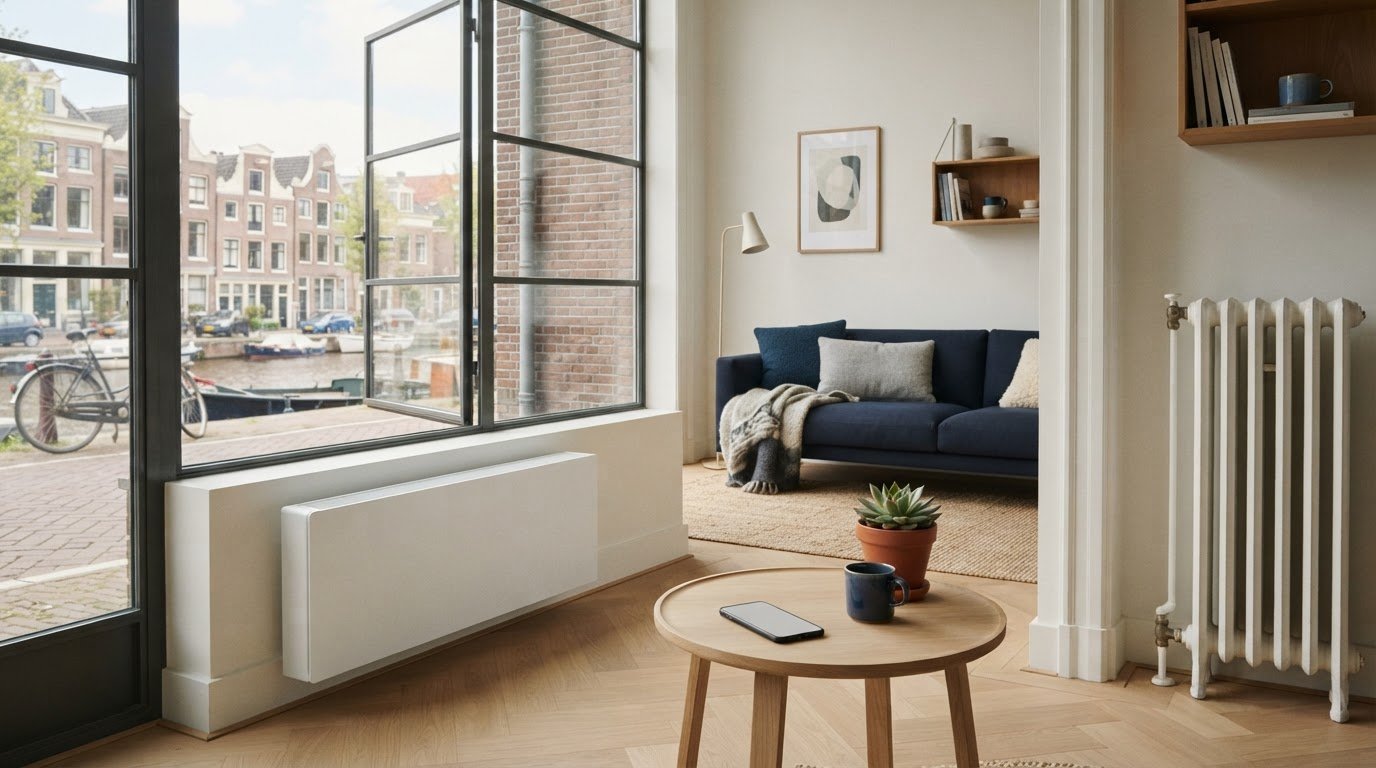
Replacing a working central heating system is not automatically the best first step. When switching from gas radiators to BEHA smart convectors, a sensible choice starts with the heat requirement per room, not with replacing every radiator.
Are you unsure whether convectors will heat your home, what electric heating means for your consumption and costs, or whether your electrical installation can handle the extra load? These are important questions, especially if your current system is still working well. Insulation, space utilization, and required power all play a role. Therefore, switching requires an assessment of your home and installation, not just a choice of heating appliance.
In this article, you will discover the steps to carefully follow in 2026, the choices to make in advance, and when smart BEHAconvectors might suit your situation. We look at the heat requirement per room, electricity consumption, and the capacity of your connection. You will also read how control via Wi-Fi and an app, and the choice of steel, glass, or paintable fronts, align with your wishes for comfort and interior design. This gives you a realistic picture before you decide what to replace and when.
Key Points
- First, assess for each room whether electric convector heating is suitable for your home's heat loss, insulation, and usage.
- Map out your electrical installation and the required capacity before choosing appliances; have the power per room determined.
- Compare the switch from gas central heating radiators to beha smart convectors in terms of comfort, control, maintenance, and consumption. Electric heating does not automatically mean a lower energy bill.
- Go through the replacement step by step and arrange the execution with a suitable professional; BEHA supplies convectors, but no installation service.
- Choose between a steel, glass, or paintable front based on the room, the installation location, and your interior preferences.
Is the switch from gas central heating radiators to smart convectors right for your home?
Switching to electric convectors is more than a one-to-one replacement for radiators. You change both the heat source and the way you control the heating. With central heating, a boiler heats water, which flows through pipes to the radiators. An electric convector heats the air in the room itself and can regulate that space independently. This means that switching from gas central heating radiators to beha convectors is not automatically the best choice for every home.
Assess the heat demand first, and only then determine the required power. How much heat a room needs depends on factors such as insulation, windows, heat loss, ceiling height, and how you use the room. Whether the electrical installation can handle the convectors also plays a role. Have the required power determined per room; a general rule of thumb based solely on floor area does not provide a reliable assessment.
What differences do you notice between central heating radiators and electric convectors?
A central heating radiator emits heat into the room after hot water has flowed through it. An electric convector heats air directly: cooler air is drawn in, heated, and then rises. This air circulation heats the room. Read more about how a convector heater. Smart BEHAconvectors can be controlled via Wi-Fi and an app, allowing you to regulate the heating per unit. Which technology is best depends on your home and daily habits.
When does a full or partial switch make sense?
A complete switch requires a careful assessment of the heat demand in all rooms and the capacity of the electrical installation. Think differently about heating for a bedroom you only use in the evenings compared to a living room where you spend long periods every day. Insulation and comfort preferences also play a role: a less well-insulated room may require more heat.
You can also switch in phases. For example, by first assessing a frequently used room or a space with its own heating demand, while the central heating system heats the other rooms for the time being. This is a way to test the choice for each room, but it is not automatically cheaper or suitable for every home. Therefore, do not replace a working system simply because electric heating is adjustable. First, map out the heat demand and electrical possibilities; only then can you assess whether full or partial replacement suits your situation.
Map out your heating needs and electrical connection before the switch
Choosing a suitable convector does not start with the number of units, but with the question of how much heat each room needs and whether your electrical installation can handle that load. The required capacity varies per home and per room: insulation, windows, usage, and available electrical capacity all play a role. Therefore, a general rule based solely on floor area is not a reliable basis for your choice.
How do you determine how much heat each room needs?
First, create an overview for each room. Note the surface area and ceiling height, the number and type of windows, the insulation, and the temperature you find comfortable. Also record how long and how often you use the space. A bedroom that is primarily used at night requires a different assessment than a living room where you spend a lot of time during the day.
A heat loss calculation provides a more accurate starting point than floor area alone. If in doubt, have the result checked by an expert and use it as the basis for the required power per room. This prevents you from choosing a device based on a rough estimate.
What do you need to have checked on the electrical installation?
Have a qualified electrician assess the available capacity and how the existing circuits are wired. Also discuss which other appliances will be used simultaneously. A convector requires power, while an oven or washing machine, for example, may also need power. The electrician can determine if the connection and circuits are suitable and if modifications are necessary before you choose appliances.
- Map out your home: note relevant features such as structural condition and insulation.
- Inventory the spaces: record dimensions, windows, desired comfort, and duration of use for each room.
- Have the heat demand determined: request a calculation per room and check it in case of uncertainty.
- Have the electrical system assessed: discuss circuits, connection value, and simultaneous power consumption with an electrician.
- Only then select appliances: compare the calculated power with the actual specifications of the convectors.
The switch from gas central heating radiators to beha convectors therefore requires more than just an estimate of the number of radiators you wish to replace. The broader Dutch energy transition provides context, but does not in itself indicate whether your home or connection is suitable. The analysis of the energy transition in the Netherlands offers that broader perspective. For an explanation of operation and smart functions, you can also view the explanation regarding electric convectors with Wi-Fi
Compare gas central heating radiators and smart convectors based on comfort, control, and consumption
When switching from gas central heating radiators to beha smart convectors, not only does the heat source change, but also the way you control the heating. A central heating boiler heats water that flows through radiators; an electric convector heats the air in the room itself. The comparison below helps you assess the differences without assuming that one system is better suited for every home.
| Element | Gas central heating radiators | Smart electric convectors |
|---|---|---|
| Heat source | Gas heats water in the central heating boiler, which flows to the radiators. | Electricity heats the air directly in the room. |
| Regulation | Often controlled via a central thermostat; zones depend on the existing installation. | A device can be configured locally. Smart BEHAconvectors can be controlled via Wi-Fi and an app. |
| Ease of use | A central setting can be familiar if you heat the home as a whole. | Separate controls can suit spaces you use at different times. |
| Maintenance | The central heating boiler and the water circuit require attention in accordance with the installation regulations. | There is no central heating boiler or water circuit in the convector; follow the product instructions for use and maintenance. |
| Points of attention | You remain dependent on gas and on the condition and operation of the central installation. | Check the electrical capacity and take into account power consumption and your energy tariff. |
What changes in comfort and temperature control?
With central heating control, you typically set the desired temperature for the home or a part of it, depending on the installation. Electric convectors, on the other hand, can be controlled per unit. This offers local control, but direct operation of a single convector is not the same as central control of multiple rooms. Check which control method the chosen model supports. The heating behavior and perceived comfort also depend on the unit, the room, and the settings.
How do you assess consumption without promising savings?
Electric heating does not automatically mean a lower energy bill. Consumption depends on factors such as heat loss, the set temperature, and the heating duration. Additionally, the final costs depend on your energy contract and system choice. Therefore, compare your own consumption data and current rates, not general price examples. Without data on your home and rates, savings or a payback period cannot be reliably determined.
If you want to view alternatives to gas heating in a broader context, Milieu Centraal offers information on heating your home sustainably. Use this guidance alongside your own heating needs and energy data to determine which option suits your home.
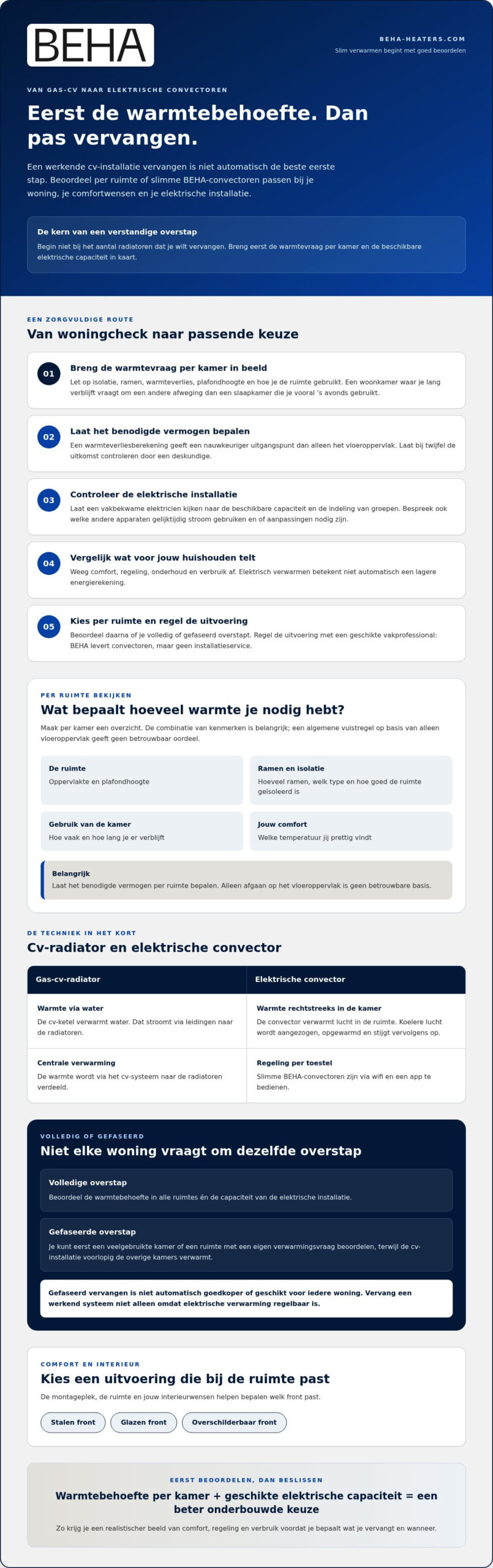
This is how you replace central heating radiators step by step without skipping important details
A careful replacement begins with preparation, not with disconnecting radiators. When switching from gas central heating radiators to beha smart convectors, you change the heat source and possibly the control system as well. Therefore, plan the selection of the electric units and the modification of the existing central heating system separately. BEHA supplies convectors but does not offer installation services.
What steps do you go through before ordering convectors?
- Map out your requirements for each room. Note the calculated heat requirement, when you use the room, where a unit can be mounted or placed, and how you want to control the temperature.
- Discuss the existing installation. Ask a suitable specialist company to assess the boiler, piping, and desired approach. Additionally, discuss the electrical connection with a qualified electrician.
- Check the current appliance details. Compare the required power with the specifications of the convectors. Also check the dimensions, installation options, and operating functions of the current model before making a choice.
- Check the current regulations. Before carrying out any work, have it determined which Dutch regulations apply to your situation and what they mean for the central heating boiler, pipes, and existing connection. Do not assume a single fixed approach for every home.
This way, you avoid ordering a device that does not match the heat demand, the installation location, or the available electrical capacity. If you receive conflicting advice regarding the installation or approach to the boiler, ask for an explanation before scheduling the work.
How do you carefully complete the replacement?
Have the central heating system safely modified or removed by a professional company suitable for this work. Have the electrical work assessed and carried out by a qualified electrician. BEHA does not sell central heating boilers itself and does not carry out the installation; therefore, make clear agreements in advance with the professionals you engage.
After installation, check the operation of each room individually. Set the desired temperature and test the operation of the unit, including Wi-Fi and app control if the chosen model has these features. Also check whether the convector functions properly in the intended location and whether the settings match your daily usage. If you notice that a room is not becoming comfortable, have the settings, unit selection, and heat requirements reassessed instead of immediately installing additional units.
If you would like to view the available smart BEHAconvectors after your inventory , compare the current product details with the advice for your spaces.
Choose smart BEHAconvectors that suit your spaces and living preferences
Once you have assessed the heat requirement and electrical connection, you can compare appliances. Start with the calculated power per room and check if the current model matches this. Next, consider the installation location: is there sufficient space for placement, and does that location suit the room's layout and usage? An appliance for a room you use daily may require different operating specifications than a convector for a room you rarely visit.
When switching from gas central heating radiators to beha smart convectors, the front panel, controls, and technical suitability are all selection criteria. Do not let appearance replace the calculated heat requirement or the inspection of your electrical installation. Check current model specifications and features before you decide.
Which front suits your interior and usage?
BEHA offers smart convectors with a steel front, a glass front, and a paintable front. This gives you various options to tailor the unit to your interior preferences. Consider, for example, where the convector will be visible and whether you want a distinctive front or a version that can be painted over. The front itself does not determine the required output; the room's heat demand remains the determining factor.
If you are considering a paintable front, check the product information and painting instructions beforehand. You can find more background on this interior choice in the guide for a paintable radiator.
Which smart features are relevant for your daily use?
The smart BEHAconvectors can be controlled via Wi-Fi and an app. This can be convenient if you prefer to adjust settings via your phone. First, determine how you actually use the heating: do you primarily want to control a unit locally, or do you find control via an app valuable? Check per model which functions are available and how the controls work. Do not assume features that are not listed in the current product information.
- Power: compare the product specifications with the calculated heat requirement.
- Installation: check dimensions and mounting location in the relevant room.
- Front: choose between steel, glass, or a paintable version based on your interior.
- Control: check if Wi-Fi and app control align with your habits.
Have you already assessed the suitability, required capacity, and electrical connection? Then take your time to view 's smart convectors BEHA and compare the current models with your choices for each room.
Make your heating choice a well-considered next step
The switch from gas central heating radiators to beha smart convectors does not start with replacing every unit, but with insight into your home. Assess the heat demand per room and have the electrical installation checked to see if it can handle the chosen convectors. This way, you base your decision on your insulation, usage, and comfort preferences, rather than on a general assumption.
Next, compare the options for operation and appearance. Smart convectors from BEHA can be controlled via Wi-Fi and an app and are available with a steel, glass, or paintable front. Which version suits you depends on the room and your preferences. Always check the current technical specifications before choosing a model.
BEHA was founded in 1917 and brings with it over a hundred years of experience in electric heating. Would you like to take a closer look at the different models? 's smart convectors BEHA and compare them with the needs of your home. With careful preparation, you can determine step by step which choice suits your situation.
Frequently Asked Questions
Is switching from gas central heating radiators to electric convectors suitable for every home?
No, electric convectors are not automatically suitable for every home. Suitability depends on factors such as insulation, heat loss per room, your usage pattern, and the capacity of the electrical installation. Have these points assessed before you decide, especially if you intend to replace the entire central heating system. You can also investigate whether a phased transition is feasible. If in doubt, seek advice from qualified professionals and check the current technical specifications before selecting appliances.
Can I replace my central heating radiators one-to-one with smart convectors?
Do not assume this without calculation. Switching from gas central heating radiators to beha convectors means a change of heat source and control system. A central heating radiator uses hot water from the central heating system; an electric convector heats the room using electricity. The required power must match the room's heat loss. Therefore, have each room assessed individually and have the electrical connection checked before selecting a device.
How do I know what power my electric convector needs?
The required power depends on more than just the floor area. Insulation, window area, ceiling height, ventilation, and the desired temperature also influence the heat demand. A heat loss calculation therefore provides a better basis than a general rule of thumb based on square meters. If in doubt, have the result checked by an expert. Then compare it with the current specifications of the appliance you are considering, so that the choice matches the space.
Will heating with electric convectors become cheaper than heating with gas?
It is impossible to say with certainty in advance. The costs depend on your home's heat demand, the overall heating situation, your energy contract, and how long and at what temperature you heat. Compare your own consumption data and current rates for gas and electricity. General savings claims say little about your specific situation. If you want to make a cost comparison, use data relevant to your home and have assumptions regarding consumption and rates clearly verified.
Do I need to have my boiler and pipes removed immediately?
No, not necessarily. Whether removal is necessary depends on your chosen approach and the condition of the existing installation. A partial or phased transition can also be explored. First, discuss the consequences for the boiler, pipes, and radiators with a suitable installation company. Furthermore, before any work begins, have the current Dutch regulations and practical considerations applicable to your situation checked. Do not remove any components until those choices and consequences are clear.
Can I control smart BEHAconvectors with an app?
Yes, BEHA smart convectors can be controlled via Wi-Fi and an app. Before purchasing, check which features are included with the specific model and whether they meet your daily needs. Also consider the placement of the unit and the wireless connection in the room. The current product information clarifies the capabilities of each model. BEHA supplies the units but does not offer an installation service itself.
Who can help with the installation of smart convectors?
BEHA sells heating products but does not carry out installation work itself. Engage a qualified electrician for work on the electrical installation. Have changes to the central heating boiler and water pipes assessed or carried out by a suitable installation company. Discuss the order of the work and how your home will remain heated during the transition in advance. This allows the professionals involved to carefully coordinate the electrical modifications with the existing central heating system.