
Textile dryer for drying wet gloves and ski boots

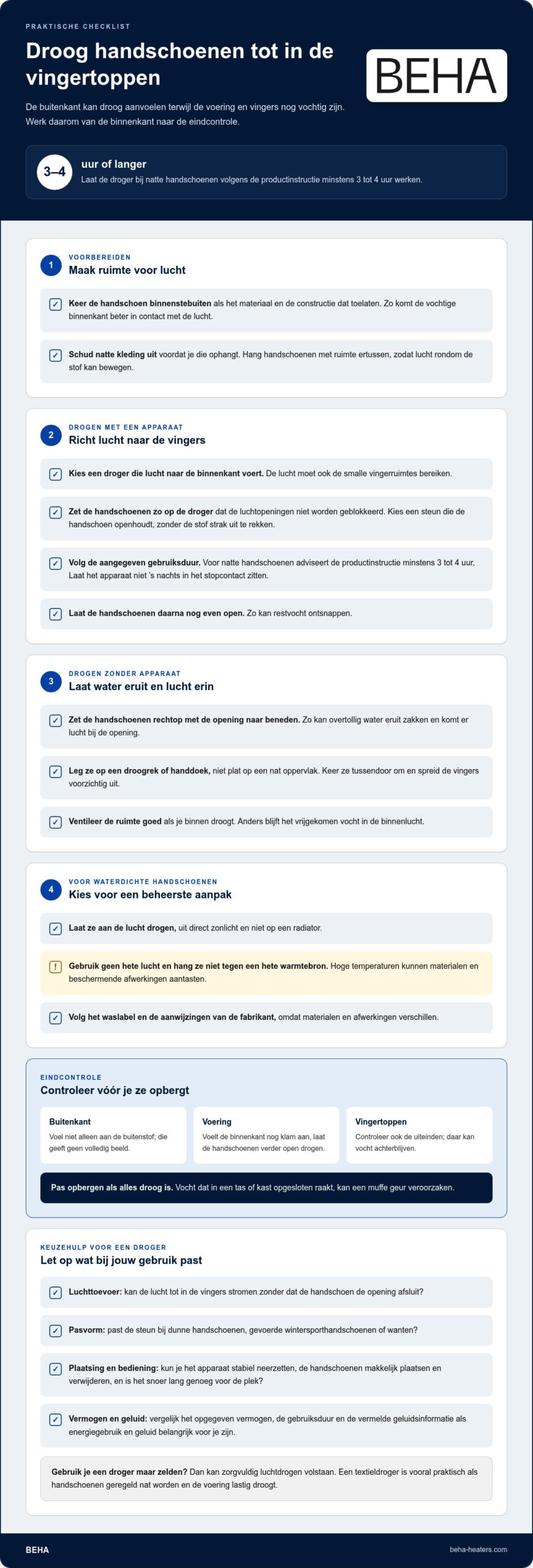
A glove may appear dry on the outside, while the lining and fingertips are still damp. A wet glove dryer draws air into the fingers; according to the product instructions, let the dryer run for at least 3 to 4 hours with wet gloves. This allows moisture deep within the fabric time to evaporate.
You want to be able to use your gloves and ski boots comfortably again, without placing them on a radiator or behathem with hot air. In this article, you will learn how to dry gloves carefully, when to turn them inside out, and why home ventilation helps. You will also discover how to dry ski boots: remove the inner boot from the outer shell so that both parts can dry separately.
Furthermore, you will read how to air out wet items in between washes and what to look out for with waterproof gloves. This way, you choose an approach that suits the material and the amount of moisture, and discover when a shoe and textile dryer is a practical solution.
Key points
- Turn wet gloves inside out if possible and allow air to circulate to the fingertips; use the dryer for at least 3 to 4 hours.
- For ski boots, remove the inner boot from the outer shell so that both parts can dry separately.
- Let waterproof gloves air dry, out of direct sunlight and not on a radiator.
- A drying device helps remove moisture, but drying is not the same as disinfecting.
- The costs depend on the type of device and the features; be sure to choose a solution that suits how often you dry wet gloves and shoes.
1. Air dry gloves down to the fingers
Winter sports gear dries slowly because moisture remains trapped in thick layers of fabric and linings. Especially at the fingers, air has difficulty reaching the narrow, enclosed spaces. As a result, a glove can feel dry on the outside while the lining is still wet. Turn the glove inside out if the material and construction allow it. This allows the damp inside to come into better contact with the air.
A textile dryer for wet gloves directs air in so that it reaches the finger spaces as well. Place the gloves on the dryer so that the air vents are not blocked. According to the product instructions, run the dryer for at least 3 to 4 hours with wet gloves. Follow this operating time and leave the gloves open for a while afterwards to allow residual moisture to escape.
No dryer at hand? Place the gloves upright with the opening facing down. This allows excess water to drain out and air to reach the opening. Lay them on a drying rack or towel, not flat on a wet surface. Turn them over occasionally and gently spread the fingers apart. This allows air to flow along the lining and between the fingers.
Waterproof gloves require a controlled approach. Let them air dry, out of direct sunlight, and not on a radiator. High temperatures can damage materials and protective finishes. A warm place is not automatically better: it is better to choose a ventilated room with air circulation. Do not hang wet gloves against a hot heat source and do not use hot air to speed up drying.
Shake out wet clothing before hanging it up. This removes some of the moisture and prevents sleeves or cuffs from remaining folded. Hang gloves with space between them so that air can circulate around the fabric. If you dry them indoors, ventilate the home well, especially the room where the items are hanging. Otherwise, the released moisture will remain in the indoor air.
Also pay attention to energy consumption and noise level. Energy consumption depends on the power of the appliance and how long you use it. Therefore, compare the stated power and the operating time. The noise varies by appliance: check the listed noise information and place the dryer on a stable surface.
Only store gloves when the lining and fingertips are also dry. Moisture trapped in a bag or closet can cause a musty odor. When checking, feel not only the outer fabric but also the lining and fingertips. If they still feel damp, leave the gloves open to air dry. This prevents you from storing wet winter sports gear immediately after use.
Therefore, check the inside and fingertips before putting the gloves away. The outer fabric alone does not give a complete picture of the drying process. If the lining still feels damp, turn the gloves inside out to allow them to dry further. Shake out clothing before hanging it up and place gloves upright with the opening facing down while drying. This allows moisture to drain out. Check the lining again before storing them.
3. Which textile dryer is suitable for wet gloves?
Choose a dryer that directs air to the inside of the gloves. The fingertips often dry more slowly than the outer fabric. A device that only heats the outside removes moisture less effectively there. Therefore, pay attention to how the glove fits over the drying opening. Air must be able to flow to the fingers without the fabric blocking the opening.
Before choosing, consider which items you want to dry with it. The shape is important differently for thin gloves than for lined winter sports gloves. Also consider mittens, where the inner space is wider. A suitable dryer must support the glove firmly without stretching the fabric tightly. This keeps the airway clear and prevents wet fabric from folding against itself.
Check the user instructions for suitable applications and recommended operating time. For wet gloves, the product instructions recommend running the dryer for at least 3 to 4 hours. The prescribed duration provides a concrete starting point, but the glove must also feel dry on the inside. Do not leave a device plugged in overnight. This is also a recommendation from the product instructions.
Also pay attention to the controls and ease of use. Can you easily place the dryer next to a drying rack? Is the cord long enough for the location where you use it? Can you easily insert and remove the gloves? Such practical points determine whether you can easily use the appliance after a wet hike or a day of skiing. Compare the stated power and noise level if energy consumption and noise are important to you.
- Air supply: check if air can reach the fingers.
- Fit: choose a support that keeps the glove open.
- Usage: view the instructions for gloves and drying time.
- Placement: consider where the device can stand stably.
A textile dryer for wet gloves is particularly practical if gloves frequently get wet and the lining is difficult to dry. If you rarely use a dryer, careful air drying will suffice. Let waterproof gloves dry out of direct sunlight and do not place them on a radiator. Also, always follow the washing label and the glove manufacturer's instructions, as materials and finishes vary.
The right choice, therefore, is not just about size. Airflow to the fingertips, appropriate support, and clear operating instructions are decisive. Match the dryer to the type of glove and how you use it, not just the appearance of the device.
4. How much does a textile dryer for gloves cost in the Netherlands?
The purchase price of a glove dryer depends on the device and its features. Therefore, compare not only prices but also what you get for your money. A simple model may be designed differently from a dryer that also supports shoes. Price alone, therefore, does not indicate whether a device suits your needs. First, consider which gloves you want to dry and how often.
Start your comparison with the product description. Check whether the device is intended for gloves, shoes, or both. Also, pay attention to the way the air is supplied. There must be enough space to place the gloves properly so that the airflow is not blocked. Next, compare the stated operating time, power, and operation. These characteristics help determine how practical use you get from the device.
Power consumption is also included in the calculation. This depends on the wattage and how long you use the dryer. For wet gloves, the product instructions recommend at least 3 to 4 hours of use. Multiply the wattage in kilowatts by the usage time and the electricity price on your energy bill. This way, you calculate the electricity costs per drying cycle, without assuming a general rate.
If you use the device mainly after winter sports, take into account how often you need it. Those who dry gloves regularly spread the purchase costs over more drying sessions. For occasional use, air drying may be sufficient. Compare the options: how often do the gloves get really wet, how long does drying take without a device, and do you also dry shoes? This way, you can see which purchase fits your routine.
Compare Dutch offers based on the same criteria. For each device, note the selling price, power, battery life, and applications. Also check if accessories are included; only take what is actually listed in the offer. A lower purchase price means little if the model does not suit your gloves. Conversely, a more comprehensive device is not automatically the best choice if you only dry thin gloves.
- Purchase: compare the selling price of devices with the same application.
- Electricity: calculate consumption with power, usage time, and your electricity tariff.
- Usage: weigh how often you dry your gloves or shoes.
- Procedure: check the air supply and supplied parts.
The total costs therefore consist of the purchase price and the power consumption during use. For a realistic comparison, use the specifications of the device and your own energy bill. The prescribed drying time of 3 to 4 hours provides a starting point for wet gloves, but the actual consumption depends on the power output. Compare these data before deciding, and choose based on your gloves, drying routine, and desired applications.
5. Which textile dryers are the best rated and where can they be bought?
A reliable review says more than just a high score. When it comes to a textile dryer, be sure to read reviews regarding the drying of gloves. A review of ski boots does not automatically tell you how well the fingertips dry. Pay attention to the application, the type of glove, and the described drying experience. This way, you compare appliances based on suitability, not just popularity.
Reviews change when new buyers share their experiences. Therefore, check the date and content of recent reviews alongside the average rating. Look for concrete observations: do the fingertips stay moist, is the airflow easy to use, and is the device stable? A description of a padded ski glove helps your choice more than a short review without a usage example.
Create a brief overview to compare models. Note the manufacturer's intended applications for the appliance, how to place gloves on it, and the applicable operating instructions. Also compare the stated power output, cord length, and noise information. This will help you determine if the dryer is suitable for the location where you intend to use it at home. A compact appliance can be convenient next to a drying rack, while a larger model requires more space.
- Application: check whether gloves are explicitly mentioned.
- Airflow: see how air is directed towards the fingers.
- Usage: read the instructions for placement and drying time.
- Experiences: search for reviews of the same type of glove.
In the Netherlands, you can look for shoe and textile dryers at sports stores, outdoor shops, and online stores. Use the same search terms everywhere, for example, “glove dryer” and “shoe and textile dryer.” Then compare the product description, user manual, and customer reviews. Before purchasing, also check whether the seller states that the dryer is suitable for your type of gloves. This will prevent you from choosing a device that is primarily intended for other footwear.
A high rating is only useful if the experiences align with your usage. If you wear lined winter sports gloves, look specifically for reviews regarding a similar lining. If you use thin cycling gloves, check whether reviewers discuss that application. A satisfied review regarding general performance is positive, but provides less information about moisture deep within the fingers.
Keep the product information and your comparison after purchase. For example, compare the described application with your first experience with the gloves. Follow the included instructions and ensure that the air vents remain clear. When reading reviews, distinguish between comments regarding delivery or packaging and experiences with the drying result. The latter, in particular, will help you assess whether the device is suitable.
In short, a “top-rated” dryer is not automatically the best choice for every glove. Compare reviews in relevant applications and check features with the seller. By making a targeted comparison between a sports store, outdoor shop, and online store, you will find a solution that suits your gloves and drying routine.
Consider the location where you dry your clothes. A hanging drying rack can be hung high, where clothing hangs in the warm air circulation. Place a drying rack indoors in a spot where few people go during the day, so that you are bothered by moisture as little as possible. Take this location into account when assessing a practical drying setup for your home.
5. Can a textile dryer also disinfect wet gloves?
No, drying and disinfecting are different processes. A textile dryer blows air through gloves and helps remove moisture. This makes the material drier, but does not prove that bacteria, fungi, or other microorganisms have been killed. Therefore, do not assume disinfection unless the manufacturer explicitly describes this function for the device.
A damp ski glove may feel more comfortable after drying. However, this only indicates the moisture, not the hygiene. Furthermore, a musty odor can linger if the lining is soiled. Therefore, use a dryer to dry, not as a substitute for cleaning.
Always follow the glove's washing label for washing. Waterproof gloves can usually be washed at low temperatures up to 30°C, depending on the label. Do not use this temperature as a general rule for every material. Leather gloves, membranes, and lined fabrics may require different care. Also check whether the label permits hand washing or machine washing.
Washing can weaken the water-repellent DWRbeha. Therefore, use only a detergent and washing method that comply with the manufacturer's instructions. If prescribed by the manufacturer, a short drying cycle at a low temperature can help activate the DWR. This is not a disinfection step: the goal is to restore the water-repellent effect.
Tackle an unpleasant-smelling glove step-by-step:
- First check the washing label and care instructions.
- Wash the glove according to those instructions, when permitted.
- Let it dry carefully and also check the lining.
- Only store it when the inside and outside are dry.
Do not add bleach, disinfectant, or fragrance to a dryer. Such agents can damage the material or finish and are only suitable if designated for care by the glove manufacturer. Also, do not spray liquid into the finger lining. Residual moisture can hinder drying and make the glove damp again.
If you primarily want to minimize odors, allow gloves to air out completely after use and do not store them wet and folded in a bag. After a wet day on the slopes, take them out of the bag and clear the opening. Drying helps wick away moisture; washing according to the label removes dirt. These actions do not constitute disinfection.
In short, a textile dryer dries gloves, but does not automatically disinfect them. Evaluate the appliance based on the operation actually described by the manufacturer. For hygienic maintenance, follow the washing label and the instructions for the material. This way, you keep drying, cleaning, and disinfecting separate.
BEHA: Smart convectors steel front
BEHA offers smart convectors with steel fronts for those who want to consider home heating in addition to drying winter sports gear. These electric convectors are intended for space heating and do not dry gloves. This allows you to choose a suitable product group for both needs, without confusing drying and heating.
In addition to convectors with steel fronts BEHA offers smart convectors with glass fronts, smart convectors with paintable fronts, and Classic convectors. The smart versions can be controlled via Wi-Fi and the app. Your desired appearance and ease of use may influence your choice. View the options on the BEHAwebsite.
Would you like to view convectors for your home? View the convectors from BEHA.
Choose the next step for your comfort at home
Don't make drying wet winter sports gear unnecessarily complicated. Choose a designated spot where gloves and ski boots can air out after use. Then consider whether a textile dryer for wet gloves suits how often you dry them. This way, you tailor the solution to your routine and leave room for other comfort choices in your home.
If you would also like to consider electric heating, BEHA offers smart convectors with a steel, glass, or paintable front. These convectors are intended for space heating, not for drying gloves. Assess both needs separately: choose a suitable drying method for your equipment and heating that suits your home.
View which convector model suits your interior and desired operation, or discuss your question directly with BEHA. Contact BEHA to explore the possibilities. With a well-considered choice, you create space for comfort at home, both after a day outdoors and during your regular daily routine.
Frequently Asked Questions
Which drying programs and temperatures are safe for leather and synthetic gloves?
Follow the washing label and the glove manufacturer's care instructions; there is no universal drying temperature for leather and synthetic fabrics. For leather, only use a drying method permitted by the manufacturer, as heat can dry out or deform the material. Synthetic gloves also vary in lining and finish. Choose a low temperature only if the instructions allow it. A short drying cycle can help activate DWR, but only when prescribed by the manufacturer.
How do you dry gloves without shrinking, damaging them, or getting an unpleasant odor?
Gently squeeze out excess water without wringing or twisting the gloves. Then press them between a clean, dry towel. Open the cuffs and fingers so that damp areas do not lie on top of each other. Allow the gloves to dry completely before storing them; a closed bag traps moisture and can cause odors. For a removable lining, follow the care instructions provided, as these may differ from those for the outer glove.
What are the safety risks involved in drying wet gloves?
Excessive heat can damage glove material, so do not use a radiator or hot air as a quick fix. For an electric dryer, follow the operating instructions and do not leave the appliance plugged in overnight. Place it on a stable surface and keep the air vents clear so that air can circulate. Do not use the appliance for applications not specified by the manufacturer. This will limit the risk of damage to the gloves and improper use of the dryer.
What is the difference between a textile dryer, shoe dryer, and glove dryer?
A textile dryer or glove dryer draws air into gloves so that the lining and fingertips can also dry. A shoe dryer is intended for shoes; some devices are suitable for both gloves and shoes.