
Wall convector for holiday home in bathroom and bedroom
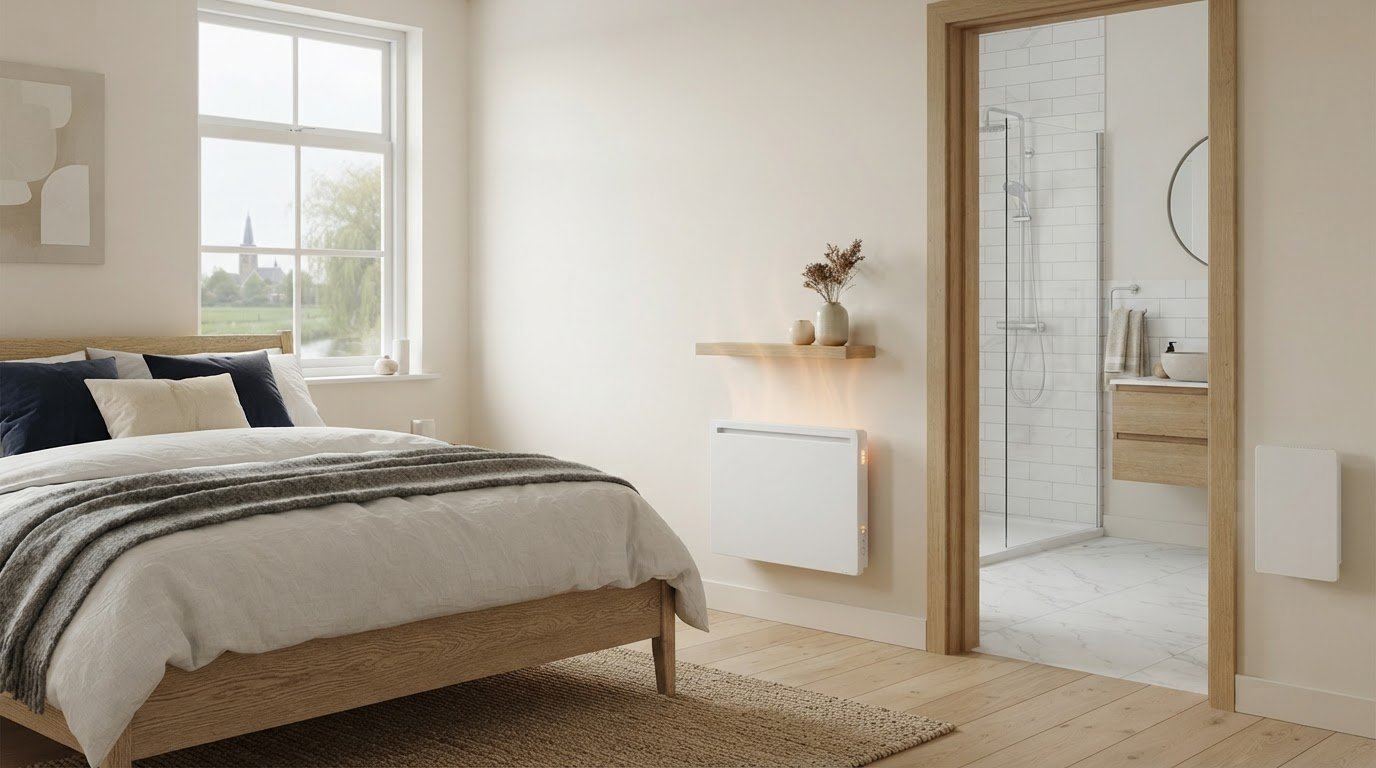
A cold bathroom or bedroom can quickly reduce the comfort in your holiday home. A wall convector for your holiday home draws in cold air, heats it, and distributes the heat via natural air circulation. With models featuring Wi-Fi, you can set the temperature using a smartphone app, even when you are on the go.
You want heat where you need it, without constantly heating the entire room. Electric supplementary heating can therefore be useful in the bathroom or bedroom, for example. Choose based on the size and insulation of the room and how you want to control the heating.
In this article, you will read how convector heating works and how it differs from other heating methods. You will also discover how remote Wi-Fi control works, what to look out for when using it in a bathroom, and when electric supplementary heating is suitable for a holiday home. This allows you to weigh the options against your spaces and usage.
Key points
- A convector heats air that circulates through the room; this helps you understand the kind of heat you can expect in a holiday home.
- With a Wi-Fi-enabled heater, you can adjust the temperature via an app when you are not at home.
- Tailor electric supplementary heating to the room, the insulation, and the time when you need heat.
- For the bathroom and bedroom, both the required power and a suitable location for the heater matter; BEHA offers convectors with various fronts.
Convector heating: What is it and how does it work?
An electric convector heats air, which spreads through the room via natural circulation. Choose a wall convector for a holiday home based on the room, the desired heat, and the position on the wall.
How convector heating works
Cold air flows into the convector through openings at the bottom. The heating element heats this air, after which it rises and spreads throughout the room. When the air cools, it sinks and the cycle begins again. In this way, the heat can distribute itself evenly. The airflow and the free space around the unit help initiate the circulation.
A convector heats differently from infrared heating, which heats people and objects directly. A traditional radiator emits both radiant heat and convection heat. With electric heating, electricity is converted into heat; consumption then depends on how long the device heats.
Convectors, storage heaters and inertia radiators
An electric convector heats the air when you need heat. An accumulator stores heat and releases it later, so that the heating moment and the heat output diverge. An inertia radiator retains heat in material with thermal mass and releases it gradually.
The difference lies primarily in heat storage and release. Choose a convector for direct air heating; compare storage heaters and inertia radiators based on heat output over time. In a holiday home, when you use the room and how quickly you want comfort also play a role.
Surface temperature and heating time
The panel of an electric convector can reach a surface temperature of 70 to 80 degrees. Therefore, take the placement into account and prevent textiles or other flammable items from leaning against the unit. Do not touch the panel unnecessarily, especially when children are using the room.
An electric convector can provide heat quickly, but the warm-up time varies by room. Room size, insulation, starting temperature, and power output all play a role. A fire hazard can arise if heat cannot dissipate properly; prolonged heating can increase energy costs. Insufficient heating during periods of absence can contribute to freezing. Adjust the setting to suit usage and keep the air outlet clear.
Thermostat and remote control via Wi-Fi
A thermostat regulates the heating around the set temperature. With a Wi-Fi-enabled device, you can adjust this setting via an app, even when you are on the go. This allows you to switch on the heating before arrival and turn it down when you leave the holiday home. The warm air spreads through the room while the thermostat regulates the temperature.
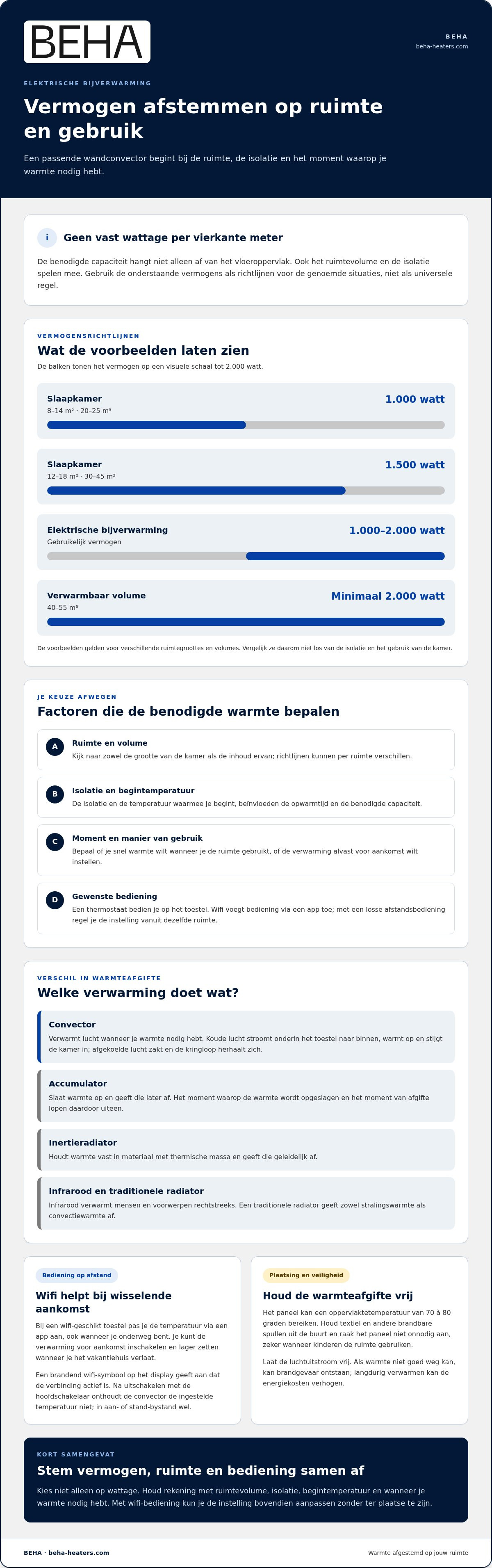
How many watts does a wall convector require per square meter? There is no fixed wattage per square meter that applies to every room. The required capacity also depends on the room volume and insulation. As a guideline, the market recommends 1,000 watts for a bedroom of 8-14 m² and 20-25 m³; for 12-18 m² and 30-45 m³, it is 1,500 watts.
Compare models not only on power output, but also on operation. With a standard thermostat, you set the temperature on the unit itself. Wi-Fi adds control via an app; a separate remote control allows you to adjust the settings from the same room. Consider in advance whether you want to control the heating locally or operate it remotely as well.
After pairing, a continuously lit Wi-Fi symbol on the display indicates that the connection is active. If the connection is lost after you unplug the device, reset the unit and pair again when the Wi-Fi symbol flashes rapidly. You switch off Wi-Fi by holding down the power button until you hear a long beep. A convector remembers the set temperature when it is on or in standby mode, but not when you switch it off with the main switch.
Wi-Fi control is particularly helpful when arrival times vary: you adjust the settings without operating the heating on-site. To make the right choice, weigh room size, insulation, and desired control together. See how Wi-Fi-enabled electric heating can support remote control.
Electric heating as supplementary heating in a holiday home
Electric supplementary heating provides warmth where you need it, for example in a bedroom. Whether a wall convector is suitable depends on the usage, the room, and the existing heating.
Electric heaters for various rooms
An electric heater can provide supplementary heating to a cold room without heating the entire holiday home. A convector heats the air; infrared heating focuses on people and objects. Electric heating plugs into a socket and makes no noise. The required capacity depends on the size and insulation of the room.
For supplementary heating, a power output of 1,000 to 2,000 watts is common. A unit of at least 2,000 watts is specified for a heatable volume of 40-55 m³. Electric heating differs from central heating, where a boiler circulates water through radiators. For instance, an electric wall convector can provide heat only in the room you are using.
Frost protection for a vacant holiday home
Which wall convector helps with frost protection when the holiday home is vacant? Choose a unit with a thermostat that allows you to set a low temperature and match the output to the room. The insulation and the room also determine how much heat is needed.
A thermostat regulates the set temperature; Wi-Fi control allows for remote adjustment on compatible models. Adjust the setting according to your absence and arrival. A convector remembers the temperature in on- or standby mode, but not after you switch it off with the main switch. Therefore, do not leave the unit completely unplugged if you want to retain the setting.
Safe installation and connection
What rules apply to electric heating and connection in a Dutch holiday home? Follow the appliance's operating and connection instructions and take the electrical connection in the home into account. The required power and other connected appliances together determine the load on the power supply.
How do you safely install a wall convector? Choose a sturdy wall location, follow the mounting instructions, and keep the air inlet and outlet clear. Do not place curtains or textiles against the unit. For a bathroom, the distance to the bath or shower is important: according to the mentioned guideline, a minimum IP21 rating applies to an electric convector starting from 60 centimeters in Zone 3. Carefully match the location and connection to the room.
Heating for bathrooms, bedrooms, and small spaces
Select heating per room based on usage, dimensions, and desired temperature. In a bathroom, also take into account the distance to water and the placement of the appliance.
Suitable for bathrooms and bedrooms
For a bedroom of 8-14 m² and 20-25 m³, the guideline specifies a heating capacity of 1,000 watts. For 12-18 m² and 30-45 m³, this is 1,500 watts. Use these examples to compare the required capacity with the volume and insulation of your room.
In the bathroom, the location is crucial. In zone 3, a minimum IP21 rating applies to electric convectors from 60 centimeters away from the bath or shower cabin. Position the unit appropriate for the zone and adjust the temperature setting to the time you use the room.
Heating for small spaces
For a compact room, output is important, but so is how quickly you need heat. Electric radiators up to 1,000 watts are recommended for rooms up to 14 m²; units from 1,001 to 2,000 watts for rooms up to 22 m². View these recommendations as a guideline and also take into account the room volume and insulation.
A thermostat helps maintain the desired temperature. This way, you heat the room when you use it, without changing the setting for the entire holiday home.
Moving heating between rooms
Some electric heaters are portable and can be moved to another room. This is practical if you want warmth in the living room during the day and in the bedroom later. A wall-mounted convector is intended for a fixed location; electric convectors are also available as freestanding units.
Only move a portable device when it is safe to do so, and leave space around the air intake and outlet. This allows the warm air to distribute and prevents furniture or textiles from obstructing its operation.
Application per dwelling and room
The appropriate heating system varies from holiday home to holiday home. A well-insulated bedroom requires a different approach than a drafty bathroom or a larger living space. Therefore, consider the room size, ceiling height, insulation, and how often you use the space. Together, these factors determine the appropriate capacity and type of heating.
For localized heat, you can opt for electric supplementary heating; a wall-mounted model is suitable for a fixed location, while a portable unit can be moved between rooms. Check out the fan heater for quick heat if you want to provide targeted heat in a room.
BEHA: Smart convectors steel front
BEHA sells smart convectors with steel fronts for rooms where you want to precisely control electric heat. You operate them via Wi-Fi and the BEHA Smart App, allowing you to adjust the temperature even when you are on the go. This lets you tailor the heating of your holiday home to your arrival and usage.
The choice depends on the room and your preference for the finish. In addition to a steel front, there are smart convectors with a glass front and with a paintable front. Classic convectors offer an alternative when control via Wi-Fi is not the primary consideration. Compare the options with what you need in, for example, the bedroom or bathroom, and take into account space, insulation, and desired operation.
Would you like to determine which version suits your holiday home? Contact BEHA to discuss the possibilities.
Make your choice to suit your stay
You shouldn't choose a wall convector for your holiday home based solely on the room. Also consider the layout, the desired controls, and whether you want the heater to be visible. This way, your choice aligns with both daily use and the interior.
BEHA offers smart convectors with steel, glass, and paintable fronts. First, determine which finish suits your interior and whether Wi-Fi control is important to you. Then, check which version is suitable for the room you want to heat. The layout and usage can vary from room to room, so tailor your choice accordingly.
Would you like to further tailor your choice to the holiday home? Contact BEHA and discuss which convector suits your needs. This way, you take the next step towards a heating solution that matches your accommodation.
Frequently Asked Questions
What is the best heating for a holiday home?
The appropriate heating depends on how you use the holiday home. For a room you use occasionally, supplementary electric heating can provide warmth without heating the entire house. With regular use, the insulation and heating needs of the home also play a role. First determine which rooms need heat and when, and then choose the type of heating.
What is the power consumption and cost of an electric heater?
You calculate consumption in kilowatt-hours by multiplying the power in kilowatts by the number of hours of use. A 2-kilowatt heater consumes 2 kilowatt-hours for one hour of heating. Your own tariff determines the costs.
What is a wall convector and how does it work in a holiday home?
A wall convector is an electric heater that hangs on the wall and circulates air through the room. The heating element heats the air, which is then distributed from the unit. A wall convector for a holiday home can be suitable if you want heat in a fixed location, for example in a bedroom that you mainly use in the evenings.
Which wall convector is suitable for the size and insulation of my holiday home?
Choose the capacity based on the individual room, not just the total living area. A bedroom with a large window or exterior wall loses heat differently than a compact, well-insulated room. Consider the floor area, ceiling height, insulation, and window surface area. Compare this data with the capacity guidelines for the room and do not choose based solely on the model name.
What are the energy costs of a wall convector for a holiday home?
Energy costs depend on the power consumption, the heating duration, and your electricity tariff. Note how many hours the convector heats and multiply the consumption in kilowatt-hours by the price per kilowatt-hour on your energy bill. A thermostat regulates the set temperature, but consumption also depends on heat loss and how often you use the room.
How much energy does a wall convector consume compared to an infrared panel or heat pump?
An electric convector and an infrared panel use electricity but heat in different ways: a convector heats the air, while infrared heats people and objects. Therefore, compare appliances based on power output and operating time. A heat pump operates according to a different heating principle; consumption depends on the appliance and the circumstances. Without this data, a direct comparison of consumption is not meaningful.