
Wall convector with frost protection for storage rooms and technical rooms
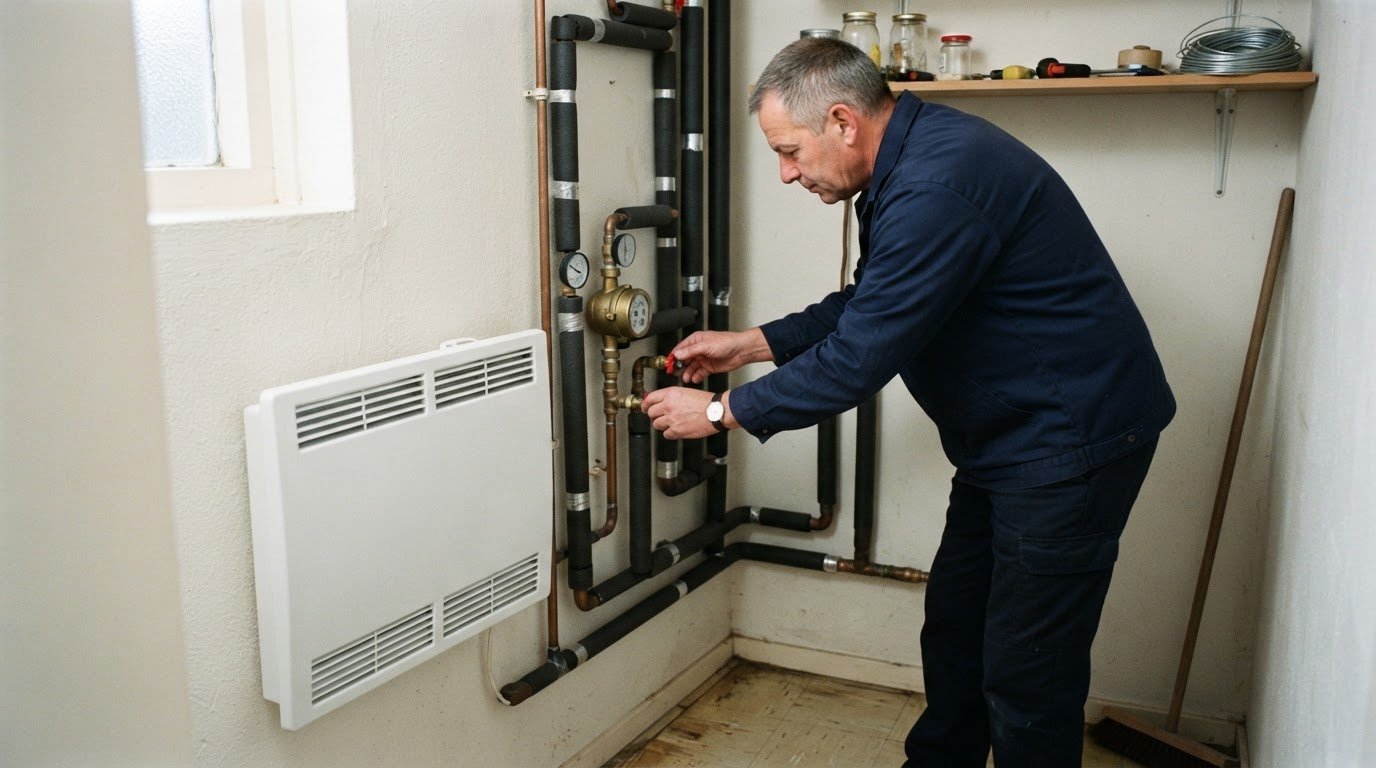
In a storage room or technical room, it is not just about heat, but also about limiting cooling. A convector heats the air, which rises while cooler air descends and is reheated. A wall-mounted convector with frost protection uses this air circulation to regulate the room temperature.
You want to know if such a heater suits the space and the practical situation. Below, you can read how a convector works and what to look for regarding price, weight, connection, and cord length. This way, you can assess what is needed for proper installation.
This gives you a clear picture of the key considerations for a storage room or technical room. You will read when a convector might be suitable and what influence the size and height of the room have on heat distribution.
Key points
- Assess whether the room and the desired temperature are suitable for heating with a convector.
- Discover which factors to consider regarding purchase price and weight.
- When installing, pay attention to the connection and whether the cord length is practical.
- Compare the available wall-mounted models by front type and choose what suits your space.
Keeping technical rooms and storage areas frost-free
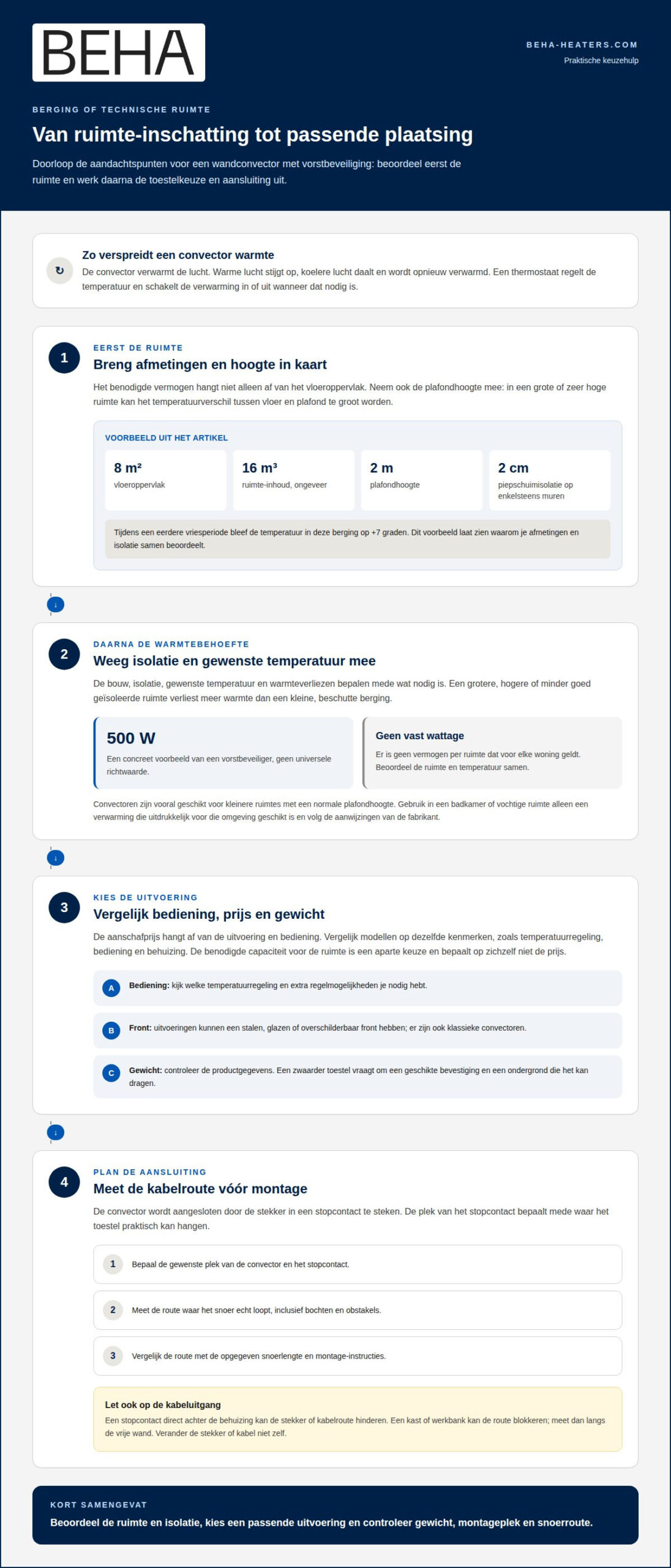
A convector heats the air, not objects directly. Warm air rises, while cooler air descends and is reheated. In this way, the heat spreads throughout the room. With a wall-mounted convector with frost protection, a thermostat regulates the temperature and switches the heating on or off when necessary. This can help keep a small storage room or technical room frost-free.
The required capacity does not depend solely on the floor area. Ceiling height, insulation, desired temperature, and heat losses also play a role. A described storage room of 8 m² has a volume of approximately 16 m³ and a ceiling height of 2 meters. The single-brick walls are insulated with 2 cm of Styrofoam. During a previous freezing period, the temperature inside remained at +7 degrees. This example shows why you assess space and insulation together.
There is no fixed wattage per room that applies to every home. A 500 W frost protector is a concrete example, but that capacity is not a universal guideline. A larger, taller, or less well-insulated room loses more heat than a small, sheltered storage room. Therefore, consider the dimensions, the construction, and the temperature you want to maintain.
Convectors are particularly suitable for smaller rooms with a normal ceiling height. In a very high or large room, the temperature difference between the floor and ceiling can become too great. For a bathroom or damp room, a separate point of attention applies: only use a heater that is specifically suitable for that environment. Follow the manufacturer's instructions for installation and use; moisture and electricity require care.
First determine the size of the space and assess the insulation. Then look at the power output and thermostat control. This way, you can make a more targeted choice for a solution for your storage room or technical room.
FROSTFREE monitors the room temperature with a thermostat and only operates the heating when necessary. The same applies to this solution: a high-ceilinged room is less suitable for convector heating.
Purchase price and weight
The purchase price of an electric convector depends on the model and controls. A simple model is not directly comparable to a version with additional control options. Therefore, in addition to the price, consider what you need, such as temperature control, controls, and a suitable housing. A thermostat monitors the set temperature and controls the heating.
Make the comparison concrete: first, note for which room you are choosing the appliance and which controls suit it. Then, compare models based on the same characteristics. This prevents you from comparing a cheaper appliance with a model that has different functions. The required capacity for the room is a separate choice and does not determine the price in itself.
The weight deserves attention, especially for wall mounting. A heavier electric convector requires suitable mounting and a surface capable of supporting the unit. The weight depends on the dimensions and construction of the model. Therefore, compare the product specifications of the versions you are considering, rather than estimating the weight based on appearance.
Also consider the practical implications of your choice. A compact model might fit better in a limited space, but the available wall space and placement must always be suitable. Check the stated weight before purchasing and tailor the installation accordingly. This way, you take both the price and the physical installation into account.
At BEHA you can view versions with a steel, glass, or paintable front alongside classic convectors. This choice helps you match the look to the room without losing sight of technical suitability. View the various convector models and compare which features are relevant for your application.
This data provides a concrete starting point for comparing versions. Additionally, pay attention to the properties you need and the suitability for the space.
A forum member mentions a price of approximately 30 to 40 euros for a small electric heater. Such a quoted amount is not directly comparable to the price of a convector: check which model and features are included in the offer. Take the stated price and recommended retail price into account in your decision-making, and also assess whether the device suits your requirements regarding operation, placement, and installation.
Connection and cord length
You connect an electric convector by plugging the plug into a socket. The location of the socket partly determines where you can practically place the unit. Therefore, first check which wall is suitable and how far it is from the connection point. This prevents the cable routing from becoming a problem after installation.
Measure the route from the appliance to the power outlet, along the actual path where the cord runs. Take corners, baseboards, and the mounting height into account. A straight distance to the outlet does not always provide enough room for the cable. Compare the measured route with the cord length listed with the appliance. This way, you know in advance whether the connection will fit without the cord being taut or awkward to run.
When installing, also check on which side the cable exits the convector. A socket directly behind the housing can obstruct the plug or cable routing. Depending on the space, a connection next to the unit is more practical. Follow the manufacturer's instructions for mounting and connection. Do not change the plug or cable yourself.
A useful preparation consists of three steps:
- Determine the desired location of the convector and the power outlet.
- Measure the cable route, including bends and any obstacles.
- Compare that route with the specified cord length and assembly instructions.
In a storage room, for example, a cupboard or workbench can block the direct cable route. Measure along the free wall and check if the cord can follow that route. Keep the cable tidy and prevent furniture from pinching the connection. Proper placement also makes the appliance easier to access and operate. Therefore, assess the connection and cord length as part of the overall setup, alongside the desired temperature control.
Wall convectors with frost protection
A frost protection setting is intended to protect a room against excessively low temperatures. When making your choice, pay particular attention to how the thermostat controls the heating.
Operation of the frost protection setting
A wall convector with frost protection uses a thermostat to monitor the room temperature. If the temperature drops below the set limit, the heating switches on. As soon as the temperature has risen sufficiently, the unit switches off again. This ensures that heat is only supplied when the control system deems it necessary. When making your choice, pay attention to the activation limit and the way the unit monitors the temperature.
Thermostat or frost protection
A thermostat regulates the temperature based on a selected setting. Frost protection is a specific application: the heating reacts to a low room temperature, not to a standard comfort setting. Some electric convectors can be operated manually or with a programmable thermostat. Therefore, check whether the unit has a separate frost mode or only an adjustable thermostat. These are not automatically the same functions.
Temperature during frost protection
The described frost protection device switches on automatically below 3 °C. This value is the activation limit, not a promise that the room will remain at exactly 3 °C. The temperature may change thereafter due to heat loss, insulation, and the conditions in the room. Therefore, evaluate the setting as protection against severe cooling, not as a control for a fixed comfort temperature.
Energy consumption of frost protection
Energy consumption depends on how long the convector needs to supply heat. In a well-insulated storage room, the temperature is generally maintained longer than in a room with significant heat loss. The thermostat switches off the heating as soon as the set limit is reached again. Therefore, the unit does not heat continuously, but consumption varies by room and usage situation. Insulation and the desired temperature also determine how often heating is required. A frost setting may be suitable for an unused room where you want to limit severe cooling.
BEHA
BEHA offers electric convectors in various designs. For a storage room or technical room, first choose the required heat, the desired control, and a practical location for the unit. Then compare which design suits the space and your preferences.
The range includes smart convectors with a steel, glass, or paintable front, in addition to Classic convectors. This allows you to choose from various looks and finishes, while suitability for the room remains paramount. Frost protection requires a separate check: pay attention to the temperature control you need and the features of the chosen unit.
Would you like to discuss your situation and the convector options? Contact BEHA.
Choose the solution that suits your space
Make your choice concrete: determine what temperature you want to maintain in the room and which control system suits that. A wall convector with frost protection is intended to limit severe cooling, not to heat every room as if it were a living space. Keep that goal in mind when comparing models.
Appearance can also be a factor. BEHA offers smart convectors with a steel, glass, or paintable front. This allows you to choose a version that matches your interior, without losing sight of the heating's purpose.
Would you like to discuss your choice for a storage or technical room? Discuss your options with BEHA and determine which convector best suits your situation.
Frequently Asked Questions
Convector heating: what is it and how does it work?
An electric convector heats the air in the room. Warm air rises, after which cooler air flows into the unit and is heated. This air circulation distributes the heat without directly heating objects. In a storage room, this can help limit temperature differences. Operation also depends on the room: with high ceilings or large dimensions, the heat may be distributed less evenly.
Which wall convectors with frost protection are suitable for Dutch homes?
A wall-mounted convector with frost protection is suitable provided the output matches the room and the desired temperature control. BEHA offers smart convectors with a glass front from 600 to 1250 W and with a steel front from 400 to 2000 W. For a bathroom, only the PGV/LGV series is designated as splash-proof with IP24. Choose the version based on the application and the room.
How much does a wall convector with frost protection cost in the Netherlands?
The price varies by model and power output. Therefore, compare the features that are important for your application, such as the controls and the type of front panel. The available space and desired operation also determine which model is suitable. This way, you assess the price in conjunction with what the device needs to do, rather than just looking at the purchase price.
How do you safely mount and connect a wall convector?
Install the unit according to the manufacturer's instructions and use the mounting hardware supplied with the model. BEHAconvectors are electric units that connect to a standard socket; a central heating boiler or piping is not required. Route the cord so that it is not pinched or damaged. For a bathroom, the PGV/LGV series has the IP24 rating.
How much wattage is needed for a wall convector per room?
There is no fixed wattage that applies to every room. The required power depends on, among other things, the dimensions, ceiling height, insulation, desired temperature, and heat losses; 500 W is an example, not a universal guideline.