
Wall convector with deactivatable child lock for home use

A child lock protects the controls without making settings unnecessarily complicated. With a wall convector featuring a switchable child lock, you lock the controls when necessary and deactivate the lock again when you want to adjust the temperature.
At home, you want both comfort and control. A wall-mounted convector heats a room through air circulation: heated air rises and sets the air in the room in motion. Which convector is suitable depends, among other things, on the room and the desired controls. Therefore, start by asking where you will use the device and how you want to manage the settings.
In this article, you will read what to look for when choosing a wall convector, how to estimate the required power, and what is important regarding installation and daily use. You will also discover how a child lock fits into a home heating system, allowing you to tailor the controls to your household.
Key points
- Match the capacity to the insulation and size of the room, and choose the placement taking into account cold exterior walls and windows.
- Take the total load into account when connecting multiple appliances to a single circuit.
- An appropriate temperature setting helps tailor the comfort to how you use the room.
- With adjustable programs, you can better align the heating with your daily rhythm.
Electric convectors for various rooms
An electric convector heats by means of airflow. The device heats air, which then rises and pushes cooler air downwards. In this way, the air circulates through the room. Comfort depends not only on the output, but also on the insulation, the room layout, and the desired temperature. Therefore, first determine which room you want to heat and how well it is insulated.
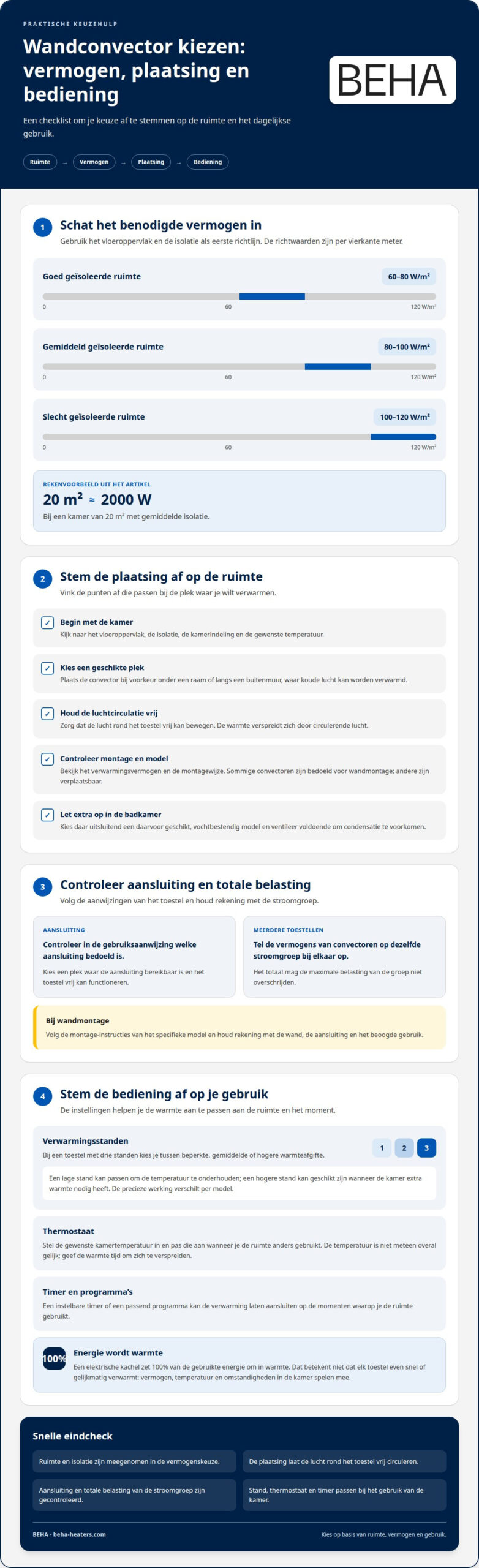
Use the floor area as the primary guideline for the required power. For a well-insulated room, approximately 60 to 80 watts per m² applies. With average insulation, this is approximately 80 to 100 watts per m². A poorly insulated room requires 100 to 120 watts per m². According to the calculation example, a 20 m² room with average insulation requires approximately 2000 watts. Therefore, check whether the heating capacity matches the room.
Not every electric convector is automatically suitable for every room. In a bedroom, usage times and desired temperature play a role. For a living room, consider the surface area and insulation. Preferably, place a convector under a window or along an exterior wall, where it can heat cold air before it moves further through the room. Keep the air circulation around the unit clear.
Some electric convectors can be mounted on the wall. Other electric convector heaters are portable, allowing you to take them to another room for extra heating. When choosing, look at the product specifications, especially the heating capacity and the mounting method. The available data does not provide specifications for the Benson convector heater; therefore, a substantiated comparison of that model is not possible.
If you want to choose a wall convector with a switchable child lock, first assess where the unit will be installed and what power output is appropriate. Combine multiple models only if each unit is suitable for the room it heats. For a humid bathroom, a suitable, moisture-resistant model is important; ensure sufficient ventilation to prevent condensation. This way, you tailor your choice to the room, the placement, and daily use.
Installation via mains electricity or socket
Check the user manual to see which connection is intended for the appliance. Therefore, choose a location where the connection is accessible and the appliance can function freely. When wall-mounting, follow the mounting instructions for the specific model. This way, you take the wall, the connection, and the interior into account.
If you use multiple convectors, add up their power ratings. The total power on a single circuit must not exceed the maximum load of that circuit. Two devices on the same circuit therefore require attention to their combined load. A suitable distribution prevents overloading of the circuit.
Electric heating works differently from central heating: a convector heats the room in which the unit is located, whereas a central heating system distributes heat via a central installation. As a result, an electric convector can serve as local supplementary heating, for example in a home office that you use temporarily. Even in a room with central heating, electric supplementary heating can provide extra heat when you need it.
Are there Dutch regulations or quality marks for electric wall convectors? Consult the product markings and user manual for the intended application and installation. In a humid bathroom, choose only a suitable, moisture-resistant model and ventilate sufficiently to prevent condensation. I cannot responsibly mention a general quality mark requirement or specific Dutch regulation number here.
When installing, keep the connection, the wall, and the intended use in mind. This allows you to distinguish between a unit for permanent installation and an electric convector used as supplementary heating. If you would like to explore the possibilities for wall heating, discover the electric wall convectors that suit your space.
Heating speed and adjustable temperature
How quickly a room heats up depends on the power output, the set temperature, and the room's heat demand. Therefore, do not look only at the heat output, but also at the controls used to regulate the heat.
Heating speed and heat settings
With an appliance featuring three heating settings, you can choose between limited, medium, or higher heat output. The low setting may be suitable for maintaining the temperature; a higher setting is appropriate when the room requires extra heat. The precise operation varies by model. Therefore, compare the available settings and read how the appliance distributes the heat.
A convector heats air, which then rises and circulates through the room. As a result, the temperature does not rise everywhere at the same time. Measure or assess the heat where you are sitting, not just right next to the unit. Electric heaters are designed for various usage situations, but the heating speed also depends on the room's heating requirements.
Setting power and thermostat
The output determines how much heat the appliance can emit; the thermostat helps regulate the desired room temperature. Set the temperature to the comfort level you are looking for and adjust it when you use the room differently. The thermostat setting does not mean that every spot in the room will immediately have the same temperature. Give the heat time to spread.
An electric heater converts 100% of the energy used into heat. This does not mean that every device heats equally quickly or evenly. The set power, the temperature, and the conditions in the room together determine how it feels. A convector remembers the set temperature when the device is switched on or in standby mode. After being switched off with the main switch, it returns to the default value when switched on again.
An adjustable timer can help tailor the heating to the times you use the room. Choose a program that fits your daily routine and prevent the appliance from heating unnecessarily. Check how the timer works with the thermostat and the heat settings. This way, you control both the desired temperature and the times when heat is available.
Energy-efficient features and weekly programs
A weekly program adjusts the heating at fixed times, for example on weekdays and weekends. This way, a heater does not have to constantly run at the same temperature.
Energy consumption and potential savings
Start with the times when you use a room. For a home office, for example, set a program that aligns with your workdays, if the device has that function. A lower setting outside of usage hours can limit energy consumption. The potential savings depend on the set temperature, the duration of use, and the heat loss of the room.
With a smart convector and app control, you can adjust settings remotely. With models that work via an app, you do not need to stand next to the unit to operate the heating. First, create a simple weekly schedule: note when you are at home and when the room is empty. Then, adjust the settings to those times.
Energy consumption and efficiency
Compare consumption based on the power output and the time the heater emits heat. Higher power does not automatically mean higher total consumption; the duration of use and the selected temperature also play a role. Therefore, evaluate the settings in conjunction with the use of the room. This way, you look at actual usage and not just the name of a program.
A convector heats air: warm air rises and cooler air moves back towards the unit. Keep the airflow clear and ensure that furniture does not block the convector. This allows the heat to spread throughout the room. Remove dust and keep ventilation openings clear so that the unit can function properly.
A weekly schedule works best when the times align with your daily rhythm. For example, choose different heating times for a guest room than for an office you use every workday. After making changes, check whether the room is comfortable at the desired times. Adjust the times and temperature to your routine as needed.
BEHA
BEHA offers electric convectors for various spaces and control preferences. The range includes smart convectors with steel, glass, or paintable fronts, and Classic convectors. This allows you to compare models based on appearance and desired functionality.
The required heating capacity, placement, and operation play a role in your choice. If you want to control settings via an app, smart convectors are a suitable category to consider. If you are primarily looking for a different design, you can compare the front-facing versions with Classic convectors. A child lock and the option to disable it depend on the operation of the specific unit; therefore, base your choice on the product information.
Contact BEHA to discuss your requirements for a convector.
Choose a service that suits your home
Choose based on daily practice: who operates the heating and when do you want to adjust settings? With a wall convector with a deactivatable child lock, it is important that the controls suit your household. Review the product information and determine which features are important to you.
Appearance can also be a factor. BEHA offers smart convectors with a steel, glass, or paintable front. This allows you to choose a version that suits your interior, without losing sight of the controls.
Would you like to discuss your preferences regarding operation and design? Contact BEHA and take the next step towards the right heating choice.
Frequently Asked Questions
Which wall convectors have a switchable child lock?
Choose a wall convector whose product information explicitly states that the child lock is present and can be deactivated. This is different from control via an app or Wi-Fi. Check which device supports the lock and how that function works. This way, you will know if you can block operation and deactivate the lock later.
How do you switch the child lock on a wall convector on and off?
The operation varies by model, so there is no universal key combination. Follow the instructions for the specific device and pay attention to the symbol or message indicating that the control is locked. Disable the lock according to the model instructions before changing settings. This way, you will not confuse the child lock control with a Wi-Fi or on/off function.
How much does a wall convector with a switchable child lock cost in the Netherlands?
The price depends on the design, capacity, and operating options. For example, a wall convector with a glass front may be priced differently than a version with a steel or paintable front. The chosen model also plays a role. Compare the specifications of models that suit your space: the purchase price alone does not indicate whether the controls meet your requirements.
What is the difference between a child lock and key lock on wall convectors?
The terminology may vary by manufacturer. A child lock typically blocks operation to prevent unwanted changes. Keypad lock usually describes blocking control buttons. Check the chosen device to see exactly which functions are locked and how to deactivate the lock. This way, you know whether the temperature settings remain protected without assuming that every function works the same way.
How much electricity does a wall convector consume and what does that cost per hour?
Power consumption depends on the output and the time the appliance emits heat. A 400-watt appliance consumes 0.4 kWh for one hour at maximum power; at 2000 watts, this is 2 kWh. You calculate the costs by multiplying the consumption in kWh by your electricity rate. The thermostat can influence actual consumption because the appliance does not heat at full power continuously.
What safety features do wall convectors have for use in a family with children?
A child lock helps prevent children from adjusting the controls, but it does not replace careful use or proper placement. Some electric convectors have overheat protection; check which features apply to the specific unit. Keep the air vents clear and follow the operating instructions for installation and operation. Position the unit so that children cannot unintentionally reach the control buttons during normal play.