
Which convector heater suits your attic?
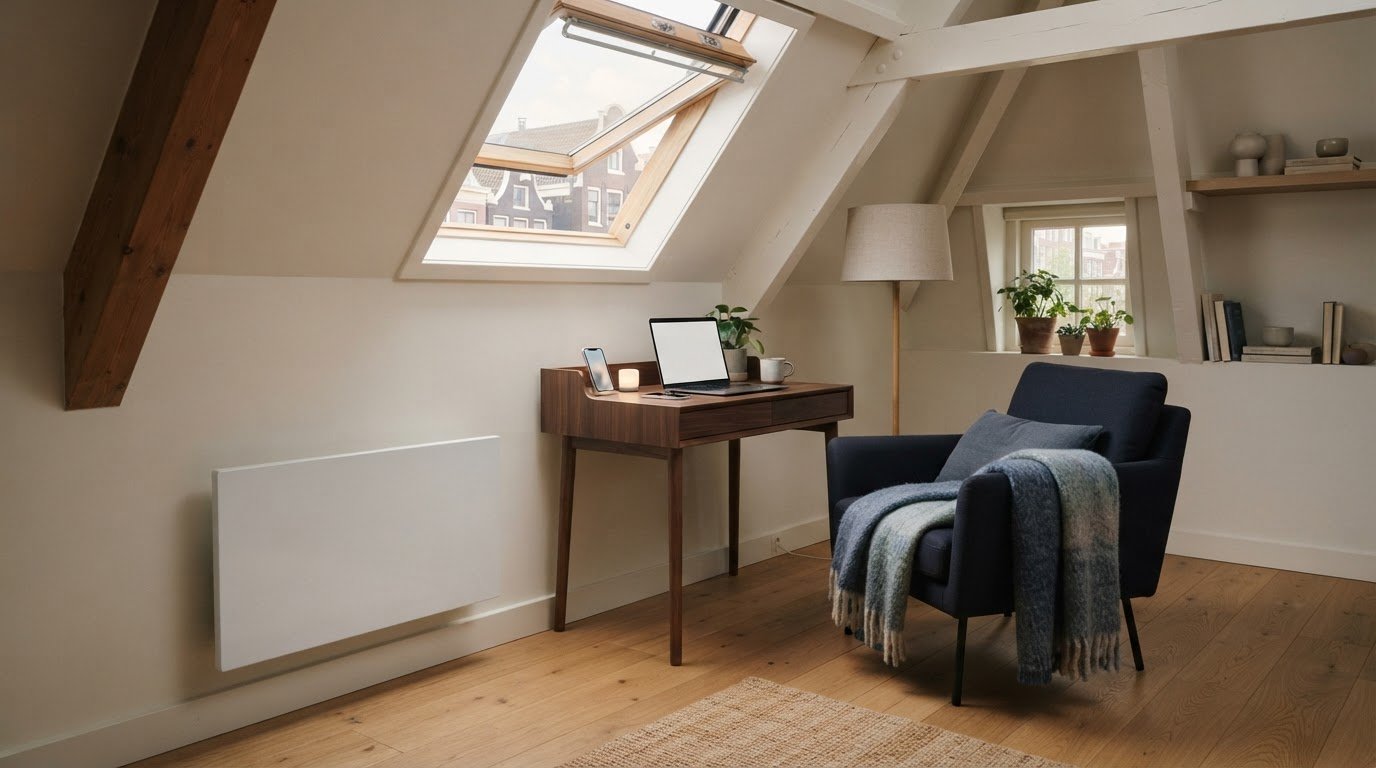
You don't always need to heat the entire attic to make it comfortable. Convector heating for the attic is particularly suitable for a small space or an attic room that you use occasionally. You regulate the temperature with the thermostat; with a smart convector from BEHA you can also adjust it via Wi-Fi and the BEHA Smart App.
Which convector heater is suitable for the attic depends on how you use the space and which part you want to heat. Do you use the room as a bedroom, workspace, or hobby room? This helps determine whether a convector that heats the room air is suitable, or whether targeted heat better suits your needs.
In this article, you will read what to look for when purchasing and how to compare an electric panel, Wi-Fi control, and targeted heating. You will also discover what to consider in a small space and how to tailor your choice to the use of your attic.
Key points
- Choose the heating based on how you use the attic: a bedroom, workspace, and storage each require a different approach.
- A panel with Wi-Fi control is handy when you want to adjust the temperature remotely.
- With a thermostat, you set a desired temperature; for an attic storage room, for example, that could be 10 degrees.
- Electric convectors are particularly suitable for smaller attic spaces and rooms that you heat occasionally.
- Compare electric heating with central heating, taking into account the use of the space and the existing heating system.
Points to consider when purchasing
The best choice depends on how you use the attic, which part you want to heat, and how often you do so. Therefore, when comparing convector heating for the attic, compare not only the units but also the locations and times when you need heat.
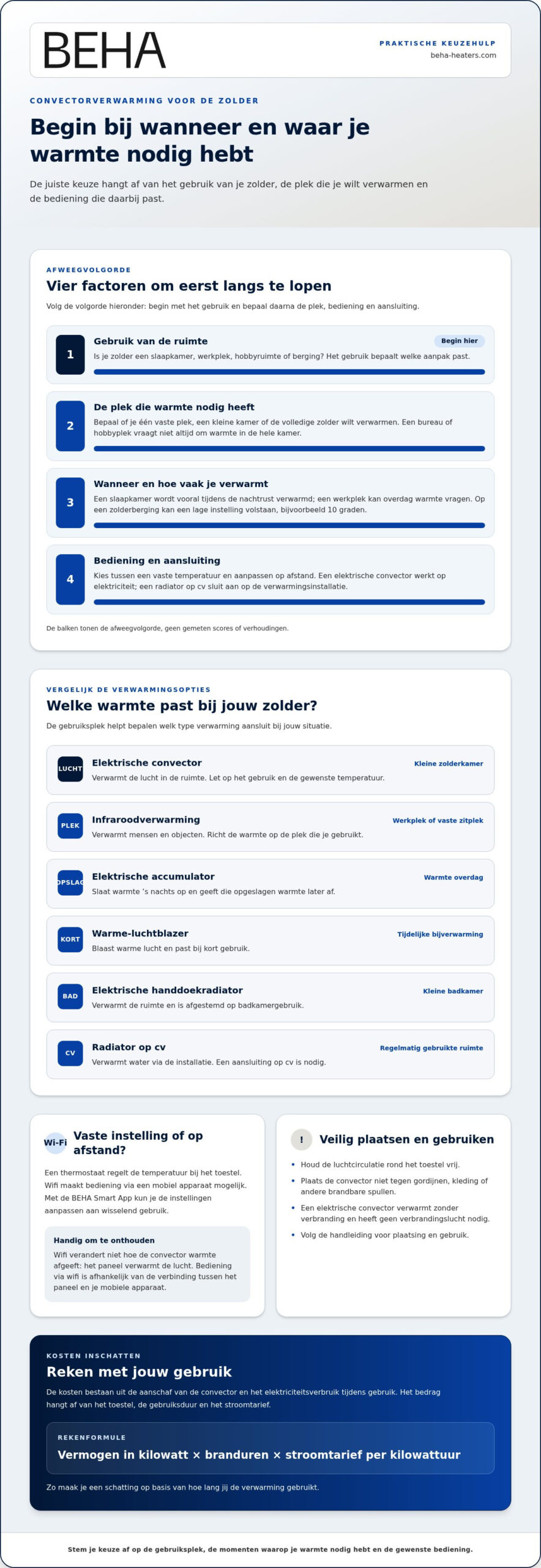
Start with the usage schedule. A bedroom is heated primarily during the night, while a workspace may require heat during the day. A low temperature may suffice for an attic storage area; an electric convector, for example, can be set to 10 degrees. If you are only heating a desk or hobby area, it can cost unnecessary energy to heat the entire room.
- Room: decide whether you want to heat a single spot, a small room, or the entire attic.
- Usage: note when you use the space, for example to sleep, work, or store items.
- Controls: choose whether you want a fixed setting or to adjust the temperature remotely.
- Connection: electric convectors operate on electricity; a central heating radiator connects to a heating system.
| Option | Suitable for use | Heat output | Point of attention |
|---|---|---|---|
| Electric convector | Small attic room | Heats air | Usage and desired temperature |
| Infrared heating | Workplace or fixed seating | Warms people and objects | Direct the heat at the used spot |
| Electric accumulator | Heat during the day | Stores heat at night | Releases stored heat later |
| Hot air blower | Temporary supplementary heating | Blows warm air | Suitable for short-term use |
| Electric towel radiator | Small bathroom | Heats the room | Designed for bathroom use |
| Radiator connected to central heating | Regularly used space | Heats water via the system | Connection to central heating required |
First, choose a heater that suits the location and the times when you need heat. Then, determine which controls and electrical connection are suitable for your attic.
Safety risks and ventilation requirements
An electric convector heats without combustion and therefore does not require combustion air. Keep the air circulation around the unit clear and do not place it against curtains, clothing, or other flammable materials. A convector heats the air, whereas infrared heating heats people and objects. Follow the unit's manual for placement and use.
Cost of an electric convector
The costs consist of the purchase of the convector and the electricity consumption during use. The amount depends on the unit, the duration of use, and the electricity tariff. Therefore, compare models based on features and calculate the consumption using: power in kilowatts × operating hours × electricity tariff per kilowatt-hour. This allows you to make an estimate based on your usage.
Compare options for convector heating in the attic based on location, duration of use, and desired temperature. Note whether you use the attic as a bedroom, workspace, or storage. Then determine whether you want to heat the entire room or just a specific spot. This way, you tailor your choice to the daily use of the space.
Convector panel with Wi-Fi and remote control
With a smart convector from BEHA , you control the heating via Wi-Fi and the BEHA Smart App. This is practical when you do not use the attic room constantly: you can adjust the settings before going upstairs, instead of heating the room at the same setting all day long.
Remote control does not change how a convector emits heat: the panel heats the air in the room. Wi-Fi primarily makes it easier to adjust the settings. An attic that serves as a workspace during the day requires a different approach than a guest room that you use occasionally. With the BEHA Smart App, you tailor the settings to that usage.
When making your choice, pay attention to the difference between a Wi-Fi function and a standard thermostat. A thermostat regulates the temperature at the unit; Wi-Fi enables control via a mobile device. These functions are not the same. First, determine whether you want to make regular adjustments remotely or if a fixed setting is sufficient for your attic. This way, you won't choose a control method you rarely use.
- Map out the usage: note when you use the attic room, for example as a workspace during the day.
- Determine where you want to control it: choose Wi-Fi when you want to set the temperature with a mobile phone or tablet.
- Compare the controls: see if you mainly want a fixed temperature or want to adjust it regularly remotely.
- Consider the connection: operation via Wi-Fi depends on the connection between the panel and your mobile device.
A smart convector with Wi-Fi is particularly suitable for an attic with variable use, such as a hobby room that is sometimes used for a whole afternoon and sometimes stands empty. With the BEHA Smart App, you adjust the settings when you need the space. For a storage room that you rarely use, a simple setting may suffice. Wi-Fi provides extra ease of use, not a different type of heat.
Also consider the location of the panel. The heat must be able to spread throughout the attic room; placement behind furniture can impede air circulation. Clear space for the unit in advance and decide from where you want to control the temperature. This way, you take advantage of the convenience of Wi-Fi without an awkward setup.
If you want to factor control via a mobile phone or tablet into your choice, compare the Wi-Fi control of convector panels with a panel without remote control. Choose based on your attic routine: the more frequently usage changes, the more useful remote adjustment can be.
Convector heating with thermostat
A thermostat helps an electric convector maintain the attic at a set temperature. This is useful in rooms where you want a constant temperature, such as a bedroom or storage room. The correct setting depends on the usage: a bedroom requires something different than a place where you store belongings.
Start with the purpose of the heating. If you use the attic only for storage, the thermostat can be set to 10 degrees, for example. If you use the space as a bedroom, a temperature between 14 and 17 degrees may suffice during the night. These examples provide a starting point; above all, determine which temperature suits the use of your room.
A thermostat measures the temperature and controls the heating based on the set value. This way, you do not have to constantly switch the convector on and off manually. A thermostat is useful if you use the attic regularly and want a constant temperature. If you only use the space occasionally, first determine at what times heat is needed.
- Select the use: note whether the room is a bedroom, storage room, or workspace.
- Determine the setting: use 10 degrees as an example for a storage room and 14 to 17 degrees as an example for a bedroom during nighttime rest.
- Choose the location: do not place the thermostat behind a cabinet or curtain, so that the reading better reflects the room temperature.
- Monitor the result: after use, check whether the set heat suits the room and your comfort.
The location of the panel affects the reliability of the temperature measurement. Choose a spot where air can circulate freely and keep the immediate surroundings open. If the device is placed next to a window or behind furniture, the measured temperature may not correspond as well with that in the rest of the room. Therefore, pay attention not only to the thermostat but also to the available wall space.
A thermostat does not determine which part of the attic you heat. If you only sit at a desk there, it may not be necessary to keep the entire room at the same temperature. If you use the entire space as a bedroom, a convector can help maintain the room at a set temperature. The function of the room determines which setting is practical.
When purchasing, compare how to set the temperature and how clearly it is displayed. Simple operation suits a fixed setting; additional control options are useful if you change settings frequently. Choose a thermostat that fits your routine: a fixed setting may suffice in a storage room, while in a bedroom you primarily consider the desired comfort during the night.
Electric convectors for small attic spaces
An electric convector can be suitable for a small attic room that you use occasionally. It heats the air and emits convection heat. An infrared panel heats people and objects. A radiator can be electric or run on a central heating system; therefore, the heat source and connection differ by type.
For a bedroom, what matters most is when you need heat. If you only use the attic for sleeping, a temperature between 14 and 17 degrees may suffice. A workspace requires heat at the times you are sitting there. If you only heat a desk, it can cost unnecessary energy to bring the entire room up to temperature.
There is no fixed wattage per square meter that is suitable for every attic. The required power depends on, among other things, the insulation, ceiling height, size of the room, and desired temperature. A well-insulated small room requires a different calculation than a high, moderately insulated attic room.
First, calculate the floor area and volume: length × width × height. Next, note how well the room is insulated and what temperature you want to achieve. Use this data to compare the convector's capacity with the room's heat requirement. The floor area alone does not provide a complete picture, as a high ceiling means more air volume.
- Usage: determine whether you heat the entire attic room or only a fixed spot.
- Insulation: note where heat can escape, such as through the roof or walls.
- Space: include both floor area and ceiling height.
- Temperature: choose the desired setting based on bedroom, workspace, or hobby room.
Calculate the monthly electricity costs using the power in kilowatts × operating hours per day × usage days × your electricity rate per kilowatt-hour. Without the power, usage duration, and rate, no suitable monthly amount can be determined. A convector that is switched on for a short time consumes differently than a device that heats for extended periods daily.
A subsidy for electric attic heating is not automatic. When considering a scheme, look closely at the specific measure: insulation and the purchase of an electric convector are different things. The conditions depend on the scheme and the home. Therefore, do not automatically assume that you will receive reimbursement for the heating device.
Install the convector according to the appliance's manual and ensure unobstructed air circulation around the panel. For example, do not place clothing, curtains, or furniture directly in front of it. A power outlet is usually sufficient for electric convectors in the attic, so no drilling or breaking work is required. Use the appliance according to the manufacturer's instructions.
For a small space, do not compare only the output. Also consider the operating time, desired temperature, ceiling height, and insulation. Targeted infrared heating may be suitable for a fixed workstation; for a small room that needs to be heated as a whole, a convector is a more logical choice.
Which convector heating is suitable for an attic: electric or central heating?
For an attic that you heat occasionally, an electric convector is often a practical choice. A radiator connected to the central heating system is more suitable if the attic is part of an existing heating installation. The right option depends on how often you use the attic and which heat source is already present.
An electric convector runs on electricity and emits convection heat. You need a suitable power connection, but no central heating pipes to the attic. This makes this type of heating suitable for an attic room that you do not heat continuously. A convector can heat the entire room, whereas infrared heating provides targeted heat to, for example, a workspace.
A radiator connected to a central heating system emits heat via the central heating installation. This water is heated by the boiler, which can operate on gas, fuel oil, or electricity. If the boiler is located in the attic, new radiators can be connected to the existing system. If the boiler is located in the garage, attic radiators are connected to the system on the floor below the attic.
| Choice | Heat source | Fits especially well with | Practical point of attention |
|---|---|---|---|
| Electric convector | Electricity | Heat occasionally | Power connection required |
| Radiator connected to central heating | Heated water | Connection to existing central heating | Piping and installation determine the connection |
| Infrared panel | Electricity | Targeted heat in a spot | Warms people and objects |
Compare not only the appliances, but also how you use the attic. For a bedroom that you heat daily, connecting to the existing central heating system may be logical. For a hobby room that you only use occasionally, electric supplementary heating may be more practical. If you mainly use a single workspace, infrared heating can deliver heat more directly.
Make your choice with these steps:
- Inspect the existing installation: determine where the boiler is located and whether the attic already has central heating pipes.
- Record usage: distinguish daily use from occasional heating.
- Select the heated zone: decide whether you want to heat the entire room or just a specific spot.
- Compare the connection: weigh an electrical connection against a connection to central heating.
Choose a heating method that suits your attic and usage pattern. An electric convector is suitable as supplementary heating for rooms you heat occasionally. A radiator connected to the central heating system is a more logical choice if the existing installation can reach the attic and you use the space regularly.
BEHA: Smart convectors steel front
BEHA offers smart convectors with steel fronts for attic rooms where you want to combine heating and remote control. You operate these convectors via Wi-Fi and the BEHA Smart App. This allows you to tailor the heating to the use of your attic, for example as a workspace or bedroom.
BEHA also offers smart convectors with a glass or paintable front. If you prefer a simple solution, there are Classic convectors. Compare the models based on operation and appearance, and tailor your choice to the room and your daily use. Wi-Fi is handy if you want to adjust settings remotely; a Classic convector is suitable if you do not need that control.
View the smart convectors from BEHA and find a dealer to choose the model that suits your attic.
Prepare your choice for daily use
Choosing convector heating for your attic is also an opportunity to incorporate the room's aesthetics. Consider the placement of the unit and how the front fits your interior. BEHA offers smart convectors with steel, glass, or paintable fronts. This allows you to choose a version that matches the atmosphere of your attic room.
Determine what suits your preference: a glass front, a steel finish, or a front that you can repaint. Link that choice to the use of the room to select a more suitable heating system. Start with what is most important for your attic, such as appearance or operation.
View the convector options and discuss which model suits your situation. Ask BEHA for personal advice and take the appropriate next step towards a more comfortable attic.
Frequently Asked Questions
How do you choose the right radiator?
Choose a radiator that suits the space, the heating requirements, and how you use the attic. Check whether a sloping roof limits the available space and whether furniture might obstruct airflow. A convector is suitable if you want to heat the entire room; for a fixed workspace, targeted heat may be more practical. Also take into account the heat source and the available electrical connection or central heating pipes.
Why a radiator in the attic?
A radiator makes an attic more usable as a bedroom, workspace, or hobby room. Without heating, the space can be less pleasant to use for extended periods on cold days. Consider, for example, a guest room that is used regularly, or a workspace where you sit in the winter. Tailor the heating to the purpose of the room: a storage attic requires something different than a living space used daily.
What is the best attic heating?
The best choice depends on which part you want to heat and how often you use the attic. An electric convector heats the room air and is suitable when you use the space as a whole. For a desk or fixed seating area, infrared heating can provide targeted heat. If the attic already has a connection to the central heating system, a radiator connected to that system could be an option. Therefore, compare the heat source with your usage.
Which thermostat and controls are suitable for convector heating in the attic?
A thermostat is useful if you want to maintain a set room temperature. For variable usage, Wi-Fi offers extra convenience: with the BEHA Smart App, you can control a smart convector remotely. The app offers features such as weekly schedules and a vacation mode. For example, set a schedule for workdays and adjust it if you are temporarily not using the attic.
Is convector heating suitable as primary heating for an attic?
Yes, a convector can serve as primary heating provided the unit supplies sufficient heat for the attic space and daily use. The required capacity depends on the insulation, the volume of the room, and the desired temperature. A well-insulated home office requires a different approach than a high attic with significant heat loss. Therefore, assess the entire space, not just the floor area, before choosing a unit.
What are the monthly electricity costs of a convector in the attic?
Calculate the electricity costs using the power in kilowatts × the number of operating hours per month × the electricity rate per kilowatt-hour. The costs depend on the appliance and how long you use it.