
White electric radiator: everything about style, comfort, and efficiency in 2026
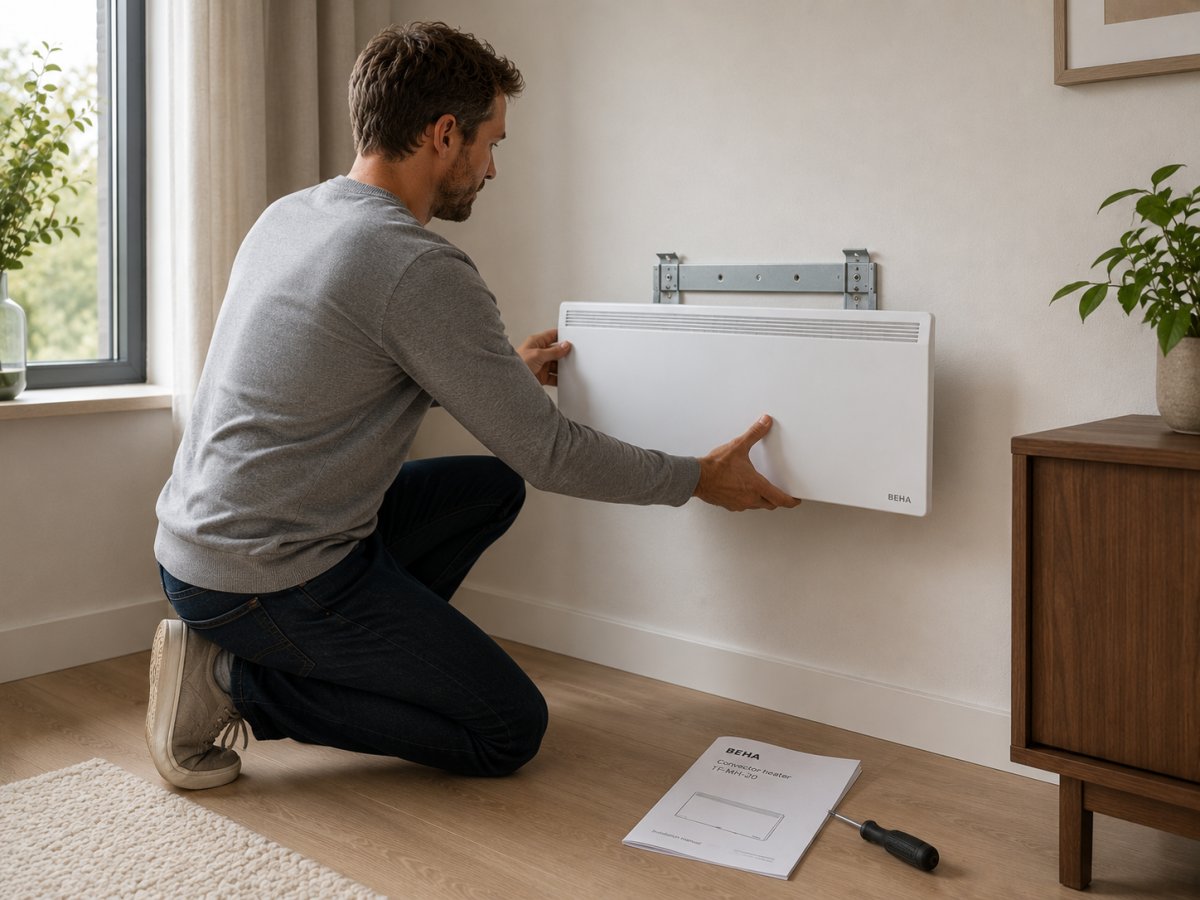
A white electric radiator combines focused heat with a calm, timeless appearance. But color alone does not make a good choice. The right output, thermostat, front panel type, mounting location, and IP rating determine whether a unit truly suits your room. In this buying guide, you compare the key options for homes in Belgium and the Netherlands, including steel, glass, Wi-Fi, bathroom use, and consumption.
Key points
- First select the required power and technical suitability; then evaluate color and design.
- An electric convector with natural air circulation operates without a fan and is therefore suitable for quiet living and sleeping areas.
- White is not always the same white: matte, glossy, and glass look different, and you should not assume a RAL code without a product specification.
- Wi-Fi and a weekly program do not reduce the maximum wattage, but they do help to heat only when necessary.
- For a bathroom, the exact model must have a suitable IP rating and be correctly installed within the electrical zones.
Why choose a white electric radiator?
White suits almost every interior style and allows a heater to blend in visually more smoothly against a light wall. As a result, a white radiator is suitable for a living room, bedroom, home office, hallway, or holiday home. On a dark wall, however, a bright graphic contrast is created.
The search term encompasses various products. A wall convector heats primarily through natural air circulation. An electric panel radiator can emit more radiant heat. An electric towel radiator is primarily designed for the bathroom and for drying or heating textiles. Do not compare these devices solely on color or wattage: their application and heat experience differ.
When is electric heating a logical choice?
A white electric radiator is particularly practical when you want to control a single room independently, do not want to install central heating pipes, or only need heat at specific times. Think of a home office, bedroom, extension, or well-insulated studio. For permanent primary heating of an entire, moderately insulated home, a heat loss calculation and comparison with, for example, a heat pump is recommended.
White as a calm base
A white appliance usually stands out less against a white or light-colored wall. However, pay attention to the undertone and gloss level. Cool white, warm white, matte steel, and glossy glass can look distinctly different next to the same wall paint. Therefore, ask for the official color name or view a product sample; do not automatically assume RAL 9016.
White, black, or paintable?
White is the most flexible standard color. Black turns the radiator into an accent, while a paintable front offers the most color freedom. Which white electric radiator looks the calmest depends on wall color, light, and gloss. If necessary, compare a given color code with the official RAL color chart. If you want the heating to blend seamlessly into the wall, read our guide on paintable radiators and the additional inspiration page on style and comfort with paintable heating.
How does a white electric convector work?
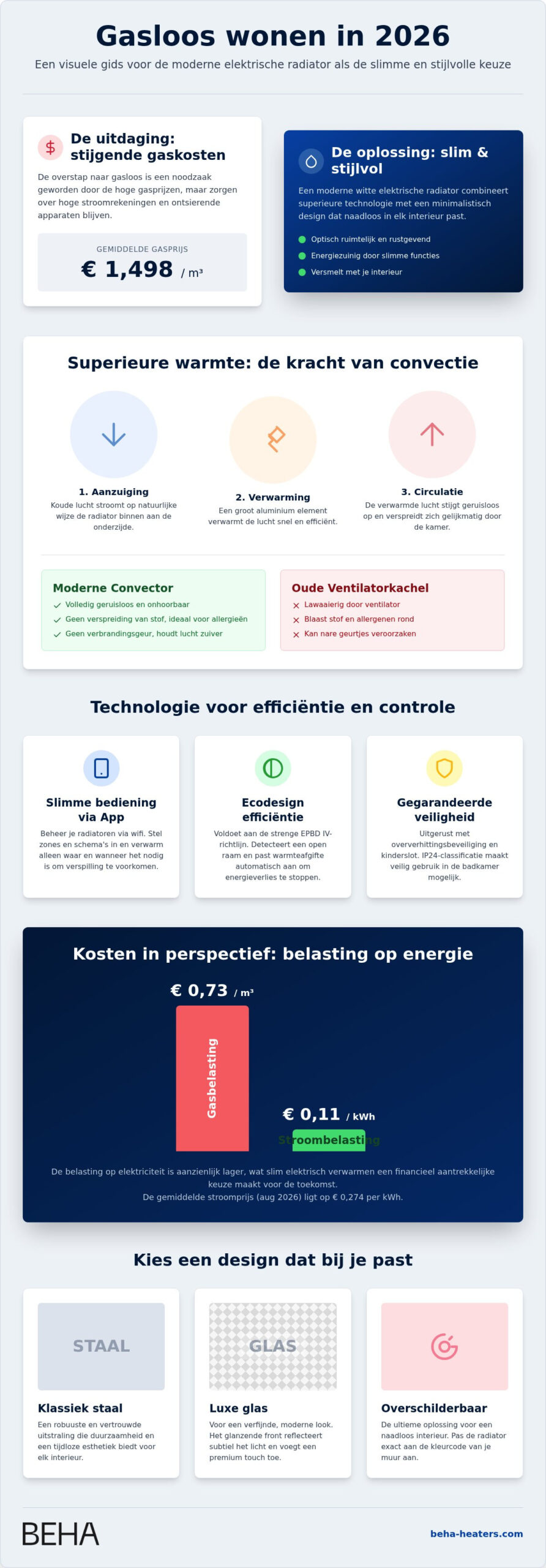
With natural convection, cooler air flows in at the bottom of the unit. An electric element heats the air, after which it rises at the top. No fan is needed. The thermostat measures the temperature and switches the element on and off to approach the set value.
Convector, panel radiator or fan heater?
| Type | Strong point | Point of attention | Fits especially well with |
|---|---|---|---|
| Wall convector | Silent natural air circulation and slim design | Free air intake and outflow required | Living room, bedroom, office and hallway |
| Electric panel radiator | Combination of convection and sensible radiant heat | Heat experience and control vary by model | Living spaces and longer periods of use |
| Towel radiator | Warmth and space for towels | Check bathroom IP, zone, and electrical connection | Bathroom |
| Fan heater | Very rapid, local heating | Fan noise and air displacement | Short-term supplementary heating |
What does Wi-Fi really do?
Wi-Fi does not inherently make a heater more energy-efficient. The benefit lies in the controls: you can use schedules, control rooms individually, and adjust the temperature remotely. This makes it easier to prevent an empty room from remaining unnecessarily warm. Read more in our existing guide on the electric convector with Wi-Fi.
Important regulatory options
- Electronic thermostat: regulates the temperature more accurately than a simple on-off switch.
- Weekly program: let the heating automatically adjust to your daily rhythm.
- Open window detection: can temporarily react to a rapid temperature drop.
- Local control: remains important when Wi-Fi or the internet is temporarily unavailable.
- Child lock: prevents unwanted changes; check if the selected model supports this.
For every white electric radiator, whether the selected model meets current product requirements. The European Commission publishes official information on ecodesign for local space heaters. An ecodesign designation does not mean that every appliance in every home is automatically the most economical heating solution.
Safe use in the bathroom
Not every white radiator is suitable for a damp room. Check the IP rating of the exact model, the prescribed safety zone, and local installation regulations. For example, BEHA PV 10 lists IP24, while the BEHA RAW HR 12 is specified as IP20. If in doubt, have the placement and connection assessed by a certified electrician.
White radiator made of steel, glass, or with a paintable front?
The front material primarily determines appearance, maintenance, and price. The required power and control remain more important for heating comfort.
| Execution | Appearance | Practical advantage | Pay attention to this |
|---|---|---|---|
| Painted steel | Timeless, sleek and usually matte or satin | Robust and easy to combine | Clean without abrasives; color code varies by manufacturer |
| White glass | Modern, smooth and reflective | Easily removable front | Fingerprints and reflections are visible more quickly |
| Paintable front | Can be precisely matched to wall or accent color | Maximum interior freedom | Only paint according to the model's instructions |
| White towel radiator | Vertical with bars or slats | Space for towels | Do not equate to a closed wall convector |
Matte white or glossy white?
Matte white looks calm and often complements matte wall paint well. Glossy white reflects more light and can be easier to wipe clean, but it also shows streaks more easily. A glass front adds depth and fits well in a modern interior; lacquered steel looks more neutral and is practical in high-traffic areas.
Horizontal or vertical?
A horizontal convector utilizes a low wall strip and often fits under a window, provided the mounting instructions allow it. A vertical designer or towel radiator saves wall width. Never choose the shape solely for space saving: check whether output, airflow, and intended use suit the room.
How many watts does your white electric radiator need?
The correct capacity depends on the heat loss of the room. Surface area alone is insufficient: ceiling height, insulation, glazing, ventilation, exterior walls, and the desired temperature all play a role. A professional heat loss calculation provides the most reliable result.
Quick orientation per cubic meter
For an initial indication, you can calculate the room volume: length × width × height. Then multiply the result by an approximate heat demand. Use the values below only as a starting point, not as an installation calculation.
| Situation | Global target value | Example for 40 m³ |
|---|---|---|
| Very well insulated | Approximately 25–35 W/m³ | 1,000–1,400 W |
| Moderately insulated | Approximately 35–50 W/m³ | 1,400–2,000 W |
| Older or limited isolation | Approximately 50–70+ W/m³ | 2,000–2,800+ W |
A bathroom typically requires a higher desired temperature than a bedroom. Large windows, high ceilings, and multiple exterior walls also increase the heat demand. If the calculated requirement exceeds what a single unit can supply, have it assessed whether two units or a different heating system would be more sensible.
Calculate consumption transparently
The nominal wattage is the maximum electrical power. A 1,500-watt appliance consumes 1.5 kWh per hour at continuous full power. The practical calculation is:
power in kW × effective duty cycle × your electricity price per kWh = costs
A thermostat switches off the heating element as soon as sufficient heat is reached. The actual operating time therefore depends heavily on insulation, outside temperature, set temperature, and usage. For Belgium or the Netherlands, always use the current rate on your own contract; a general internet average may misrepresent your actual costs.
Is higher power automatically more expensive?
Not necessarily. A correctly sized appliance reaches the desired temperature and then switches on thermostatically. An appliance that is too small can remain switched on for a long time without making the room comfortable. However, an appliance that is much too large is not automatically better either. Choose based on the heat demand, not on the highest wattage.
Which white BEHAradiator suits you?
BEHA offers various series of electric convectors. The best choice depends on operation, front material, space, and budget.
| Series | Front and color | Operation | Assets / examples | Especially interesting for |
|---|---|---|---|---|
| Classic HCW BEHA | White, classic front | Electronic control with weekly program | 500, 1,000, 1,500 and 2,000 W | Simple, timeless wall heating |
| BEHA PV | Painted steel front | Wi-Fi, app and manual control | PV 10: 1,000 W; PV 15: 1,500 W | Smart control and robust design |
| BEHA PGV/LGV | Glass front | Depending on the version, various models with Wi-Fi | Check the current model | A luxurious, smooth appearance |
| BEHA | Lightly textured, paintable front | Wi-Fi and app | 800, 1,000 and 1,250 W | Make the radiator blend in with the wall color |
View the current dimensions and versions at BEHA Heaters, the official BEHA Classic , and the specifications of the BEHA PV 10 Wi-Fi heater. For freedom of color, you can find the models on the BEHA RAW.
When do you choose steel?
A steel front is the no-nonsense choice for a living room, bedroom, study, or hallway. It combines a neutral look with a robust finish. Also read our comprehensive buying guide for electric heating with a steel front.
When do you choose glass?
Glass is suitable when the radiator is intentionally part of the interior. The smooth, reflective front adds a modern accent. Compare the dimensions, controls, IP rating, and mounting distance for each model; a glass front does not automatically make a unit suitable for the bathroom.
For home, office or project
For multiple rooms, zone control, total connected power, and central planning are particularly important. For offices, practices, hospitality venues, or projects, you will find additional points to consider in our guide on electric heating for commercial applications.
Buying checklist for a white electric radiator
- Determine the use. Will it be primary heating, zone heating, or short-term supplementary heating?
- Calculate the heat demand. Note dimensions, ceiling height, insulation, windows, and exterior walls.
- Choose the control. Compare local thermostat, weekly program, Wi-Fi, and app.
- Check the color. Ask for matte or gloss and the official color name.
- Measure the wall. Take into account the plug, cable, baseboards, curtains, doors, and furniture.
- Check safety. View IP rating, mounting distances, voltage, and maximum circuit load.
- Compare service. Check current warranty conditions, manual, parts, and support in the Benelux.
Installation without blocking heat
Always follow the mounting distances specified in the manual. Keep the air intake and outlet clear and do not place the unit behind long curtains, a sofa, or a closed enclosure. Use only the supplied or prescribed wall brackets. Check for pipes and cables before drilling.
Electrical connection in Belgium and the Netherlands
Many wall convectors operate on 220–240 V, but the connection and plug type vary by model. Include the power consumption of other appliances on the same circuit. Have a fixed connection, bathroom installation, or any doubts regarding the load assessed by a certified electrician in accordance with locally applicable regulations.
Maintenance of a white radiator
Switch off the appliance, unplug it if prescribed, and allow it to cool down completely. Remove dust with a soft cloth or a suitable vacuum cleaner brush. Do not use abrasives or harsh cleaners. Keep grilles clear and always follow the product-specific manual for glass, lacquer, or a paintable front.
Conclusion: technique first, then the shade of white
The best white electric radiator is not simply the most beautiful model. The unit must have sufficient output, be able to be safely mounted in the chosen location, and suit your usage rhythm. A steel convector is robust and timeless, glass adds a luxurious accent, and a paintable front offers maximum color freedom.
Therefore, compare heat demand, thermostat, Wi-Fi, IP rating, dimensions, and warranty before you buy. This way, you choose a white radiator that not only matches your interior today but also operates comfortably and reliably every day. View the current range and local support via BEHA Benelux.
Frequently asked questions about white electric radiators
Is a white electric radiator energy-efficient?
Consumption is determined by power rating, effective duty cycle, insulation, temperature setting, and electricity tariff. An electronic thermostat, zones, and a weekly program help prevent unnecessary operating hours, but do not change how much power the appliance draws at full power.
How much electricity does a 1,000-watt radiator use?
For one hour of continuous full power, a 1,000-watt appliance consumes 1 kWh. In practice, the thermostat switches depending on the heat demand. Multiply the actual number of kWh by the rate on your Belgian or Dutch energy contract.
Which white radiator fits in the living room?
Choose a unit that covers the calculated heat demand and has sufficient free wall space. Steel works well for a calm appearance; a glass front acts as a design accent. Wi-Fi is useful when working with fixed schedules or different zones.
Which radiator is suitable for the bedroom?
A convector without a fan is a logical, quiet choice. Additionally, pay attention to an accurate thermostat, display light, child lock, weekly program, and the correct power output for the lower desired night temperature.
Is a white electric radiator allowed in the bathroom?
Only if the exact device has a suitable IP rating and is installed in accordance with the prescribed electrical zone. Color or front material says nothing about bathroom safety. If in doubt, ask a certified electrician for advice.
Is IP20 suitable for the bathroom?
IP20 offers no protection against splashing water. Do not automatically use an IP20 device in a bathroom. Check the manual, installation zone, and local regulations; for damp rooms, choose a model that is explicitly approved for this purpose.
Is a Wi-Fi radiator cheaper to use?
Wi-Fi does not reduce electrical efficiency or wattage. However, it can help reduce heating times thanks to schedules, remote control, and room-by-room control. The savings depend entirely on your behavior and initial situation.
Can I repaint any white radiator?
No. Only paint a model whose manufacturer explicitly states that the front is paintable. Use the prescribed preparation and paint, and keep grilles, sensors, controls, and labels clear.
What is better: a glass or steel front?
Neither is universally better. Steel is robust and neutral; glass is smooth and luxurious. Above all, compare power, control, IP rating, dimensions, mounting, and price of the exact model.
Do I need a separate circuit?
That depends on the power of the radiator, other appliances on the same circuit, and the local installation. Add up the total load and consult an electrician for multiple powerful appliances, a fixed connection, or bathroom use.
What is the difference between RAL 9010 and RAL 9016?
RAL 9010 generally appears warmer, while RAL 9016 can appear brighter and cooler. Perception changes depending on light, gloss, and material. Always check whether the manufacturer actually specifies a RAL code and, if possible, compare with a physical sample.
How long is the warranty on a BEHAradiator?
The current PV 10 product page states a five-year warranty. Warranty may vary by series, model, and sales channel. Therefore, please check the product specifications and warranty conditions of your exact device before purchasing.