
Electric heating in your apartment: a smart guide for 2026
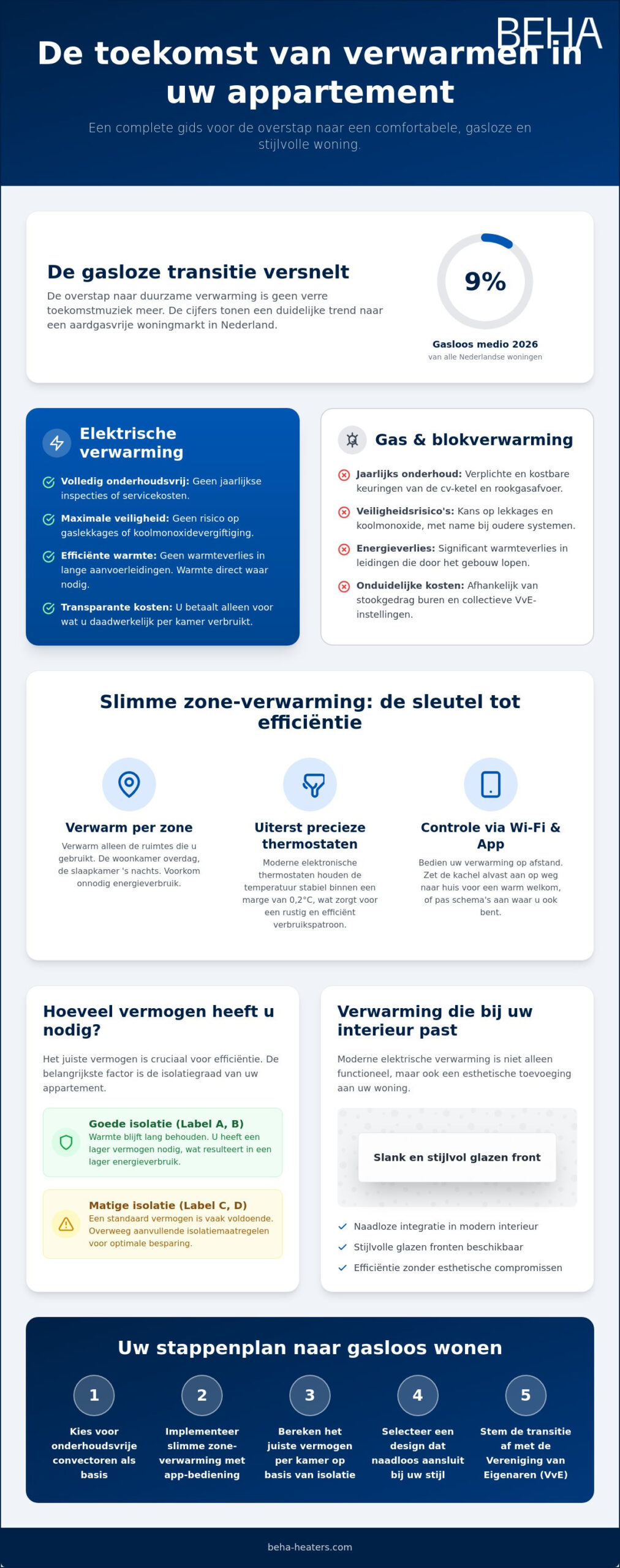
Did you know that by mid-2026, nearly 9% of all Dutch homes will be heated entirely without natural gas? The transition to a sustainable living environment is accelerating at a record pace, but for many residents, the switch to electric apartment heating still raises quite a few questions. You likely recognize the fear of uncontrollable energy costs due to outdated systems or the frustration with bulky radiators that simply do not fit your modern interior. Finding the right balance between technical capability and aesthetic integration often seems like a complicated puzzle.
In this guide, we show that a gas-free apartment is not only a responsible choice but also represents a significant upgrade to your living comfort. You will discover how innovative convection technology and smart zone control give you complete control over your energy consumption. We walk you through the possibilities of invisible integration and user-friendly operation via an app. This allows you to create a warm and stylish home that is ready for the future, without having to worry about the required capacity or a cluttered appearance.
Key Points
- Discover why maintenance-free convectors form the ideal foundation for a worry-free transition to completely gas-free living.
- Learn how to accurately control the costs of electric heating in your apartment with smart zone heating and app control.
- Gain insight into calculating the correct power per room based on the specific insulation values in your home.
- See how stylish glass fronts and modern designs blend seamlessly into your interior without sacrificing efficiency.
- Follow a practical step-by-step plan for the transition from gas to electricity, including the necessary coordination with the Homeowners Association (VvE).
Why electric heating is becoming the standard in apartments
The Dutch housing market is undergoing a fundamental change. Since legislation banned gas connections for new construction in 2018, the search for sustainable alternatives has gained momentum. This transition is particularly relevant for apartments. While traditional central heating often struggles with significant heat loss in the long supply pipes running through the building, electric apartment heating offers a direct solution. The heat is generated exactly where you need it. This principle aligns closely with the fundamental principles of electric heating, where energy loss during transport becomes a thing of the past.
Modern technological standards, such as the strict ECODESIGN guidelines, have taken the efficiency of electric convectors to a new level. These European regulations force manufacturers to integrate features such as open-window detection and precise weekly timers. As a result, a modern unit consumes significantly less energy than the old heaters of ten years ago. It is no longer a stopgap solution, but a conscious, high-quality choice for a comfortable indoor climate.
The advantages over gas and district heating
The greatest advantage lies in the simplicity and reliability of the system. With a gas connection, you are bound to annual maintenance for the central heating boiler and the necessary inspection of complex flue systems. With electric systems, these costs and risks are completely eliminated. In addition, it offers a solution to the often opaque cost allocation associated with district heating. You are no longer dependent on the heating habits of your neighbors or the collective settings of the Owners' Association. You decide for yourself when and how warm it is. Moreover, safety is a decisive argument; without gas in the home, there is no risk whatsoever of carbon monoxide poisoning or leaks.
When is electric the best choice for your situation?
Switching to electric apartment heating is particularly cost-effective in homes with a high level of insulation, such as energy label A or B. In such apartments, the generated heat lingers for a long time, meaning the convectors only need to provide supplementary heating briefly to maintain the desired temperature. It is also a smart choice for rooms you do not use continuously. Think of a guest room or a home office that you only heat during working hours. If your Owners' Association invests in solar panels on the shared roof, the transition becomes even more attractive. You then use your own generated electricity to climate control your living space, which immediately reduces monthly energy costs.
Smart zone heating: the key to a low energy bill
Zone heating is the most effective method to keep the costs of electric apartment heating under control. Instead of heating the entire house to one central temperature, you divide the home into different climate zones. Why heat the bedroom all day if you only sleep there? With a targeted plan, you heat the living room during your active hours, while the bathroom is only comfortably warm in the morning and evening. This precision prevents valuable energy from being wasted on rooms where no one is present.
The electronic thermostat plays a crucial role in this. While older systems often operate with large temperature fluctuations, modern convectors remain stable within a margin of 0.2 degrees. This constant level ensures a more consistent consumption pattern. In this context, electric apartment heating is not just a heat source, but an intelligent component of your digital household. The BEHAapp acts as your personal energy advisor. You can see at a glance which devices are active and intervene immediately if you have forgotten to turn down a heater.
Remote control via Wi-Fi and Bluetooth
The freedom of remote control is a major step forward for living comfort. Imagine you are on your way home via easytaxischiphol.nl . You switch on the heating in the living room in advance via your smartphone. By the time you open the door, it is pleasantly warm inside. Thanks to the combination of Wi-Fi and Bluetooth, connecting new devices to your network is arranged within seconds. You can create groups for different rooms, allowing you to put the entire apartment in night mode with the touch of a button. For those already using smart home systems, these connections offer seamless integration into your existing ecosystem.
Energy-saving features you should know
Modern technology does more than just heat; it actively thinks along with you. Features such as open window detection prevent you from literally heating the outside air. As soon as the convector signals a sudden temperature drop of more than five degrees, the element switches off temporarily. Another smart innovation is the adaptive start. The heater learns from experience how long it takes to heat up your specific room. Do you want a warm room at 8:00 AM? Then the system calculates itself whether to start at 7:30 AM or 7:45 AM.
There is still often a persistent myth that it is cheaper to leave the heating on all the time. For a well-insulated apartment, this is simply not true. It is much more efficient to lower the temperature by a few degrees during your absence and build it back up using a smart weekly program. This way, you benefit from maximum comfort at minimal cost. Discover the possibilities of our smart steel-front convectors for the efficient layout of your zones.
Calculating the required power for your apartment
An accurate calculation of heat demand is the absolute foundation for an energy-efficient home. Many residents make the mistake of choosing a device with insufficient capacity, hoping to save electricity. In practice, however, this has the opposite effect. A heater that is too small for the space must continuously operate at full power to reach the set temperature, without ever actually achieving it. This results in an uncomfortable indoor climate and an unnecessarily high energy bill. With proper sizing of your electric apartment heater, the convector switches off regularly as soon as the room reaches the desired temperature, which extends the lifespan of the device and minimizes your consumption.
The insulation level of your home plays a major role in this. While an older apartment with single glazing loses enormous amounts of heat through the windows, a modern building with HR++ glass actually keeps the energy inside. For an apartment built after 2010 or thoroughly renovated, a lower power output is often sufficient to guarantee behawarmth. It is therefore essential not to rely blindly on standard rules of 100 watts per square meter, but to consider the specific characteristics of your living space.
Rules of thumb for an accurate calculation
Every room in your home has its own purpose and, consequently, a unique heat demand. In the bedroom, a capacity of 60 to 80 watts per square meter is often sufficient. After all, you spend less time here, and a lower base temperature promotes a good night's sleep. The bar is set higher for the living room; large windows are often present here, which cause additional drafts. A capacity buffer is necessary here to ensure you can sit comfortably on the sofa even during a period of severe frost. The bathroom requires a completely different approach. Because you only stay here for a short time, you want the room to heat up extremely quickly. An overcapacity in wattage is actually a smart strategy here for immediate comfort.
The impact of ceiling height and exterior walls
In an apartment, you are dealing with unique architectural factors. A corner apartment has more exterior walls than a home surrounded by neighbors on both sides, which leads to greater heat loss. Do you live directly under the roof? Then bear in mind that heat rises and escapes more quickly through a less well-insulated roof. For residents of loft apartments, ceiling height is the most important variable. Because you have to heat the entire volume of air, a calculation based on square meters is unreliable. In such cases, it is essential to take cubic meters (m³) as the starting point. To get a clear picture of the situation, it is important to remember that 30 watts per m³ is the basis for modern insulation. With high ceilings or many exterior walls, simply add a correction factor of 10% to 20% to this to always ensure sufficient heat capacity.
Design and aesthetics: heating that matches your interior
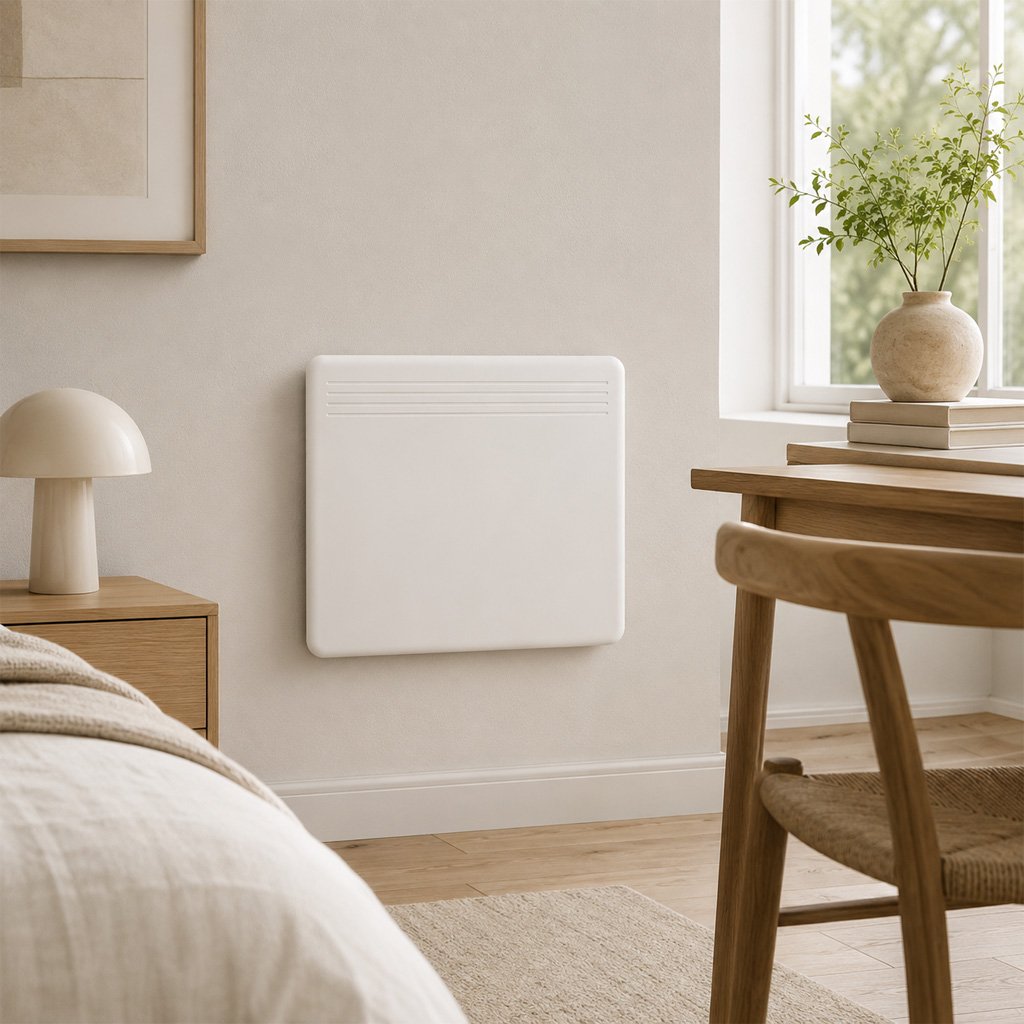
In a compact apartment, every square meter counts. Where we used to have to settle for bulky, white radiators that dictated a room's layout, modern electric apartment heating been transformed into a full-fledged design element. The visual tranquility of an interior is often disrupted by technical installations that do not match the chosen style. By switching to slim, wall-mounted convectors, you not only gain physical space but also create a cleaner interplay of lines in your home. These devices are designed to blend into their surroundings or, conversely, make a subtle statement.
For those striving for completely seamless integration, today's technology offers unique solutions. A paintable radiator allows you to give the heating source the exact same color as your wall. As a result, the device visually disappears from view, which provides a huge aesthetic gain, especially in minimalist apartments. It is a smart way to provide comfort without compromising on your personal taste.
Steel front vs. glass front
The choice between steel and glass depends closely on the desired atmosphere and the specific space. Steel convectors are known for their robust character and excellent heat conduction. They are timeless and fit into almost any interior. On the other hand, we are seeing growing popularity of glass fronts. These are made of tempered safety glass and give a luxurious, reflective appearance to spaces such as the living room or bathroom. Moreover, glass is very easy to clean with a damp cloth, making it a hygienic choice for environments where dust-free living is a priority.
Use of color and personalization
Personalizing your heating system goes beyond just the choice of material. With heat-resistant paint, you can adapt a convector to the latest interior design trends. Do you have an accent wall in a deep earth tone? By painting the heater in the same color, you maintain the continuity of the room. Despite these creative possibilities, an electric heater with a steel front the most versatile choice for many due to its neutral finish and durable construction. It offers a reliable foundation that lasts for years, no matter how often you change your interior.
Would you like to experience for yourself how our designs can enrich your apartment? View our range of smart glass-front convectors for a modern and stylish finish to your home.
Case study: heating an apartment entirely electrically
Successfully transforming an existing home into a completely gas-free environment requires a methodical approach. In practice, we see that an average 75-square-meter apartment can switch entirely to electric heating. The first step in this process is always a thorough inventory of the current insulation and the available electrical capacity. It is essential to contact the Homeowners' Association (VvE) at an early stage. Although you have a great deal of freedom within your own home, the switch by multiple residents can affect the building's shared main connection. A proactive attitude towards the VvE ensures that any network upgrades are scheduled in a timely manner.
The results after the first heating season are often surprisingly positive. Users report a significantly higher level of comfort, simply because every room now has exactly the desired temperature at the right time. Moreover, the reliability of the technology makes BEHA a popular partner for commercial electric heating; project developers and property managers rely on Norwegian solidity for large-scale renovations and new construction projects.
Installation and technical preparation
Before the first convector is mounted on the wall, an inspection of the fuse box is necessary. Depending on the total required power, it may be necessary to create an additional circuit or upgrade the connection to 3-phase power. The installation itself, however, is surprisingly simple. Thanks to the plug-and-play principle, most residents can carry out the wall mounting and connection to the app entirely independently. For complex projects or specific technical questions, it is advisable to seek advice from a specialized wholesaler for electric heaters. They can accurately calculate which configuration yields the best return for your specific living situation.
Cost savings in practice
Switching to electricity offers immediate savings on fixed costs. The monthly costs for the gas connection and mandatory maintenance of the central heating boiler are eliminated entirely. Although the electricity price remains an important factor, smart control via the app ensures a shorter payback period for the investment. By heating only where and when necessary, actual consumption often decreases faster than initially estimated. In addition, the market value of your apartment increases significantly. A home that is already fully gas-free and technologically modern by 2026 is a sought-after property for future buyers looking for a carefree and sustainable home.
Ready for a gas-free future in your apartment
The transition to electric apartment heating is more than a sustainability commitment; it is an investment in your daily quality of life. Just as you take control of your energy consumption, you can also take control of your personal development; if you want to find a suitable coach, Coach-spot helps you make the right connection. By choosing smart zone heating and an accurate calculation of the required power, you maintain control over both your comfort and your energy bill. You have seen in this guide that aesthetics and technology go hand in hand, whether you choose a glass front or a paintable radiator that blends seamlessly into your interior.
With over 100 years of Norwegian experience in heating, BEHA solutions that meet the strictest ECODESIGN requirements. Our systems are designed for simple Wi-Fi control via the BEHAapp, giving you control over your indoor climate anytime, anywhere. It is time to say goodbye to inefficient systems and choose the reliability of a market leader that combines tradition with innovation. View our range of smart convectors for your apartment and take the step today towards a stylish, gas-free home where you truly feel comfortable.
Frequently asked questions about electric heating in apartments
Is electric heating in an apartment more expensive than gas?
The consumption costs per kWh of electricity are higher than those of gas, but the total cost of ownership is often more favorable. You save immediately on the fixed costs of a gas connection, the annual maintenance of the central heating boiler, and the high purchase price of a new installation. Moreover, in a well-insulated apartment with smart zone control, you limit consumption to the times when you are actually present in a room, which keeps monthly costs manageable.
How many electric heaters do I need for a 70 m2 apartment?
For a 70 m² apartment, you need an average of five to seven convectors. This is based on the installation of one unit per living space, such as the living room, kitchen, bedrooms, and bathroom. The exact distribution depends on the cubic meters per room and the insulation value of the building. By placing a separate unit in each room, you can accurately manage the temperature per zone and prevent unnecessary power consumption.
Can I heat my apartment entirely with only electric convectors?
Yes, it is entirely possible, and even increasingly the norm, to heat an apartment exclusively with electric convectors. As long as the home has good insulation, such as energy label A or B, modern convectors provide sufficient direct heat for a comfortable indoor climate. The fast warm-up time and accurate thermostat make this system extremely suitable as primary heating in a gas-free living environment.
Do I need permission from the Owners' Association to switch to electric heating?
For modifications within your own apartment, permission is usually not required, but consultation with the Owners' Association is essential if the main connection needs to be upgraded. If the transition to electric apartment heating places a greater load on the building's shared electricity grid, the Owners' Meeting must decide on this. Furthermore, collective subsidies or loans are often available through the Owners' Association for these types of sustainability measures.
What is the difference between an infrared panel and an electric convector for an apartment?
An electric convector heats the air in the entire room, whereas an infrared panel only heats objects and people in the direct path of radiation. For primary heating in an apartment, convectors are more effective because they create an even base temperature without cold spots. In apartments, infrared is more often used as local supplementary heating in specific areas, such as directly above a workspace or in the seating area.
Can my current electrical grid handle the extra load from electric heaters?
Most modern apartments can handle the load, but a check of the fuse box is necessary when making a complete switch. If you use multiple heavy appliances simultaneously, upgrading to a 3-phase connection may be necessary to prevent overloading. Based on the total wattage required by your heaters and kitchen appliances, a certified installer can quickly determine whether your current connection is sufficient or needs to be upgraded.
Are electric heaters safe to leave on in the bedroom at night?
Yes, modern electric convectors are very safe for use during the night. BEHA devices are equipped with thermal protection that immediately switches off the device in the event of overheating. Because there are no exposed heating elements or combustion of fuels, there is no risk of carbon monoxide poisoning or fire hazard. Furthermore, the precise electronic thermostat ensures a constant, safe temperature without fluctuations.
How long does a modern electric convector from BEHA last?
A BEHA convector is designed for a lifespan of decades thanks to the absence of moving parts. Mechanical wear is virtually eliminated in these devices because no pumps or fluids are involved. Our Norwegian tradition of reliability and the use of high-quality components ensure that you invest in a durable heating solution that continues to function optimally and efficiently even after many heating seasons.