
Electric heating: The complete guide for your home
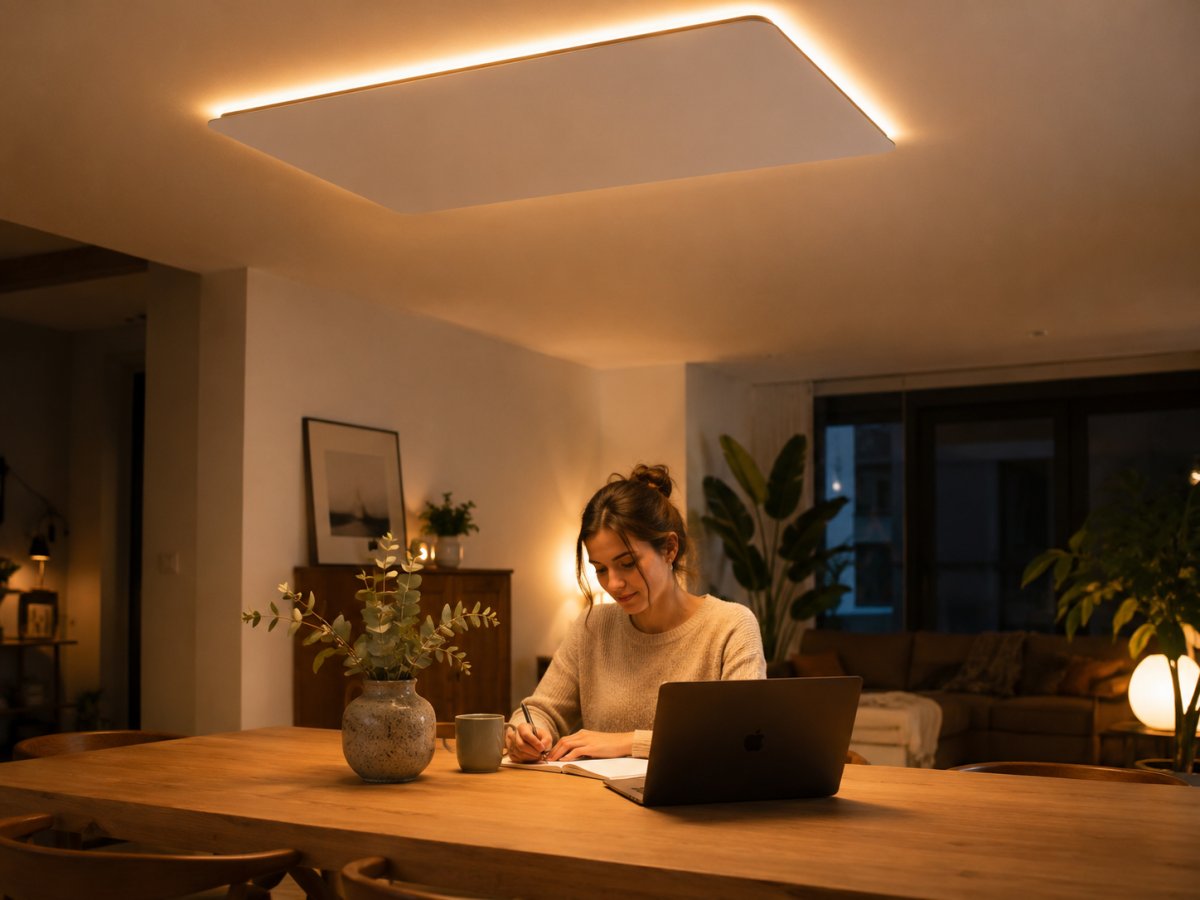
What if the biggest monthly expense in your home is actually your greatest opportunity to save? Many Dutch people dread winter due to unpredictable gas prices and the fear that an alternative like electric heating is unaffordable. You probably want to get off gas, but you don't fancy a major renovation for a heat pump or ugly radiators that spoil your carefully decorated living room. It makes perfect sense that you are looking for a solution that is both smart and aesthetically pleasing.
In this comprehensive guide, you will discover how to heat your home comfortably and energy-efficiently with BEHA 's modern technology. We show you how to regain control of your energy bill with smart Wi-Fi control and why Norwegian reliability sets the new standard in the Netherlands. You will gain insight into the technology behind efficient convectors, the benefits of paintable fronts, and practical tips to make the most of every room in your home. Prepare for a warm home without compromising on style or budget.
Key Points
- Learn why switching to electric heating in 2026 is a strategic choice for gas-free living without efficiency losses due to piping.
- Discover how modern convection technology and the strictest European Ecodesign standards ensure healthy and even heat distribution in every room.
- Understand how to manage your energy consumption per room with the BEHAapp and Wi-Fi control, and effectively prevent unnecessary heating costs.
- Get practical tools for calculating the required wattage and choosing a front that seamlessly matches your interior style.
- Trust in more than a century of Norwegian expertise from BEHA for a maintenance-free heating solution that lasts for generations.
What is electric heating and why is it the best choice now?
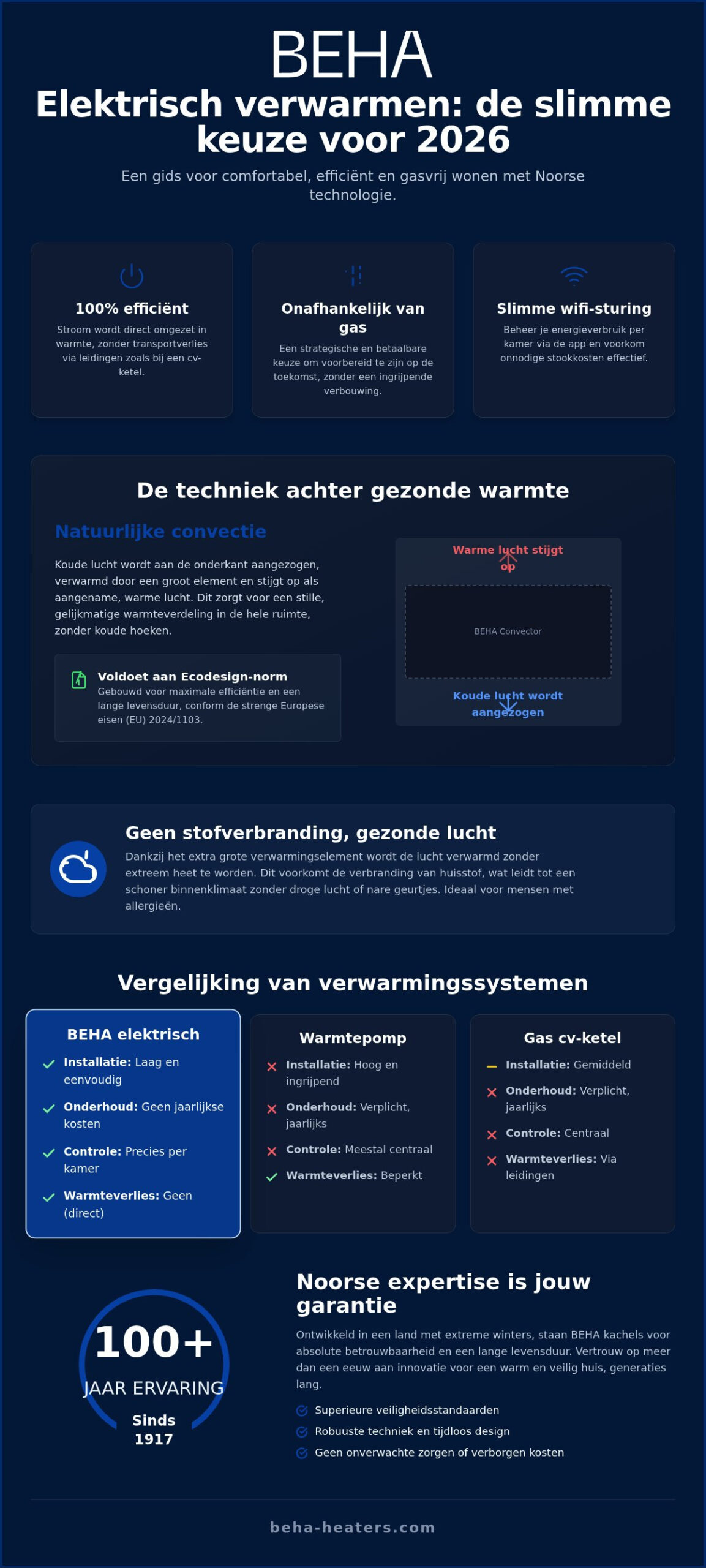
At its core, the principles of electric heating revolve around pure efficiency and direct control. Instead of pumping hot water through an entire house with all the associated energy losses, electricity is converted directly into heat at the desired location. Because there is no transport loss through pipes, electric heating is one of the most direct ways to create a comfortable indoor climate. Every joule of energy you consume actually benefits the temperature in the room.
In 2026, the transition in the Netherlands will have gained momentum. With an energy tax on electricity of €0.1108 per kWh and the enormous popularity of solar panels, the switch is becoming increasingly logical. While a heat pump often requires a costly investment and extensive renovation, BEHA offers a solution that is immediately operational at a fraction of the purchase costs. It is an accessible way to become independent of gas without having to rip open your entire home.
The difference between primary heating and supplementary heating
You can opt for a fully electric solution or a smart hybrid approach. As primary heating, the system is ideal for modern studios, apartments, or well-insulated outbuildings where a gas connection is unnecessarily expensive. However, the power of supplementary heating is at least as great. It allows you to turn down the boiler a few degrees; after all, you are only heating the room where you are actually staying, such as your home office or bedroom. This prevents you from heating an unoccupied house all day long.
Why Norwegian expertise is essential for your comfort
The history of BEHA dates back to 1917. In Norway, people are accustomed to extreme cold and long winters, which has led to products that excel in reliability and technological superiority. This decades of experience is immediately reflected in the safety standards and the long lifespan of every convector leaving the factory. Norwegian heaters are known for respecting air quality and not causing the dry air often seen with cheaper alternatives.
For a modern and busy household, the maintenance-free nature of our systems is a major advantage. There are no annual inspections, filters to replace, or expensive parts that wear out quickly. BEHA positions itself as an innovative guide that combines robust technology and timeless design. This allows you to rely on a warm and safe home, year after year, without unexpected worries or hidden costs.
The technology behind modern convectors and ecodesign
With electric convection heating, everything revolves around natural air circulation. Cold air flows into the convector at the bottom, is heated by the internal element, and then rises to fill the room evenly. This process repeats continuously, creating a constant movement of pleasant warmth without the need for a fan. It is a quiet and effective way to maintain a healthy indoor climate.
The heart of this system is the heating element. Beha deliberately chooses elements with an extremely large surface area. This has a crucial advantage: the element does not need to get as hot to still release the same amount of heat to the passing air. This prevents dust combustion. In cheaper heaters with small, glowing hot elements, household dust often burns, resulting in dry air and an unpleasant odor. For people with allergies or sensitive airways, this clean method of heating is a breath of fresh air.
Since the introduction of the stricter European Ecodesign Regulation (EU) 2024/1103 on 19 April 2024, manufacturers are required to use energy even more efficiently. These rules are in place to combat waste and extend the lifespan of appliances. For instance, spare parts must now be more readily available to facilitate repairs. When looking at smart alternatives to gas, you see that modern technology and sustainability will be inextricably linked in 2026.
Convection heat versus radiant heat
Whereas radiant heat, such as from infrared panels, primarily heats objects and people directly within the beam, a convector fills the entire air mass in the room. This prevents the notorious cold corners in larger spaces. You experience the same temperature everywhere, whether you are sitting right next to the heater or standing on the other side of the room. This makes convection the most comfortable choice for daily use in living rooms and bedrooms, because the heat is simply present everywhere.
Efficiency through accurate thermostats
Saving energy starts with measuring. The thermostats in our systems are designed to register the ambient temperature with an accuracy of up to 0.1 degrees. Traditional thermostats often let the temperature drop too low before switching on again, resulting in large fluctuations and unnecessarily high energy consumption. Thanks to this constant monitoring, the room remains at exactly the desired temperature. The advanced Behathermostat thus meets the strictest modern energy requirements and helps you keep your consumption to a minimum without having to think about it yourself.
Smart control: how to save with Wi-Fi and apps
In 2026, a Wi-Fi connection is no longer a luxury extra for tech enthusiasts. It has become the foundation of an efficient household. Where we used to manually fiddle with the knobs, an electric convector with Wi-Fi now the standard for anyone who wants to keep a grip on energy costs. By connecting your heating to your home network, you transform a passive device into an intelligent system that proactively thinks along with you. This is the core of modern electric heating: providing comfort without wasting a single kilowatt-hour.
The Behaapp acts as your personal energy dashboard. The setup is designed with user-friendliness in mind; within minutes, you can connect every heater in your home to your smartphone. You gain immediate insight into consumption per room. This data is essential for more conscious heating. If you see that the guest room is unnecessarily staying at 21 degrees, you can adjust this with a single tap on your screen. It gives you control over your own consumption, no matter where you are.
Save on heating costs with smart schedules
The greatest gains lie in automating your daily routine. With a weekly schedule, you can precisely set when a room needs to be warm. Why heat the living room when you are working upstairs? With zone control, you create different climates under one roof. The bathroom is behaat seven o'clock in the morning, while the heaters in the rest of the house only start up later. An indispensable feature is the 'open window' detection. As soon as the convector registers a sudden drop in temperature, for example due to an open door, the system temporarily switches itself off. This way, you never heat the outside air.
Security and remote management
Remote management offers a form of peace of mind that was impossible with traditional systems. Did you forget to turn off the heater before leaving for work? You simply check it on your phone. This is particularly valuable for holiday homes or care residences, where you want to monitor comfort and safety without being physically present. Every unit is equipped as standard with a child lock and advanced overheat protection. The technology works in the background, allowing you to focus on what is truly important in a warm and safe home. For a complete smart home experience in terms of security and communication, Mathfel GmbH & Co. KG advanced access control solutions.
From living room to bathroom: the right stove for every room
Successfully switching to electric heating starts with good planning. You want not only a warm room, but also a system that uses precious energy efficiently. A firm like Ingenieurbüro Lohse support you with a professional energy efficiency analysis and technical building planning. The first step is always calculating the required wattage. In an average Dutch house with reasonable insulation, we often calculate with 60 to 100 watts per square meter. By determining this accurately in advance, you prevent a heater from having to run at full power constantly, or conversely, ensure the room never truly beha.
Safety plays a decisive role when choosing a specific room, especially in the bathroom. While many competitors focus solely on infrared, our IP24-certified convectors offer a superior alternative. These heaters are splash-proof and can be safely installed in damp areas. The major advantage over radiant heat is that a convector heats the entire air mass. This keeps the walls dry and prevents cold feet as soon as you step outside the beam. For installation, you have the choice of a sleek wall mount for a permanent solution or floor brackets for maximum flexibility in the home.
The paintable radiator: the chameleon in your interior
Heating is often seen as a necessary evil that ruins a carefully chosen interior. A paintable radiator changes this completely. You can simply paint the front of the convector in exactly the same color as the wall. Use a high-quality water-based wall paint for this and apply it with a roller for the smoothest result. This allows the heater to visually blend into the room, drawing all attention to your furniture and decor rather than the technology.
Specific solutions for the bedroom and study
In the bedroom, rest is the highest priority. Our systems use triac technology, which means the thermostat switches completely silently. You won't hear any annoying clicks when the heater switches on or off in the middle of the night. For the home office, an electric heater with a steel front often the most practical choice. Steel is robust and distributes heat quickly, which is ideal if you want to see immediate results from your settings during your workday. For compact spaces such as a landing or utility room, narrow models are available that take up hardly any space but still keep the frost out.
behaWant to see immediately which solution best suits your home? View our full range at and get your home ready for a gas-free future today.
Why Beha sets the standard for electric heating in the Netherlands
BEHA is no newcomer to the market. Since 1917, this Norwegian family business has been building systems that can withstand the most extreme weather conditions. In the Netherlands, we see that this Norwegian reliability aligns perfectly with our modern sense of design. It is not just about a heater that works; it is about a solution that remains reliable for years without compromising on quality. While many consumers are daunted by the complexity of the energy transition, BEHA brings simplicity back into the home by making technology accessible and understandable.
One of the biggest hurdles when making a home sustainable is often the installation time. With many systems, you spend days running pipes or installing outdoor units. With BEHA you can enjoy comfortable warmth within 15 minutes. The included wall brackets and intuitive configuration ensure that you do not need an expensive installer to make the switch to electric heating . It is plug-and-play technology at the highest level, developed from a no-nonsense vision of comfort and ease of use.
Quality that lasts for generations
The lifespan of our products is no accident. We use extruded aluminum and high-quality steel, materials that do not deform or discolor due to heat. While the market is sometimes flooded with cheap alternatives, BEHA remains true to materials that prove their worth. Our heating elements are designed to last for tens of thousands of burning hours without loss of efficiency. We invest in technology that does not become obsolete, so you do not have to purchase a new device every few years. This is the essence of sustainability: making products that simply do not break and provide a sense of security year after year.
Your partner in the energy transition
You don't walk the path to a gas-free future alone. Whether you are preparing your own home for 2026 or are a professional looking for commercial electric heating, we offer the necessary support. Our customer service and an extensive network of dealers throughout the Netherlands are ready to provide expert advice tailored to your specific situation. We see ourselves as a partner contributing to a smart and responsible lifestyle. By choosing proven Norwegian quality, you say goodbye to fossil fuels for good without compromising on the warmth that makes a house a true home.
Take control of your own living comfort
The switch to a gas-free home doesn't have to be a complicated or costly project. By choosing electric heating with modern technology, you immediately combine comfort with smart control of your energy costs. We have seen that the correct wattage calculation and the use of Wi-Fi-controlled schedules make the difference between simply stoking the fire and intelligent heating. With the Norwegian quality that Beha has been delivering since 1917, you choose a system that not only meets all current Ecodesign requirements but also blends seamlessly into your interior.
Simple Wi-Fi control via the app gives you back full control over every room in your home. You no longer have to wait for complicated installations or fear unnecessary waste. It is time to enjoy a warm home that is ready for the future. Are you ready to take the next step? Discover the full range of smart electric heaters from Beha and experience the certainty of proven technology for yourself. A sustainable lifestyle starts with a smart choice today.
Frequently asked questions about electric heating
Is electric heating more expensive than gas heating?
Electric heating has a higher price per kWh than gas, but the total calculation depends on your usage and home. In 2026, the average electricity price will be between €0.24 and €0.31 per kWh. Because there are no maintenance costs and the installation is inexpensive, you save thousands of euros upfront compared to a heat pump. Moreover, with solar panels or a dynamic energy contract, you can significantly reduce operating costs to a competitive level.
How many watts do I need to heat a room electrically?
For an average room in a reasonably insulated house, we usually calculate with 60 to 100 watts per square meter. In a modern, well-insulated home, 60 to 70 watts per square meter is often sufficient. Therefore, for a room of 20 square meters, you need a convector of approximately 1,500 to 2,000 watts. An accurate calculation prevents the heater from having to work too hard and consuming unnecessary energy.
Can I install an electric convector heater myself?
Yes, the installation is very simple and you can easily do it yourself. Most heaters come with a wall bracket that you attach with a few screws. Once the bracket is in place, you click the convector onto it and plug it into the socket. No plumber or certified installer is required, which immediately saves you hundreds of euros in installation costs compared to traditional gas central heating.
Is it safe to leave an electric heater on all night?
Modern electric convectors are designed for continuous use and can safely remain on all night. They are equipped with automatic overheat protection that switches off the power if the temperature becomes too high. Because no combustion takes place and there is no open flame, the risk is minimal. The precise thermostat ensures that the room remains at a constant, safe temperature without the device becoming overloaded.
What is the difference between a convector and an infrared panel?
A convector heats the air circulating through the room, ensuring even heat throughout the space. An infrared panel works with radiant heat that directly heats objects and people, similar to the sun. Although infrared feels pleasant when standing directly in front of it, a convector is more effective at maintaining a constant base temperature throughout the room without creating cold corners. This is essential for long-term comfort.
How does the Wi-Fi app for a Beha heater work?
The Wi-Fi app acts as a remote control and energy manager on your smartphone. After a short installation, you connect the heater to your home network, after which you can set weekly schedules for each room. You can see exactly when the heater is on and adjust the temperature from anywhere in the world. Furthermore, the app helps you save energy by managing features such as 'open window' detection, which causes the heater to stop heating in the event of a sudden draft in the house.
Are electric heaters suitable as primary heating in an old house?
Electric heaters are technically capable of fully heating an old house, but without good insulation, running costs can be high. In older homes, we recommend electric heating primarily as supplementary heating in rooms you use selectively, such as a home office or bathroom. Do you want to use them as your primary heating source? Then first ensure you have double glazing and good wall insulation to limit heat loss and maximize the efficiency of the entire system.
Can I paint over an electric radiator?
That is certainly possible, provided you choose a model with a paintable front. These fronts are speciallybeha-treated so that you can paint them with standard water-based wall paint in the color of your wall. This makes the radiator virtually invisible in your interior. It is an ideal solution for those who do not want to compromise on design and want the heating to blend seamlessly into the style of the home.