
Everything about the parking heater: 7 ultimate buying tips

Everything about parking heaters starts with one important distinction: a true parking heater is an autonomous heating system for a vehicle or vessel, whereas a portable electric heater is a 230V alternative for locations with shore power or a mains socket. In this guide, you will discover which solution suits a camper, van, boat, garage, or garden shed. We compare operation, fuel, power consumption, output, noise, installation, maintenance, and safety for users in Belgium and the Netherlands.
A well-chosen heating system keeps you comfortable while stationary without running the vehicle engine. However, the best choice does not depend solely on the number of kilowatts. Is shore power available? Do you plan to spend the night off-grid? How well is the space insulated? And where can combustion fumes and exhaust gases be safely vented? With the selection plan below, you can avoid an oversized heater, an overloaded campsite connection, or an unsafe installation.
Key points
- A fuel-fired parking heater operates independently of the engine, but uses 12V or 24V during operation for the control system, pump, and fan.
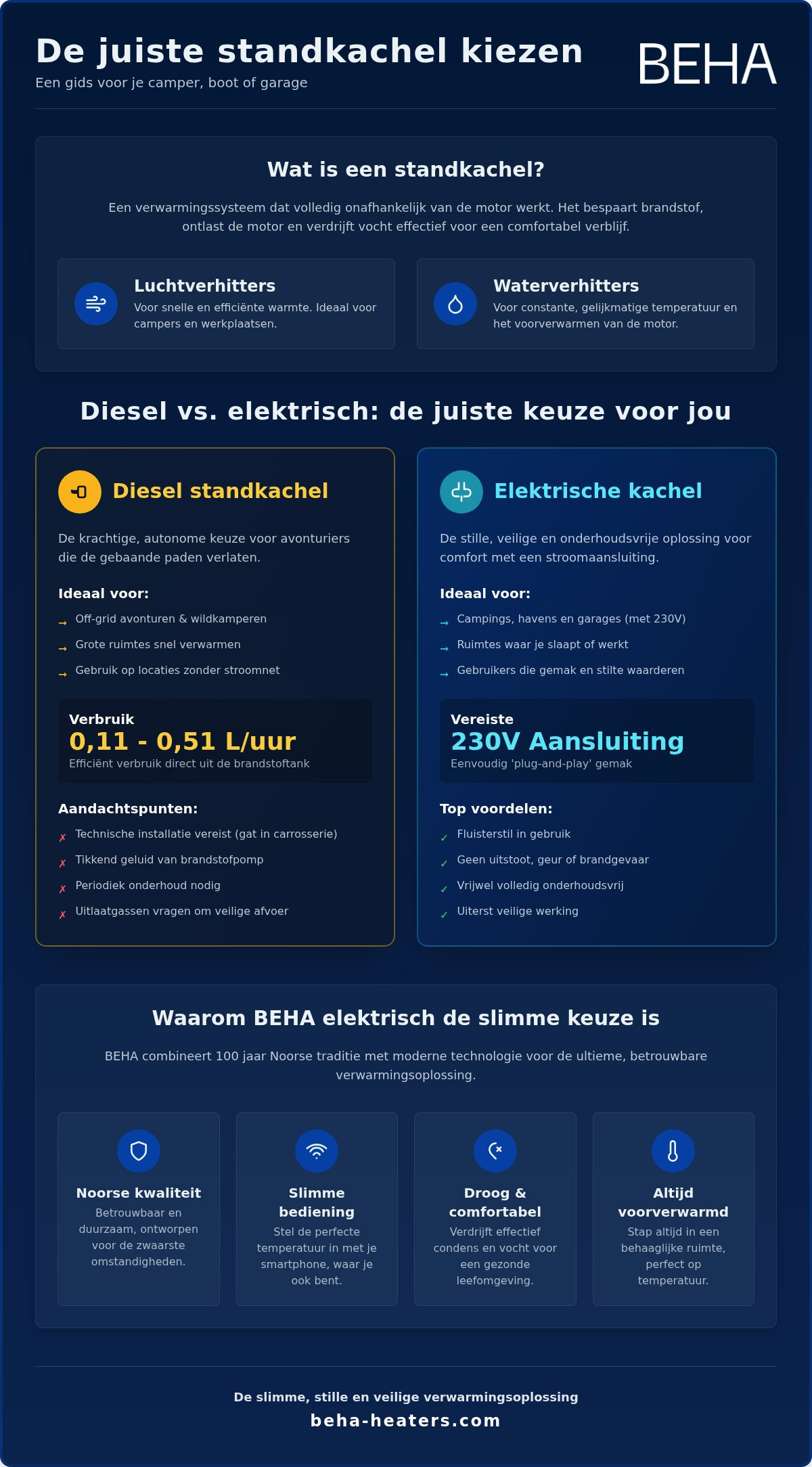
- An air heater heats the living space directly; a water heater heats the coolant circuit and can also help preheat the engine.
- For off-grid use, diesel or petrol is usually more practical. With reliable 230V shore power, an electric convector is simpler and very quiet.
- Fuel consumption, power demand, and maintenance interval depend on the model. Always use the technical data sheet and installation manual of the selected appliance.
- Ventilation, a proper exhaust, a smoke detector, and a carbon monoxide detector are essential for a combustion appliance. Preferably, have a fuel stove installed by a professional installer.
Everything about the parking heater: what is it and how does it work?
A parking heater, also known as a stationary heater, heats a stationary vehicle without the need for the drive engine to run. A pump supplies diesel or petrol to a closed combustion chamber. A heating element initiates combustion, the heat exchanger absorbs the heat, and a fan or fluid pump distributes that heat. Combustion air is drawn in from outside, and exhaust gases must be completely vented outside the living space.
Electricity is still required even while running. The electronics, fan, and fuel pump typically operate on the on-board voltage of 12V or 24V. During starting, the power demand may be temporarily higher. Therefore, you should check not only the fuel tank but also the condition and available capacity of the leisure battery. The exact values vary significantly depending on the type and power setting.
Everything about the parking heater as an air heater
A stationary heater draws in ambient air, passes it over a heat exchanger, and blows the heated air back into the cabin. The combustion circuit remains separate from this. This type heats up quickly, is compact, and is often a good fit for motorhomes, vans, and cabins. Proper placement of the intake and exhaust vents prevents cold corners and makes the noise level more pleasant.
Everything about the parking heater as a water heater
A water or coolant heater brings the engine's cooling circuit up to temperature. The existing vehicle fan or a separate heat exchanger then transfers heat to the interior. This is useful if you behato preheat the engine as well as the cabin. Please note: “water heater” here usually means coolant heater; the unit does not automatically supply hot tap water for the shower or faucet.
What an electric heater is and isn't
In practice, a 230V convector or fan heater is sometimes referred to as an electric parking heater. Technically, this is not autonomous parking heating: the device requires mains power, shore power, or a suitable power supply. However, for a garage, garden shed, home, or camper at a campsite, it can be a simpler alternative. Without combustion, there are no flue gases, fuel lines, or hot exhaust under the vehicle.
Diesel or electric: which parking heater suits you?
Anyone who everything about the parking heater should focus primarily on the usage scenario. The comparison below prevents two very different products from being presented as directly interchangeable.
| Type of heating | Strongest application | Advantages | Points of attention |
|---|---|---|---|
| Diesel air heater | Camper or van, often off-grid | Autonomous, rapid warm-up, fuel from vehicle tank possible | Professional installation, 12V required, pump/fan audible, maintenance |
| Petrol parking heater | Gasoline vehicle and preheating | No separate diesel supply required | Model selection and installation must match the vehicle |
| Gas heating | Caravan or camper with existing gas system | Comfortable and versatile | Gas supply, inspection, ventilation and CO safety |
| 230V convector | Campsite, harbor, garage, or garden shed with power outlet | Simple, no combustion, low maintenance, very quiet | Not autonomous; power must fit within the power connection |
| 230V fan heater | Reheat quickly and briefly | Instantly noticeable warm air, portable | Fan audible; free airflow required |
When do you choose diesel or petrol?
Choose a fuel-fired parking heater if you regularly travel without shore power, require heat for extended periods at low outside temperatures, or wish to preheat the engine. A suitable 2kW rating may suffice for many compact, well-insulated motorhomes, but larger vehicles or significant heat loss require a calculation by the supplier or installer. An oversized heater often runs on a low setting, which can adversely affect comfort and operational efficiency.
Use consumption figures only as model information. By way of illustration, Webasto provides different control ranges for certain Air Top models, depending on version, power, and fuel. This underscores why a single universal figure for liters per hour is misleading. Consult the manufacturer's official technical data and calculate based on your expected operating time and power setting.
When do you choose an electric solution?
If you have a reliable 230V connection, electric heating is attractive due to its simple operation and limited maintenance. A convector has no fuel pump or combustion fan and is therefore usually very quiet; however, a click may sometimes be audible due to material expansion. A fan heater warms up noticeably faster, but the fan produces noise. Consider, for example, fan heating for temporary, targeted heat.
Electric heating via a standard 12V leisure battery is usually not practical. A 1000W heater theoretically draws about 83A at 12V, even before losses from the inverter and cables. At 2000W, this is theoretically around 167A. This places a heavy load on the battery, inverter, and cabling. Therefore, use a 230V heater in a camper primarily on a suitable shore power connection and check the manuals for the vehicle, inverter, and power outlet.
Calculate the power and consumption of a parking heater
Everything regarding a parking heater also revolves around sizing. Floor area alone is insufficient. Volume, insulation, glazing, drafts, outside temperature, desired indoor temperature, and exposure to wind all combine to determine heat loss. A camper with a lot of glass loses heat relatively quickly; an insulated garden shed reacts differently than a metal delivery van.
How many kW do you need?
Use online rules of thumb only for an initial estimate. For structural use, have the required power checked by a professional or supplier. Do not automatically opt for “more for safety”: too much power can result in short cycles, severe temperature fluctuations, and unnecessary noise. Too little power means the desired temperature will not be reached during frost. Also take into account use at height if the manufacturer specifies limitations or an altitude kit for this.
Everything about the parking heater and fuel consumption
The consumption of a diesel or petrol heater varies depending on the setting, outside temperature, insulation, and the chosen model. Note the minimum and maximum hourly consumption from the technical data sheet. Multiply this by the expected operating hours, but be aware that a thermostatically controlled unit modulates. Also check the electrical consumption during startup and continuous operation so that the leisure battery has sufficient reserve for the entire night.
Electricity consumption and campsite connection
For an electric heater, the calculation is simple: power in kW × actual time at full power = kWh. A 1500W unit running continuously at full power for two hours consumes 3 kWh. The thermostat allows the element to switch off for part of the time after heating up. The actual costs therefore depend on heat loss, duration of use, and the electricity rate of the campsite, marina, or energy supplier.
| 230V connection | Theoretical maximum | Practical significance |
|---|---|---|
| 6A | approximately 1380W | A 1500W or 2000W heater is too heavy; other appliances also count. |
| 10A | approximately 2300W | A heater up to 2000W will fit, but leave margin for the fridge and chargers. |
| 16A | approximately 3680W | More space, but total load and connection quality remain determining factors. |
These are calculated values at 230V, not advice to load the connection to the maximum. Always check the fuse rating, cable reel, CEE connection, and house rules. Unroll a cable reel completely and use equipment suitable for outdoor use and the required current.
Condensation: heating and ventilating
A warm room feels drier, but a heater does not remove moisture on its own. People, wet clothing, and cooking introduce water vapor into a small space. Therefore, heat evenly, ventilate in a controlled manner, and keep permanent ventilation openings unobstructed. This way, you limit condensation on cold windows and metal parts without degrading air quality.
Installation and safety of your parking heater
to everything related to the parking heater . A fuel heater combines fuel, hot components, electrical connections, and combustion gases in a small space. Therefore, preferably have the installation carried out and inspected by a professional installer who has experience with your specific type of vehicle or boat. Follow the manufacturer's instructions regarding cutouts, heat distances, cable cross-section, fuse, fuel line, air supply, and exhaust route.
The Fire Department recommends, among other things, a smoke detector, CO detector, fire extinguisher, and regular inspection of the electrical installation for safe camping. Install a CO detector according to its own manual and the installation advice for a camper, caravan, or boat. A detector is an additional safety measure and never a substitute for proper installation and ventilation.
Everything about the parking heater: safety check
- Use an approved device suitable for the vehicle or vessel and for the fuel used.
- Keep combustion air and heated room air strictly separate; vent exhaust gases completely to the outside.
- Position the exhaust so that gases cannot re-enter through windows, doors, ventilation grilles, or floor gaps.
- Protect hot exhaust parts from flammable material, cables, pipes, and contact.
- Protect the power supply with the prescribed fuse and cable cross-section. Do not bypass fault codes or protections.
- Test smoke and CO detectors regularly and keep a clear escape route and appropriate fire extinguisher available.
- Stop immediately in case of smoke, fuel smell, exhaust fumes in the living area, abnormal noise, or repeated malfunction, and have the system checked.
The existing technical service information for specific parking heaters shows that procedures are model-specific. Use such documentation exclusively for the mentioned appliance; your manufacturer's official manual and the judgment of a professional installer remain the guiding principles.
Safe use of an electric heater
- Check if the socket, camping pole, extension cable, and fuse can handle the total load.
- Preferably connect a powerful heater directly to a suitable grounded outlet, according to the manual.
- Never cover the appliance and keep air vents and prescribed distances to curtains, bedding, and furniture clear.
- Use only a model that is suitable for the environment. In damp zones, additional requirements apply regarding placement and degree of protection.
- Check the cord and plug for heat, damage, or discoloration, and stop if there are any abnormalities.
Maintenance without guesswork
Maintain a fuel heater according to the manufacturer's schedule. The commonly heard advice to run a diesel heater periodically at high power may apply to certain models, but always follow the appliance's own manual. Have the burner, heat exchanger, exhaust, fuel line, and electrical connections professionally inspected when required. For an electric heater, disconnect the power to the air vents and remove dust according to the manual; do not disassemble the unit yourself.
When is a BEHA electric heater the smart choice?
A BEHAheater does not replace a built-in fuel-powered parking heater during off-grid travel. However, it is interesting if you have sufficient 230V power available at the campsite, in the harbor, at home, in a garage, or in a well-ventilated garden shed. You avoid fuel storage and exhaust fumes, while an electronic thermostat helps maintain the set temperature.
Convector or fan heating?
An electric heater with a steel front is suitable for even room heating and operates without a fan. For fast, targeted heating, BEHA electric heating also offers solutions with air displacement. When making your choice, consider wattage, thermostat, installation requirements, noise level, and any smart controls. Before use in a camper, always check whether the unit can be suitably installed and secured.
Norwegian experience and additional drying solutions
BEHA develops electric heating products based on years of Norwegian experience. For wet shoes, targeted drying is often more efficient than heating the entire room. An electric shoe dryer can therefore be a useful addition after hiking, boating, or working in wet weather. Check the current warranty conditions, features, and operating instructions for each product.
Everything about the parking heater: selection guide in 7 steps
- Determine the space: a vehicle cabin, camper living area, boat, garage, or garden shed each requires a different installation.
- Choose the usage: daily, occasional, preheating only, or keep comfortable for a full night.
- Inventory energy: vehicle fuel, gas, 12V/24V battery, and available 230V shore power.
- Calculate heat loss: note dimensions, insulation, glazing, ventilation, and lowest expected outdoor temperature.
- Check the technical specifications: consumption, starting current, noise level, elevation, control range, and certification.
- Plan for a safe installation: in the event of combustion, consult a professional installer and check CO, smoke, and fire safety.
- Compare total costs: add up purchase, installation, fuel or electricity, maintenance, and expected service life.
For most off-grid campers, a correctly sized fuel-to-air heater is the logical primary heating system. For a camper that is almost always connected to shore power, a suitable electric convector or fan heater can be comfortable. For engine preheating, you need a coolant heater designed for that purpose. Thus, regarding the parking heater, there is no universal winner, but rather a choice that suits your situation.
Conclusion: choose warm, economical, and above all safe
Everything about the parking heater summarized: first compare the energy source and location of use, only then determine the power output. Diesel or petrol offers autonomy, but requires expert installation, electricity, and maintenance. A 230V heater is simpler and produces no combustion gases, but requires sufficient shore power and is not a realistic heavy load for a standard 12V battery.
Check product specifications instead of general consumption figures, always combine heating with ventilation, and never compromise on smoke and CO safety. Do you have a suitable mains connection and are you looking for an electrical solution for a camper at the campsite, a workspace, or an outbuilding? 's heating solutions BEHA and choose the power based on space, connection, and usage.
Frequently asked questions about everything related to the parking heater
Is a diesel parking heater safe to use at night?
Only when the specific appliance is suitable for this purpose, is correctly installed, and is used according to the manual. Ensure unobstructed, permanent ventilation, a properly positioned CO detector and smoke detector, an intact exhaust system, and timely maintenance. Stop if you smell fuel or exhaust fumes, and always have any doubts assessed by a qualified installer.
How much does a parking heater consume per hour?
There is no universal consumption. For a fuel heater, it depends on the model, fuel, power setting, and conditions; check liters per hour and electrical consumption in the technical data sheet. For electric heaters, the rule is: a 2000W element consumes 2kWh per hour as long as it operates continuously at full power. Thermostat operation often reduces the actual operating time.
Can I install a diesel parking heater myself?
The installation affects the fuel supply, bodywork, electrical safety, combustion air, and exhaust. A fault can cause a fire or carbon monoxide in the living area. Therefore, professional installation is strongly recommended. Anyone performing the work themselves must demonstrate competence, follow the manufacturer's instructions exactly, and have the system inspected by an expert.
Is 2kW or 5kW better for my camper?
Bigger is not automatically better. Many compact and well-insulated motorhomes end up in a lower power class, while a large or poorly insulated vehicle may require more. Have the heat loss and control range assessed. Choose a device that can run in an optimal power setting for a sufficiently long time during normal use.
Does a parking heater make a lot of noise?
A fuel-fired parking heater has a fan, pump, and exhaust, and is therefore audible. Proper installation, vibration isolation, and correct air ducts help. A convector without a fan is generally very quiet, although materials may tick when heating or cooling. An electric fan heater naturally produces fan noise.
Can I use an electric convector in my camper?
This is possible if the manufacturer permits the setup and the camper has a suitable 230V connection. Check the camping fuse, total load, grounding, cables, clearances, and ventilation. Heavy-duty electric space heating via a standard 12V leisure battery and inverter is usually impractical due to the very high current demand.
Does a parking heater prevent condensation?
Heating increases the surface temperature and can therefore limit condensation, but it does not remove moisture. People, cooking, and wet items continue to produce water vapor. Combine even heating with controlled ventilation and dry wet materials separately whenever possible.
What should I do if the parking heater smokes or smells?
Switch off the appliance safely according to the manual, ventilate, and do not use it again until the cause has been determined. Do not check hot parts or fuel lines yourself. In case of exhaust fumes in the living area, a CO alarm, fire, or health problems: go outside immediately and call 112.