
Heating for small spaces: the complete guide to efficient comfort in 2026
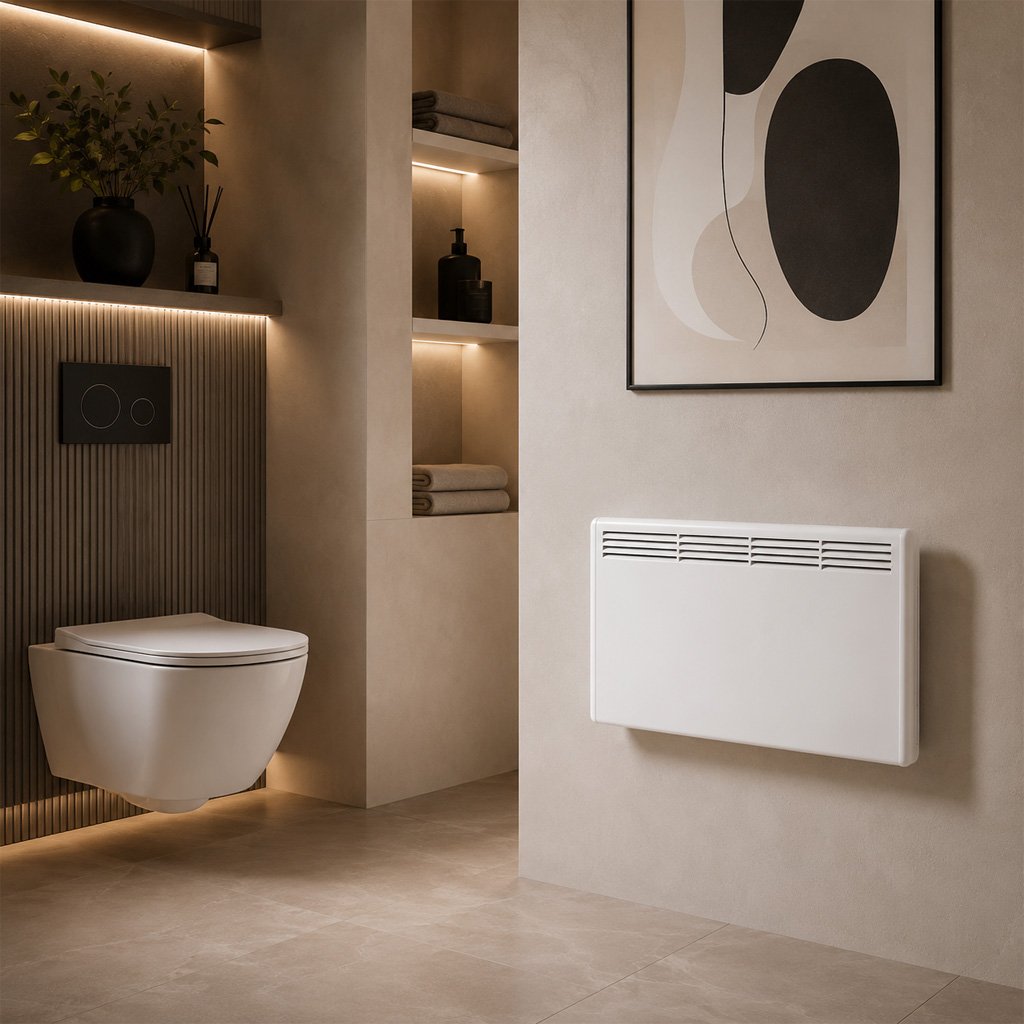
Are you still paying for the inefficiency of an outdated heater that takes up more precious square footage than it offers in comfort? In 2026, finding the right heating for small spaces is no longer a matter of compromising on style or your monthly expenses. We recognize the frustration of a bulky, unsightly appliance that unnecessarily drives up the energy bill. With an average electricity price of €0.258 per kWh in July 2026, a well-thought-out approach is essential to keep your home affordable and comfortably warm.
In this guide, you will discover how to heat small rooms efficiently and stylishly with the latest electric solutions from Norway. We show you how modern convectors with a glass or steel front blend virtually invisibly into your interior. Additionally, you will learn how to easily calculate the correct wattage and maintain full control over your energy consumption via an intuitive app. This way, you enjoy a perfect climate and modern convenience without having to worry about unnecessary waste.
Key Points
- Discover why direct heat output and simple installation without drilling make electric heating the ideal choice for compact rooms.
- Learn how to calculate the exact wattage for your small room heating using the correct basic formula and taking insulation into account.
- See how stylish convectors with a glass or steel front seamlessly blend into your interior and create a modern, luxurious look.
- Save on your energy costs by using smart app control and weekly schedules that automatically adjust the temperature to your daily rhythm.
- Understand the added value of Norwegian quality and Beha 's years of expertise in safety and technological superiority.
Why electric heating is ideal for small spaces
In a compact room, every square meter and every second counts. Traditional central heating takes time to heat water and pump it through a system of pipes, during which heat is always lost along the way. With electric heating, that process is fundamentally different. Modern convectors operate on the principle of Joule heating, whereby electrical energy is converted directly into heat with an efficiency of nearly 100%. This speed is crucial for effective heating of small spaces. After all, you want the study or guest room to be pleasant the moment you open the door, not half an hour later.
The installation of these systems is remarkably simple. In a small bedroom or home office, there is often no room for complicated pipework or large radiators. A convector requires only a sturdy wall mount and a power outlet. This not only saves on initial installation costs but also prevents any drilling or breaking work in your home. Moreover, the technology behind modern electric heating is virtually maintenance-free. Because no moving parts or fluids are involved, there is no wear and tear on pumps or leaks. This results in a very long lifespan and a reliability that is essential for your daily comfort.
Another important aspect is independent control per room. Instead of heating the entire house for one active room, electric convectors allow you to take a very targeted approach. Some advantages of this targeted approach are:
- Instant response: The room reaches the desired temperature within a few minutes.
- No energy waste: Unused rooms stay cool without affecting the rest of the house.
- Space-saving: Slim designs take up hardly any depth and leave the floor free.
The difference between supplementary heating and primary heating
In many well-insulated homes, a BEHA convector is now sufficient as the sole heating system. In a room of 10 to 15 square meters, a convector with the right wattage provides enough capacity to maintain a constant temperature even during a harsh winter. By using electric heating for small spaces, you can turn down the central gas heating in the rest of the house or even switch it off completely in certain zones. We always recommend fixed wall mounting over a portable unit. A fixed convector is safer and distributes warm air more efficiently throughout the room.
Sustainability and the Ecodesign Directive
The current generation of electric heaters must comply with the strict European Ecodesign Directive. These regulations force manufacturers to incorporate intelligent features that prevent energy waste. Examples include highly accurate thermostats that react to temperature differences of just 0.1 degrees. Features such as open-window detection, where the device temporarily switches off if a sudden drop in temperature is detected, are also now the standard. By choosing technologically advanced heating, you invest in a system that not only increases your comfort but also reduces your ecological footprint through smart control.
Calculating the correct wattage for a small room
Determining the required power is a crucial step to guarantee both comfort and a low energy bill. Many people make the mistake of looking only at the floor area, but effective heating for small spaces requires a more precise approach. It revolves around the balance between the volume of the room and the rate at which heat escapes through walls and windows. A wattage that is too low means the convector has to constantly operate at full power without reaching the desired temperature, leading to unnecessary wear and tear and higher costs.
Interestingly enough, a slight overcapacity is often actually more energy-efficient. A more powerful convector brings the room to the set temperature faster and can then switch to an energy-saving mode to simply maintain the heat. The function of the room also plays a role. In a hallway that you only walk through, a lower base temperature suffices, whereas in an office where you sit still for hours, you have a higher heat requirement for a comfortable working environment.
Wattage table for rooms up to 15 m2
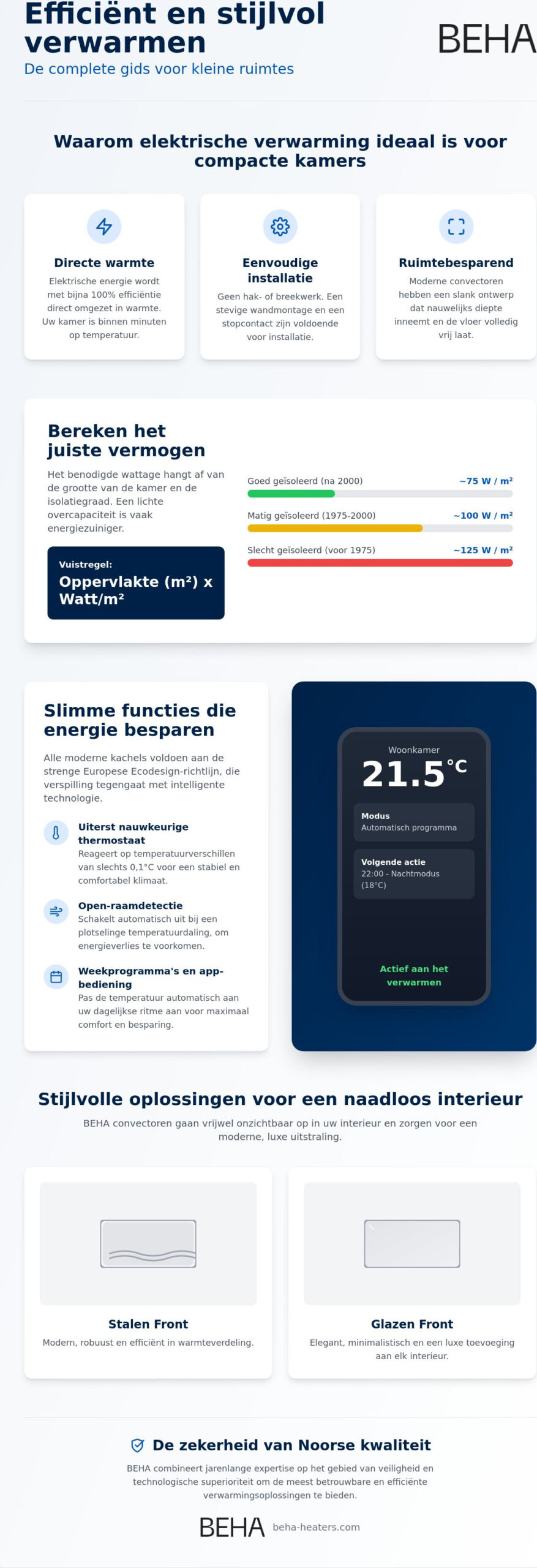
The guidelines below will help you make the right choice for your specific situation. Please note that ceiling height is a determining factor; standard calculations assume a height of 2.5 meters. If your ceiling is higher, you should increase the wattage by approximately 10% for every half meter of additional height. For an average insulated room of 10 m², a power output of 800 to 1000 Watts is considered the standard for optimal comfort in 2026.
- Good insulation (A-label): 60 to 70 Watts per m².
- Average insulation: 80 Watts per m².
- Moderate insulation (older homes): 100 Watts per m².
Positioning of the heating for optimal efficiency
The location where you mount the convector is at least as important as the output itself. The ideal position is under a window. This ensures that the cold air entering through the glass is heated immediately, breaking the so-called cold draft and allowing the heat to circulate more evenly throughout the room. Always ensure sufficient free space around the device: keep at least 10 centimeters clear at the bottom and sides, and 20 centimeters at the top for an unobstructed airflow. For those unsure about the best configuration, it can be helpful to compare the various smart convectors based on their specific dimensions and power range. In narrow passageways or niches, it is essential that the warm air does not directly hit an obstacle, otherwise the thermostat will switch off too early.
Stylish solutions for a seamless interior
Interior design in a compact home requires smart choices. Every object you add influences the atmosphere and spaciousness of the room. Where heating used to be a necessary evil that obstructed the view, we now see a clear shift towards designer radiators that form an integral part of the room. Well-thought-out heating for small spaces combines a sleek profile with high-quality materials. As a result, the convector becomes almost a work of art on the wall rather than a bulky obstacle.
The color of your convector plays a major role in visually enlarging a room. By choosing a model that has the exact same shade as your wall, you create a sense of calm and unity. This is especially essential in small bedrooms or narrow hallways. Slim wall-mounted models are the standard in this regard. They take up hardly any depth and leave the floor free, which immediately makes the room appear larger. It is a simple way to add luxury without sacrificing valuable living space.
The paintable radiator for an invisible finish
Do you want your heating to blend completely into its surroundings? Then a paintable radiator the ultimate solution for a minimalist result. You can paint the front of this convector in exactly the same color as your wall, making the device virtually invisible. However, it is important to use a heat-resistant, water-based paint suitable for metal. This prevents discoloration and ensures that the paint does not peel due to heat output. For those striving for a seamless interior, this is the most sophisticated choice.
Glass versus steel: which material do you choose?
The choice between a glass or steel front depends on the desired appearance and the function of the room. A glass front immediately gives a room a luxurious, modern look. Moreover, the reflective surface of the glass can visually brighten up a small space. Glass is extremely low-maintenance; a damp microfiber cloth is often sufficient to keep the front dust-free and shiny. Steel fronts, on the other hand, are robust and timeless. They have a matte finish that is less noticeable and highly resistant to daily use in, for example, a children's room or office. Both materials are sustainably produced and retain their high-quality finish throughout the entire lifespan of the appliance.
Smart features that save energy in small rooms
In a compact room, the temperature can fluctuate rapidly due to external factors such as direct sunlight or drafts. Smart technology ensures that you never consume more energy than strictly necessary for a comfortable climate. While old-fashioned heaters often use imprecise rotary knobs, BEHA systems utilize advanced electronic thermostats. These respond to minimal temperature fluctuations of just 0.1 degrees. This is essential for efficient heating in small spaces. It prevents the convector from continuing to heat unnecessarily once the room has already reached the desired temperature.
Open window detection is another indispensable innovation for a sustainable household. As soon as the sensor detects a sudden, rapid drop in temperature, the heating temporarily switches itself off. With the current average electricity price of €0.258 per kWh in July 2026, features like this are no longer a luxury. By operating the convector only when truly necessary, you keep monthly costs low without compromising on your daily comfort.
Wi-Fi integration and smart home connections
With Wi-Fi integration, you manage all the heaters in your home from one central app. You can set a unique weekly schedule for each small room that seamlessly aligns with your daily routine. After all, the guest room doesn't need to stay at 20 degrees all week if someone is only staying there on weekends. Furthermore, you monitor current consumption via your smartphone. This provides immediate insight into your heating habits and helps you make informed choices. It also offers extra safety; you can check from work whether the heater in the children's room is set to the correct setting.
We also see this focus on automation and efficiency in other sectors; for those curious about innovations in retail, check out Blumenautomat24 to see how they are modernizing flower sales.
Specific functions for the bedroom and garage
Specific rooms often have very different climate requirements. A quiet electric bedroom heater is indispensable for an undisturbed night's sleep, ensuring you are not bothered by ticking noises when switching it on or off. For the garage or storage room, a reliable frost-protected electric heater essential to prevent frozen pipes by keeping the temperature just above freezing. BEHAconvectors feature child-safe settings and a limited surface temperature for maximum safety.
Would you like to experience for yourself how smart control increases your living comfort and lowers your energy costs? Then discover the possibilities of our smart convectors and choose a future-proof solution for your home.
Why choose the Norwegian quality of BEHA?
The Norwegian climate places extreme demands on technology and reliability. BEHA understands this like no other, with a history dating back to its founding in 1917. When looking for heating for small spaces, you want a system that is not only functional but also offers proven safety under all conditions. Our focus on durability is reflected in every component, from the durable heating elements to the robust housing tested in the harshest Scandinavian winters. This Norwegian pragmatism translates into products that do what they promise: keeping your home comfortably warm without unnecessary complications.
In the Netherlands, we offer extensive support so that you can always count on expert advice when furnishing your home. The installation is designed with the user in mind. Within minutes, the convector is mounted on the wall and ready for use. It is this combination of user-friendliness and technical superiority that makes our brand a trusted partner for households that choose quality over quick fixes.
Tradition meets innovation
For over a century, BEHA has set the standard for electric heating by adhering to core values such as reliability and Norwegian simplicity. Norwegian design is praised worldwide because form always follows function, resulting in a timeless appearance. We have made the transition to smart, connected convectors without losing sight of the fundamental physical quality. Our modern devices combine the familiar heat output of the past with the digital connectivity of today. This means you benefit from a product rooted in tradition, yet fully equipped for the modern smart home.
Ready for the future of gas-free living
The energy transition calls for sustainable solutions that last for generations. BEHAproducts contribute directly to an energy-efficient home through their highly precise control and long lifespan. Unlike cheaper alternatives, we choose materials that retain their value and remain virtually maintenance-free. This is not only beneficial for your wallet but also reduces your household's ecological footprint. Are you looking for a robust solution for your office or bedroom? Discover our electric heater with a steel front for small spaces and experience the Norwegian standard in comfort for yourself.
Choose the future of smart heating
Achieving a comfortable climate in compact rooms no longer requires compromises between design and consumption. By choosing a well-thought-out heating system for small spaces, you combine precise heat output with the aesthetics of a modern interior. You have seen that correctly calculated wattage and the use of smart features, such as open-window detection and app control, are essential to keeping your energy costs manageable in 2026. This makes the transition to gas-free living a feasible and stylish reality.
Beha guarantees over 100 years of Norwegian experience and innovation. Our products meet the strictest Ecodesign requirements and offer you the assurance of a safe, maintenance-free solution that lasts for years. Thanks to simple operation via a free app, you maintain full control over your living comfort anytime, anywhere. View our range of smart convectors for small spaces at BehaBeha-heaters.com experience the solidity of Norwegian craftsmanship for yourself. We are happy to help you create a warm, sustainable place where you truly feel at home.
Frequently Asked Questions
How many watts do I need for a 10 m² room?
For a 10 m² room with average insulation, you typically need a power output of 800 to 1000 Watts. This wattage ensures that the room heats up quickly without the convector having to constantly run at its maximum capacity. In very well-insulated new-build homes, 600 Watts may sometimes suffice. However, it is wise to choose a slight overcapacity for more efficient heating in small spaces.
Is an electric heater expensive to use in a small room?
Electric heating does not have to be expensive, provided you use smart thermostats and time programs. With an average electricity price of €0.258 per kWh in July 2026, targeted heating is essential. By heating only when you are present and accurately setting the temperature per room, you prevent unnecessary waste. Moreover, the energy required in small spaces is limited, meaning the total costs often turn out lower than expected.
Can I safely use an electric convector in the bathroom?
Yes, you can use an electric convector in the bathroom, provided the device has an IP24 certification. This rating means that the heater is splash-proof and can be safely installed in damp areas. When installing, always ensure that the convector is placed at a safe distance from the shower or bath. For a comprehensive overview of safe and energy-efficient options, you can consult our guide on the electric bathroom radiator with Wi-Fi . Our smart convectors are designed to function reliably and safely in various environments.
What is the advantage of a paintable radiator for small spaces?
The main advantage of a paintable radiator is that it blends seamlessly into your interior. In compact rooms, conspicuous appliances can visually reduce the size of the space or disturb the tranquility. By painting the convector in exactly the same color as the wall, you create a seamless finish. This makes it the ideal heating solution for small spaces where a minimalist design and a calm appearance are desired.
Are Beha electric heaters quiet enough for the bedroom?
Beha 's electric convectors are ideally suited for the bedroom because they operate completely silently. Unlike fan heaters or older systems with mechanical thermostats, you will not hear any disturbing clicking noises or blowing motors with our models. This guarantees an undisturbed night's sleep while the room remains at a constant, pleasant temperature. The precise electronic control ensures that temperature fluctuations are kept to a minimum.
How does the open window detection work on a Beha convector?
The open-window detection works via a sensitive sensor that signals a sudden drop in ambient temperature. When you open a window to ventilate, the convector detects this immediately and temporarily switches off the heating. This prevents the device from working harder to compensate for the cold outside air. As soon as the window is closed and the temperature stabilizes, the convector automatically resumes its normal program.
Do I need a dedicated circuit for a heater in a small room?
For a single convector in a small room, a separate circuit is usually not required. A standard Dutch 16-amp circuit can handle a total power of approximately 3600 watts. Since a convector for a small room often consumes between 500 and 1500 watts, it can be connected to an existing circuit without any problems. However, do check that no other heavy appliances are running on the same circuit at the same time.
Can I control the heater remotely when I am not at home?
Yes, you can control the convector from anywhere in the world via the free Behaapp on your smartphone. As long as the heater is connected to your local Wi-Fi network, you have full control over the settings and the weekly schedule. This is ideal for turning on the heating in advance before you get home or for checking whether you have turned it off after leaving. It offers both convenience and an additional savings opportunity.