
Ski boot dryer: the complete guide to dry and warm feet in 2026
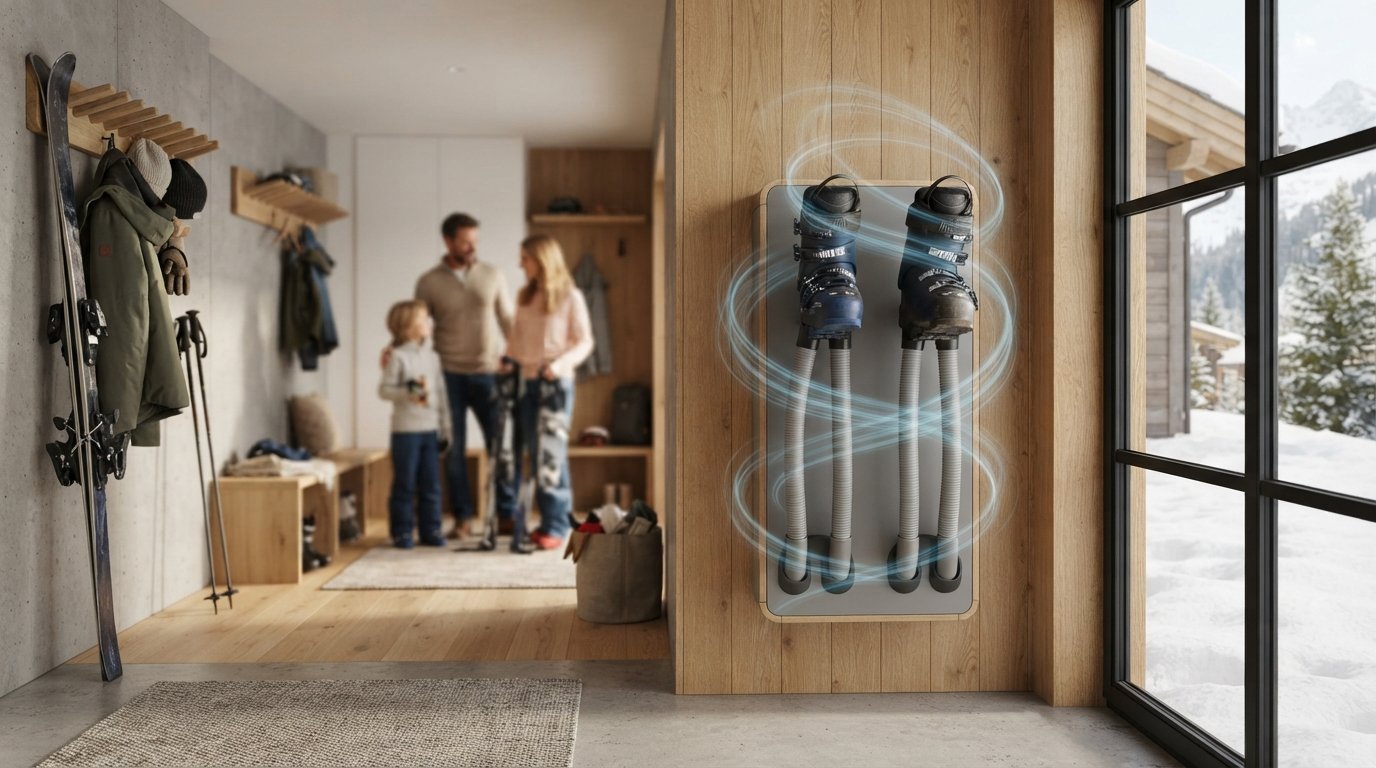
Putting your ski boots against the heater immediately after skiing seems like a handy shortcut, but it is the surest way to permanently ruin the fit of your inner boot. Fortunately, a reliable ski boot dryer works very differently: not with aggressive heat, but with a controlled, gentle airflow that effectively removes moisture without damaging the delicate, thermoformable material.
Nothing spoils the fun of winter sports faster than having to step into a damp, ice-cold boot in the morning where bacteria and odors have run rampant. You simply want to be able to count on warm, dry feet and optimal comfort as soon as you step onto the first ski lift. In this complete guide for 2026, you will discover how to dry your equipment safely, keeping it fresh and shape-retaining for the best performance on the slopes. We discuss the various drying techniques, compare compact travel solutions with robust wall-mounted models, and show what to look for in an energy-efficient setup for the whole family.
Key Points
- Why a specialized ski boot dryer is indispensable for safely tackling moisture buildup in stiff synthetic shells.
- The crucial difference between gentle, continuous air circulation and harmful radiant heat for preserving your thermal inner boots.
- The practical pros and cons of compact portable dryers compared to robust wall-mounted models with flexible hoses.
- A clear step-by-step plan for after skiing to immediately prevent bacterial growth, mold, and unpleasant odors.
- How to dry both ski boots and gloves simultaneously with an energy-efficient drying solution and keep your ski room organized.
Why a special ski boot dryer is indispensable
A day on the slopes demands a lot from your feet, but even more from your equipment. While running shoes made of breathable mesh can air out after exercising, ski boots are enclosed in a hard, impermeable outer shell of polyurethane or polypropylene. Moisture caused by perspiration or penetrating snow has nowhere to go. A specialized boot dryer forces gentle air deep into the toe of the boot, actively initiating the evaporation process. Passive drying simply does not suffice in such a sealed structure.
Classic quick fixes almost always fall short. While crumpled newspapers do absorb some of the surface moisture, they further seal off the airway and leave wet ink residue in the footbed. A hairdryer, on the other hand, blows air that is far too hot onto one concentrated spot. This causes the material to dry unevenly and puts you at immediate risk of structural damage. Without a targeted approach, the inner boot remains damp for days, with all the resulting consequences for your skiing enjoyment.
The danger of wet ski boots to comfort and fit
Moist linings conduct cold to your skin up to three times faster than dry material. As a result, your feet cool down dangerously quickly within half an hour on the slopes. Furthermore, the combination of clammy textile and constant pressure causes friction, which significantly increases the risk of painful blisters.
Does perspiration repeatedly remain trapped inside the inner boot? If so, salts and acids slowly break down the cell structure of the cushioning foam and stitching. Additionally, the warm, dark inner shell forms an ideal breeding ground for bacteria and fungi immediately after skiing, leading to a persistent odor that cannot be removed from the material.
Why conventional heating or underfloor heating is not working
Many winter sports enthusiasts park their equipment on underfloor heating or clamp the shells against a hot radiator. Both methods cause problems:
- Underfloor heating does not reach the core: The rising heat stops at the thick synthetic sole and does not penetrate the deep, narrow toe of the inner shoe.
- Radiators cause deformation: The intense contact heat from central heating can irreparably bend the outer shell. As a result, modern custom-fit shoes permanently lose their exact fit.
- Weakening of adhesive layers: Uneven heat attacks the adhesive bonds between the different layers, causing sole structures to detach.
A specific ski boot dryer bypasses these problems by directing a constant, moderate airflow from the inside through the shell, precisely where moisture collects.
How does an electric ski boot dryer work properly?
The operation of an effective ski boot dryer relies on active air displacement rather than pure heat. Whereas traditional heat sources rely on passive radiant heat that remains stagnant inside the shaft, an electrically driven fan continuously propels fresh, slightly warmed air toward the toe of the boot. This convection current directly targets the condensation point at the toes and forces the saturated, moist air out through the top of the shaft.
Thanks to this dynamic circulation, the indoor temperature remains constantly moderate. After all, an excessively hot airflow poses risks to high-quality materials. A controlled system therefore keeps the outlet temperature strictly below fifty degrees Celsius, ensuring a safe and even drying process.
The importance of gentle air circulation against bacterial growth
Bacteria multiply rapidly in a warm, humid, and oxygen-poor environment. By blowing a continuous stream of fresh air through the fabric immediately after your descents, you deny microorganisms time to attach themselves. A drying cycle of a few hours prevents sweat odors from penetrating the lining, while the waterproof and breathable membranes of your winter sports gear remain completely intact.
Protection of custom liners and thermo-moldable inner boots
Modern ski boots are often equipped with thermoplastic foam liners, such as EVA material, that is molded exactly to your foot during a boot fitting session. If this material is exposed to temperatures above fifty degrees Celsius, the foam can relax and lose its specific shape. A high-quality dryer therefore operates at a limited temperature, ensuring that your expensive custom-fit remains perfectly preserved season after season.
Energy consumption and duration for a complete drying cycle
In contrast to letting a large electric heater roar in the ski room for hours, a targeted dryer consumes only a fraction of that energy. A well-designed electric shoe dryer with a power output of around three hundred watts gets the job done in just two to three hours.
Thanks to a built-in mechanical timer, the device switches off automatically as soon as the cycle is complete. This prevents unnecessary standby power consumption and guarantees safe operation, even while you enjoy the après-ski or go to sleep. If you want to smartly equip your ski room at home or in the chalet with proven heating technology, check out the complete range at beha- efficient solutions.
The different types of shoe dryers compared: wall-mounted versus plug-in units
Anyone looking for a suitable drying solution will quickly find themselves facing two completely different concepts: freestanding plug-in units and fixed wall models. While mobile plug-in models are primarily aimed at minimizing luggage during a holiday by plane, fixed wall units with air hoses have been the gold standard in Scandinavian chalets and mountain huts for decades. The right choice depends on your travel style, the intensity of your skiing, and the number of family members.
The performance differences between the two systems are significant. Compact drying rods often deliver only localized radiation, whereas a full-fledged ski boot dryer with hoses builds up airflow that effortlessly ventilates even thick outer shells. Furthermore, wall-mounted models offer the flexibility to connect not only heavy boots but also soaked mittens or ski socks at the same time.
Fixed wall-mounted models with flexible air hoses
Wall-mounted models are designed for maximum capacity and an organized space. Thanks to long, flexible hoses, the heated airflow reaches the deepest point of the shoe toe unimpeded. Because the base unit hangs securely on the wall in the garage, ski room, or utility room, the floor remains free of dangling cables and meltwater. The robust construction is designed to support the heavy weight of multiple pairs at once, making this setup ideal for families or avid winter sports enthusiasts.
Compact portable heating elements for on the go
Insertable elements consist of two small heating elements that you lower into the shaft via a thin power cable. They are lightweight and fit easily into a weekend bag. The disadvantage lies in their operation: most insertable elements lack a mechanical fan. As a result, moisture evaporates slowly and partially remains trapped in the shaft. Additionally, the thin wires wear out relatively quickly when you regularly rub them against the stiff, sharp edges of ski boots.
What should you pay attention to when making a choice for your situation?
Take a number of practical factors into account when purchasing:
- Number of users: If you need to dry four or more shoes at once after a day of skiing with the whole family, separate adapters fall short. A multi-outlet wall-mounted model with multiple outlets saves time and power outlets.
- Safety and moisture resistance: Choose a device with solid overheating protection and a housing that is resistant to dripping water from melting snow.
- Noise level and operation: A quiet motor and a simple timer ensure that your equipment dries silently without you having to remember to manually switch off the unit.
For a durable installation that lasts for years, a fixed wall-mounted ski boot dryer simply offers the most thorough and reliable operation.

Step-by-step plan: how to dry and maintain your ski boots after a day of skiing
As soon as you return from the slopes, it pays to immediately stick to a fixed routine. With a few well-thought-out actions, you protect the fit of the inner boot and simultaneously extend the lifespan of the hard outer shell. This step-by-step plan guides you smoothly from arrival to the next morning.
Preparation: clearing snow and inspecting the inner boot
Upon entering, immediately tap all caked-on snow and ice off the shell. This prevents meltwater from seeping in through the overlapping shell sections. Then, completely loosen the buckles and carefully pull the tongue of the inner boot forward to open the airway. Briefly check with your hand if the insole lies flat. A folded insole dries unevenly and is guaranteed to cause painful pressure points the next morning.
Setting the ideal drying routine with the timer
Slide the flexible air tubes all the way through to the bottom of the toe box. Precisely there, around the toes, the highest concentration of moisture collects. Set the mechanical timer to the desired time. For normal condensation and sweat after an intense descent, a cycle of two to three hours is sufficient.
Let technology do the work and resist the temptation to aim extra heaters at the shoes. A dedicated ski boot dryer distributes the air evenly and prevents the material from overheating.
Maintenance of outer shell and buckles during drying
Never let ski boots dry with the shells opened. Instead, fasten the buckles loosely on the first tooth or the first hook. This allows the plastic to retain its original contoured shape while the material dries and stabilizes. This prevents the plastic flaps from permanently sagging or deforming. Does your system have four air hoses? Then immediately slide your wet mittens or ski gloves over the remaining nozzles.
Ready to take optimal care of your winter sports gear and extend its lifespan? Discover the Norwegian boot dryers from BEHA and enjoy dry, warm, and fresh ski boots every morning.
The well-designed shoe dryers from BEHA for the ultimate winter sports experience
When you choose Norwegian heating technology, you are choosing equipment shaped by Europe's harshest winters. In Scandinavia, soaking wet and frozen clothing is not an exception, but a daily reality. It is precisely based on this practical experience that the Norwegian family business BEHA, active since 1917, has perfected its drying systems. A well-designed ski boot dryer from this brand combines functional ingenuity with uncompromising build quality designed for intensive use over many years.
The focus is entirely on practical usability. Thanks to four separate, flexible air tubes, you can easily dry two pairs of ski boots at the same time, or effortlessly switch between boots and thick mittens. This ensures that you step into bone-dry and behagear every morning.
Norwegian solidity and reliable technology for winter sports enthusiasts
With over a hundred years of experience in electric heating, BEHA avoids unnecessary frills that are prone to malfunctions. Operation is straightforward and effective: a robust mechanical timer regulates the desired drying time, after which the device stops automatically. The internal technology delivers a perfectly tuned airflow that dries quickly, without compromising strict European Ecodesign safety requirements or the maximum safe temperature for thermal insoles.
Easy wall mounting in the garage, storage room, or ski room
Fixed wall mounting creates calm and order in areas where wet materials accumulate. The floor remains clear and easy to keep clean, while meltwater can neatly drain into a drip tray underneath. Furthermore, the impact-resistant housing can easily withstand bumps from heavy soles or metal buckles. Do you want to optimize the climate in your ski room or chalet even further? Then combine the unit with a Wi-Fi electric convector, so that the entire room remains frost-free, pleasantly warm, and at the perfect temperature.
Multifunctional use for ski boots, gloves, and snow boots
Although a fixed ski boot dryer is indispensable during winter sports, the installation proves its value year-round in every active household. The long hoses reach just as easily into high hiking boots, soaked children's boots, or heavy work boots after a heavy autumn shower.
Curious about all the models for a tidy and comfortable home? View the complete overview of BEHA shoe and textile dryers and experience the reliability of Norwegian craftsmanship for yourself.
Step into warm, perfectly fitting ski boots every morning
A successful winter sports trip starts with well-maintained gear and warm feet. By opting for continuous, gentle air circulation instead of aggressive heat sources, thermally molded boots remain perfectly fitted and bacteria stand no chance. With a consistent routine after every descent, you effortlessly extend the lifespan of your entire winter gear.
With a fixed ski boot dryer, you choose convenience and safety for the whole family. Based on over 100 years of Norwegian heating expertise BEHA delivers proven technology capable of withstanding the harshest Scandinavian winter conditions. The solid, Ecodesign-compliant construction guarantees energy-efficient and safe operation, so your ski boots and mittens dry silently while the floor remains clean.
Do you want to leave clammy linings and cold feet behind for good? Check out the reliable Norwegian boot dryers from BEHA and enjoy a comfortable, fresh start on the slopes every single ski day.
Frequently Asked Questions
Can a boot dryer damage my custom-made ski boots?
No, as long as you choose a device with a controlled exhaust temperature. Custom-made liners contain thermoplastic foam that only deforms at temperatures above fifty degrees. A decent ski boot dryer blows soft, gentle air and is equipped with overheat protection. This ensures the molded footbed remains intact and the boot retains its precise fit, without adhesives or cushioning materials coming loose due to excessive heat.
How long does it take for a wet ski boot to dry completely?
With a system featuring active air circulation, a full drying cycle takes an average of two to three hours. Because the fan continuously blows fresh, warmed air past the insole, condensation evaporates quickly and evenly. Passive inserts without a fan often require four to six hours or a whole night. For soaked outer shells, simply set the mechanical timer to the desired time for a guaranteed dry result.
Is it wise to remove the inner boot from the shell every day?
No, we strongly advise against this for daily maintenance. Repeatedly removing and stuffing the liner causes friction, leading to wear on the stitching and damage to the thermal foam around the heel. Furthermore, this can cause the shell to warp. With flexible air tubes, you effectively dry the liner in place without mechanical stress on the delicate material. Only remove the liner in case of extreme water damage or at the end of the season.
Can I also use a ski boot dryer for thick ski gloves?
Yes, absolutely. Models with multiple flexible tubes are specifically designed for versatile use. You simply slide the air tube deep into the fingers or palm of thick ski gloves or mittens. Because these accessories often contain membrane fabrics such as breathable mid-layers, the moderate air temperature protects the waterproof properties. This way, after an intense descent, you can effortlessly dry two pairs of boots and two pairs of gloves simultaneously in the same drying cycle.
Why am I never allowed to put ski boots on the central heating?
Traditional radiators generate uncontrolled, intense contact heat that can locally rise to well over seventy degrees. This heat causes the plastic outer shell to warp and thermal liners to detach irreparably. Additionally, adhesive bonds in the sole construction dry out, causing layers to separate. A safe ski boot dryer, on the other hand, uses convection heat with a constant, safe air temperature specifically tailored to delicate winter sports equipment.
How much power does an electric ski boot dryer consume on average?
The power consumption is surprisingly low, especially compared to heating an entire room. A well-designed electric wall-mounted model typically operates at a power output of around 300 watts. If the unit runs a full two-hour cycle, you consume approximately 0.6 kilowatt-hours of electricity. Thanks to a built-in timer, the device stops automatically, ensuring you do not waste unnecessary power once the materials are completely dry.
Should I close the buckles on my ski boots while they are drying?
Yes, it is important to loosely fasten all buckles to the first position. As warm air flows through the inner boot, the surrounding synthetic material becomes more flexible. If you leave the buckles open, the shell can warp and permanently change shape after cooling. By lightly closing the buckles, the outer shell retains its sleek profile, the overlaps fit together perfectly, and you can step in without any problems tomorrow.