
Convector heating vs infrared heating: what is the best choice for your home?
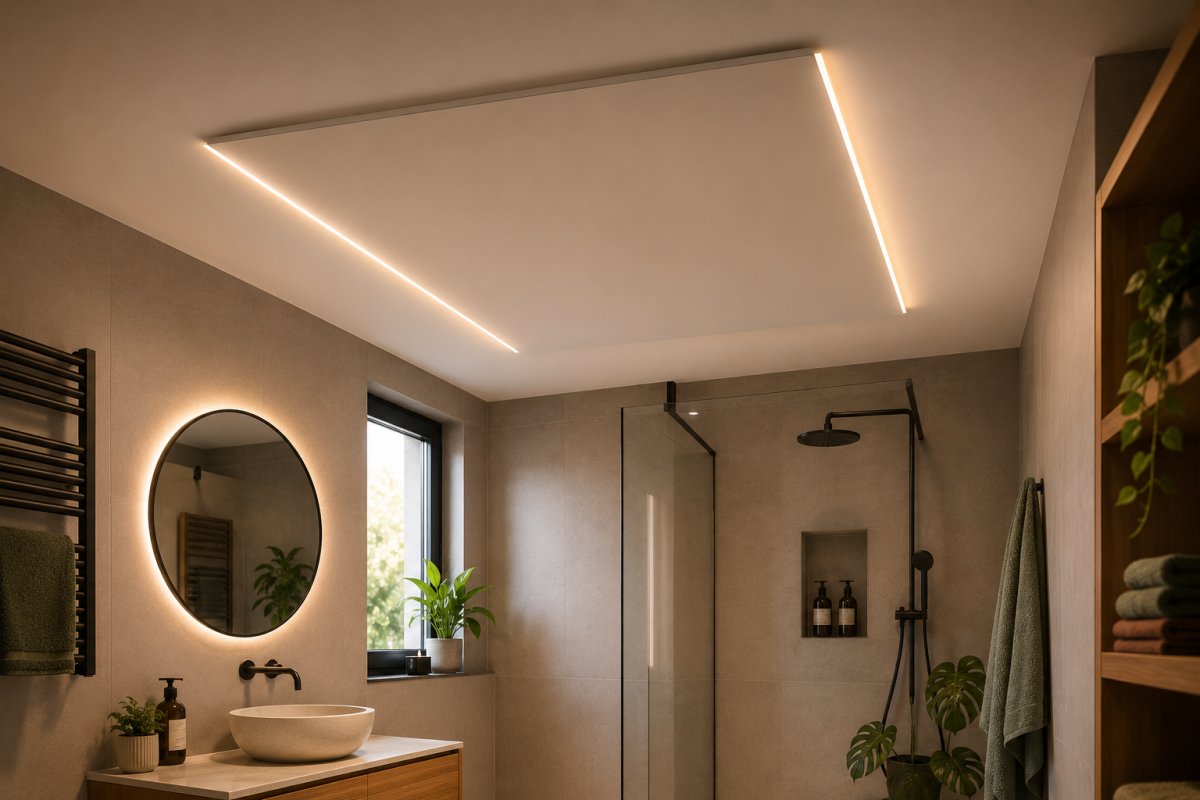
You are considering the switch to a gas-free home, but the fear of cold feet and an unpredictable energy bill may be holding you back. In the search for the ideal solution, the choice between convector heating and infrared heating is often central. It is a decision that determines not only your daily comfort but also the aesthetics of your interior and your monthly electricity costs.
We understand that uncertainty regarding actual consumption costs and the fear of bulky, unsightly devices cause considerable doubt. After all, you want a warm home without your living room turning into a technical room. In this article, you will learn the crucial differences between convector and infrared heating, so that you can make the most efficient and comfortable choice for your specific situation. We dive into the technology behind smart zone control and show how Norwegian quality ensures a system that blends invisibly into your room, while your energy bill remains low thanks to smart innovations.
Key Points
- Understand the fundamental difference between heating air and directly heating objects for an optimal indoor climate.
- When weighing convector heating against infrared heating, discover which system offers the most constant heat without unnecessary dust displacement.
- Learn how to make the right choice for each room, from a quiet bedroom solution to powerful, even heating for the living room.
- Gain insight into how smart Wi-Fi control and Ecodesign standards help you effectively manage and reduce your electricity costs.
- Discover how Norwegian expertise and a paintable design create a heating system that blends seamlessly and invisibly into your interior.
How do convector and infrared heating actually work?
To make an informed decision when comparing convector heating versus infrared heating, it is essential to understand how these systems physically transfer heat. Although both options use electricity as a source, the results for your living comfort differ significantly. The way your home heats up affects not only how quickly you feel warm but also how the air quality inside remains. A basic understanding of how convector and infrared heating work helps you determine which system fits your daily routine and the insulation level of your home.
The technology behind the convector
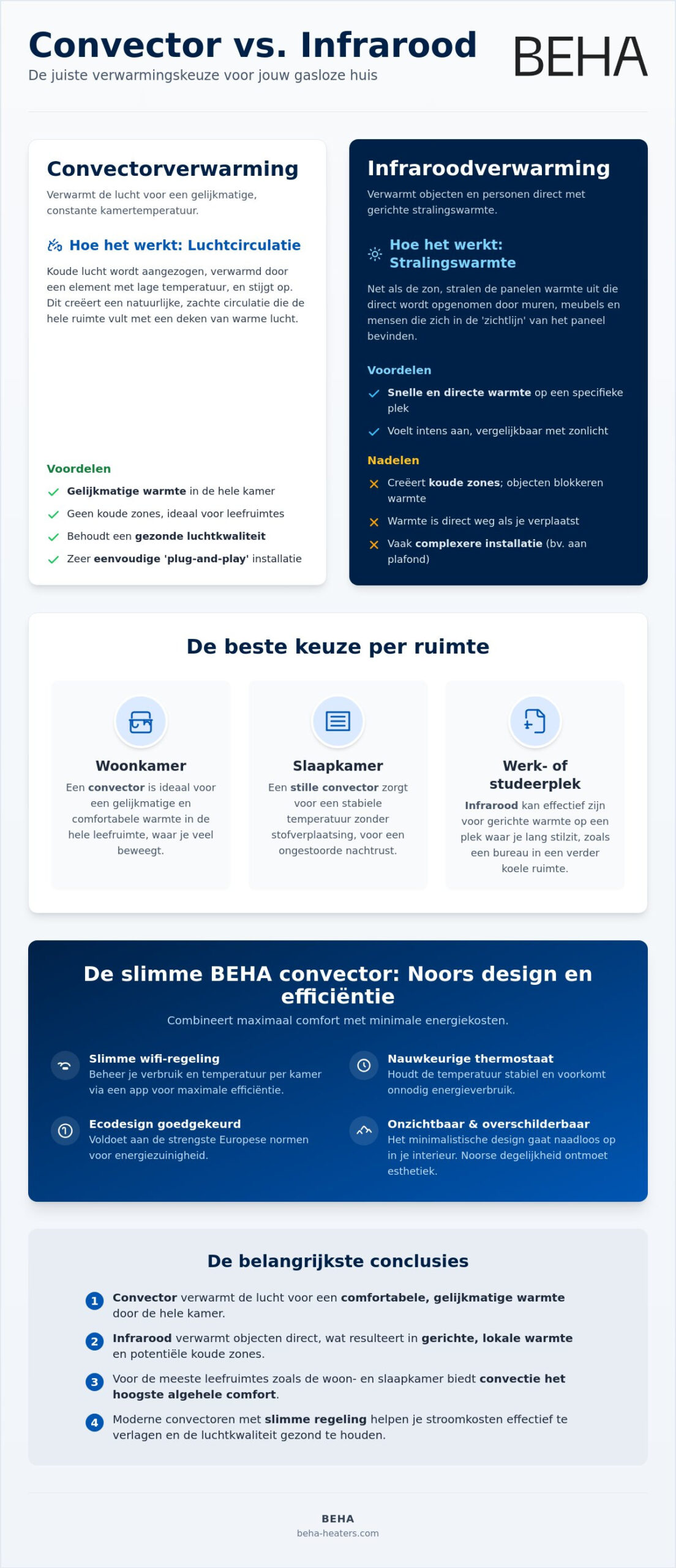
A convector utilizes natural air circulation. Cold air at the bottom of the room is drawn in by the heater, warmed by an internal element, and then rises to the ceiling. This process creates a constant flow that heats the entire room evenly. The result is a stable base climate without cold corners. Modern BEHA convectors use low-temperature elements to minimize dust combustion and dry air, which is a major advantage over traditional electric heaters.
The operation of infrared panels
Infrared panels work with direct radiant heat, similar to the sun's rays on a cold winter day. They do not heat the air, but directly the objects, walls, and people within their range. These objects store the heat and radiate it back out, creating a high thermal mass in the room. The position of the panel is of vital importance in this regard; you only feel the heat if you are standing directly in the panel's 'line of sight'. Discover Infraroodpaneel.nl for more information about the different types and applications.
The difference in the perception of heat is significant. With convector heating, you are enveloped by a warm blanket of air, which is particularly pleasant in larger living spaces where you move around a lot. Infrared, on the other hand, offers powerful, targeted heat that is ideal for places where you sit still for extended periods. The choice between these two technologies is therefore essential for both your personal comfort and your eventual energy consumption. If you want to keep a room at a constant temperature, the even distribution of a convector often offers the most peaceful and predictable experience for your senses.
The pros and cons of convector heating versus infrared
When making the final decision between convector heating and infrared heating, everything revolves around the balance between immediate need and long-term comfort. A convector excels at creating an even base temperature throughout the entire room. It is a system that heats the entire mass of air, allowing you to move freely through the space without encountering cold spots. Infrared, on the other hand, offers very specific, localized heat. This is pleasant if you are working or relaxing in a fixed spot, but the heat disappears almost immediately as soon as you step outside the panel's radiation angle. For many homes in the Netherlands, this limitation is a crucial point of attention.
Comfort and health in the home
Air quality plays a major role in how we experience heat. It is often claimed that convection causes dry air or significant dust displacement. With older systems, this was a valid point, but modern technology has largely eliminated this disadvantage. BEHA ’s smart convectors utilize advanced heating elements with a low surface temperature. This prevents dust combustion and keeps the air fresh and healthy.
Infrared is often praised for its therapeutic effects on muscle pain or rheumatism, because the radiation penetrates deep into the body. However, scientific research into the pros and cons of convection heating versus infrared shows that a constant air temperature often provides more comfort to the body in a living environment. Convection heat prevents the 'cold spots' that can occur with infrared when furniture blocks the radiation. This creates a calmer indoor climate where you do not constantly have to adjust the position of your heater.
Ease of installation and flexibility
When it comes to installation, the difference is significant. An electric convector is a true plug-and-play system. You mount the bracket to the wall, click the heater into place, and plug it into the socket. This makes it an ideal solution for those who want to become more sustainable without any demolition work or technical complexities. With infrared panels, this is often more complex. For optimal efficiency, these panels often need to be mounted on the ceiling, which involves tricky wiring and visible drilling.
Both systems are fundamentally maintenance-free, as they contain no moving parts or fluids. However, the convector offers more flexibility in your home layout. You can easily move or replace a convector if you rearrange the room. If you are looking for a solution that delivers immediate results and seamlessly complements a modern interior, take a look at our smart convectors with Wi-Fi, which combine Norwegian quality with easy installation.
The best choice per room: living room, bathroom, or bedroom
The ideal heating solution is not a universal concept; it depends entirely on the dynamics of the space in which you live. The trade-off between convector heating and infrared heating takes on a completely different meaning when considering a large, open living room versus a compact home office. In every room, you face different needs regarding heating speed, stability, and aesthetics. By intelligently considering the function of a room, you prevent unnecessary energy consumption and maximize daily living comfort.
Why the living room requires constant heat
The living room is the place where you spend the most time and where an even temperature distribution is crucial. Nothing is more annoying than cold feet while the rest of your body feels warm. In these large living spaces, a convector offers a major advantage because it moves and heats the entire air mass. This creates an 'enveloping' warmth that is uniform throughout the room, regardless of whether you are sitting on the sofa or standing at the dining table.
Many people fear that a heater will spoil their carefully chosen decor. A modern solution for this is the paintable radiator. You can paint these steel fronts the exact same color as the wall, causing the heater to visually disappear completely. In combination with a Wi-Fi app for zone control, you can efficiently keep the living room at 20 degrees during the day, while other rooms in the house remain at a lower temperature.
Speed and efficiency in smaller rooms
In rooms you use less frequently, such as a guest room or the attic, response speed is the most important factor. A convector has the unique property of heating the air in a small space very quickly. This is ideal for a home office where you want to get straight to work in the morning. You turn on the heater and within a few minutes the chill has vanished from the air.
For the bedroom, precise control is essential for a healthy night's sleep. Silent operation without ticking noises is a requirement here. By using digital schedules, you can lower the temperature to a comfortable 16 or 17 degrees just before going to sleep, to have it automatically rise again early in the morning. In the bathroom, rapid heating is also desirable. Although it is often claimed that infrared is the only option here, a powerful convector often proves its worth by heating the humid air faster and helping to dry the room after showering.
Energy-efficient heating without gas: consumption and saving tips
The move to a gas-free home raises questions for many people regarding monthly costs. In the debate between convector heating and infrared heating, the focus is often on power output, but the true efficiency lies in the intelligence of the control system. A 1000-watt heater only consumes that amount of energy when it is actually actively heating. The more accurate the thermostat and the smarter the software, the less often the heating element needs to switch on to maintain the desired temperature. If you want to understand how the costs of electric heating compare in practice, our complete guide to a gas-free home offers a clear and concrete overview.
The energy consumption of an electric convector is currently strictly regulated by European legislation. Since 2026, the ecodesign electric heater standards have been the standard for every manufacturer. These requirements necessitate innovations that prevent waste, such as electronic temperature control and weekly timers. As a result, modern convectors are many times more efficient than the old electric heaters of the past. Wi-Fi control plays a key role in this; by controlling your heating via an app and only running the heater when you are actually present, you can save up to 20% on your total electricity consumption.
Do you have solar panels on your roof? Then the synergy with electric heating is optimal. You use your own generated electricity directly to heat your home, which shortens the payback period of your panels and drastically lowers your energy bill. Thanks to the combination of Norwegian technology and modern software, electric heating becomes a profitable investment. Do you want to see immediately which solution suits your consumption? Discover our smart steel-front convectors for an efficient and gas-free home.
Save with smart features
Small technological additions make a big difference to your wallet. Open window detection is a perfect example of this; the heater recognizes a sudden drop in temperature and temporarily switches itself off to prevent you from trying to heat up the outside air. Additionally, a thermostat that measures with an accuracy of up to 0.1 degrees ensures a stable climate. As a result, the temperature does not overshoot unnecessarily, which immediately saves energy. Would you like more practical tips? Read our comprehensive guide on saving on heating costs.
Insulation and efficiency
The level of insulation of your home determines which system delivers the highest efficiency. In a moderately insulated space, such as a garage or an old shed, infrared can be a solution because you only need local heat where you are standing. In a well-insulated home, however, the convector is the undisputed winner. In such cases, the heat remains effectively contained within the walls. The convector then only needs to provide supplementary heating for short periods to keep the entire air mass at temperature, ensuring a quiet and stable consumption profile without peaks.
Why BEHA 's smart convectors offer the best of both worlds
In the ongoing debate between convector heating and infrared heating, the search is often for a balance between comfort and efficiency. At BEHA , we believe this balance lies in the combination of robust Norwegian engineering and state-of-the-art digital control. Our systems are designed to withstand the most extreme Scandinavian winters. This means they create a stable and pleasant indoor climate in the Dutch climate with playful ease. Where infrared sometimes falls short in fully heating a larger room and traditional heaters lack control, our smart solutions seamlessly fill these gaps.
The core of our innovation is the electric convector with Wi-Fi technology. This transforms a passive heater into an active component of your smart home. You control the temperature per room, set schedules based on your lifestyle, and monitor consumption in real-time via an intuitive app. This gives you the control that is lacking in many other systems, while you enjoy the natural, enveloping warmth that only a high-quality convector can offer. It is an investment in comfort that pays for itself through lower energy consumption.
Norwegian quality in your interior
An often overlooked aspect when choosing between convector heating and infrared heating is the visual impact on your home. Many electric heaters are white blocks that undesirably demand attention. BEHA takes a different approach with steel fronts that are not only more durable than plastic but also aesthetically more versatile. Our paintable models make it possible to give the heater the exact same color as your wall. This allows the heater to blend seamlessly with your interior, a unique advantage that unites design and functionality without compromise.
In addition, the use of steel offers superior heat dissipation and a longer lifespan. While glass fronts can be fragile and plastic can discolour over time, a steel front from BEHA remains in top condition for decades. Moreover, the modular nature of our range allows you to start small. You can switch to electric heating room by room, keeping the transition to a gas-free home behaand straightforward.
The future of heating is electric
With 100 years of experience, BEHA is the ideal partner for your transition to a sustainable lifestyle. We deliver not just a product, but proven technology that lasts for generations. The assurance of Norwegian reliability combined with state-of-the-art Wi-Fi control ensures that you are ready for the energy transition.
Choose a system that blends invisibly into your room yet provides a noticeable presence of comfort. Whether you choose our smart convectors with a steel front or the paintable variant, you are choosing a reliable future. Start making your home more sustainable today and experience the peace of mind of a perfectly regulated indoor climate.
Switch to smart and sustainable heating today
The choice between convector heating and infrared heating determines how you experience your home. While infrared panels provide targeted heat to one specific spot, a smart convector ensures an even and constant base temperature throughout the entire room. By choosing systems with advanced Wi-Fi control and precise thermostats, you maintain control over your energy consumption without compromising on comfort. It is the most logical step for anyone seeking a stable indoor climate without cold spots.
With over 100 years of Norwegian experience, BEHA solutions that meet the strictest ecodesign standards. Our heaters combine technical superiority with a minimalist design that fits seamlessly into any interior. Thanks to simple Wi-Fi control, you achieve maximum savings on your electricity costs while enjoying a carefree, warm home. Are you ready to take the next step? 's smart electric convectors BEHA and discover how simple the switch to gas-free living can be. Enjoy quality that lasts for generations.
Frequently asked questions about electric heating
Is convector heating more expensive to use than infrared?
Convector heating is not necessarily more expensive than infrared, as consumption depends entirely on insulation and room usage. A convector is more efficient at maintaining a constant temperature throughout a room, whereas infrared only heats locally. In the battle between convector heating and infrared heating, the convector often wins on comfort in well-insulated Dutch homes, because the heat lingers better and more evenly there.
Can I heat my entire house with only infrared panels?
Although it is technically possible, we advise against heating an entire home exclusively with infrared for your daily comfort. This is because you will encounter so-called shadow effects; zones behind furniture or walls that are not directly illuminated remain cold. For a behaand stable indoor climate in the living rooms and bedrooms, a system that heats the air is often a much more logical and comfortable basic solution.
Which heater is best for people with allergies?
Modern convectors with a low surface temperature are ideally suited for people with allergies or sensitive airways. While old electric heaters often burned dust, the advanced elements in a BEHA heater completely prevent this process. Although infrared does not move air, a high-quality convector ensures healthier humidity and a more constant temperature throughout the room, which is perceived as more pleasant by many users.
How many watts do I need for a 20 square meter room?
For a 20-square-meter room, you need an average of between 1,400 and 2,000 Watts of power for optimal results. This figure depends heavily on the insulation value of your home and the ceiling height. A good rule of thumb is 70 to 100 Watts per square meter for standard rooms. With an accurate thermostat, you prevent this power from being drawn on unnecessarily, which keeps your energy bill low.
Is it safe to leave an electric convector on when I am not at home?
Yes, a modern electric convector is completely safe to leave on thanks to built-in overheating protection and strict safety requirements. BEHA heaters are specifically designed for continuous use and offer the necessary security. Furthermore, with the Wi-Fi app, you can check the status of your heating at any time and turn down the temperature if you are unexpectedly away from home for an extended period, ensuring extra peace of mind and safety.
What is the difference in warm-up time between these two systems?
Infrared panels emit radiant heat onto your skin almost immediately, whereas a convector takes a few minutes to get natural air circulation going. However, the convector heats the entire air mass in the room faster and more evenly. When weighing convector heating against infrared heating, the choice is simple: do you want instant heat in one specific spot, or a behaand constant temperature throughout the entire room within a short time?
Can I install a convector heater myself?
You can very easily install an electric convector yourself without the help of an expensive mechanic or installer. The system is completely plug-and-play; you mount the included wall bracket with a few screws, click the heater into place, and plug it directly into the socket. This makes it an ideal solution for anyone who wants to make the switch to gas-free heating in their home quickly, independently, and without extensive demolition work.
Do I need a dedicated circuit for electric heating?
For a single heater, you usually do not need a dedicated circuit, provided the total consumption on that circuit remains below 3600 Watts. However, if you decide to heat your entire home electrically, it is wise to distribute the load across multiple circuits. An electrician can easily advise you on whether your current fuse box is ready for a complete switch to a modern, gas-free heating system.